


- Four themes dominated the talks at Davos 2024, which took place between 15 and 19 January: growth, artificial intelligence (AI), climate, nature and energy, and peace and security.
- All four themes have interwoven risks and opportunities with an underlying understanding that communities worldwide must be involved in decision-making and policy implementation when advancing and deploying solutions.
- Here’s how the Meeting served as a platform to rebuild a basis of trust, generate new ideas and develop partnerships that can improve outcomes for people, economies and the planet.
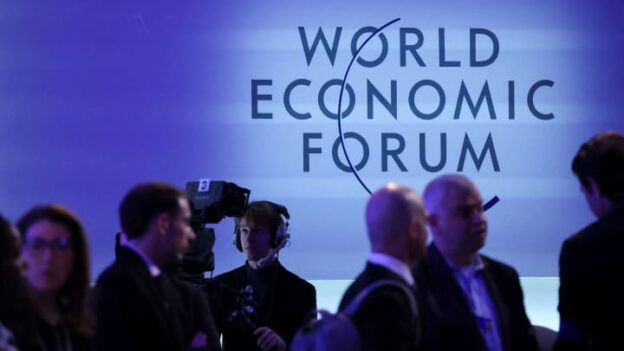
Davos 2024, the recently concluded Annual Meeting of the World Economic Forum in Switzerland, cut across four ambitious themes dominating today’s global landscape: Achieving Security and Cooperation in a Fractured World, Creating Growth and Jobs for a New Era, Artificial Intelligence as a Driving Force for the Economy and Society and A Long-Term Strategy for Climate, Nature and Energy.
Nearly 3,000 policy-makers, business executives, international organizations, civil society leaders, academics and innovators convened “against its most complicated geopolitical backdrop to date,” as President Borge Brende described at the beginning of the year.
Over the week, the Forum and its partners also launched or advanced more than 50 high-impact initiatives, serving as ongoing platforms for multi-year collaboration across geographies and industries.
Here’s how the Meeting served as a platform to rebuild a basis of trust, generate new ideas and develop partnerships that can improve outcomes for people, economies and the planet:
Security and cooperation
Rocky global peace, security and cooperation in 2023 will spill over into 2024 with evidential implications for trade, growth, climate action and advanced technological development. World leaders called for rebuilding trust in the face of this increasing fragmentation.
“Geopolitical divides are preventing us from coming together around global solutions for global challenges,” said United Nations Secretary-General António Guterres,
The Forum’s new Global Cooperation Barometer showed that global cooperation has been resilient for much of the past decade, particularly in the areas of trade and capital, innovation and technology, and climate and natural capital, but has been pulled down by a sharp decline in cooperation on peace and security.
Ajay S. Banga, President of the World Bank Group, emphasized the interconnectedness of crises; “We cannot think about eradicating poverty without caring about climate. We cannot think about eradicating poverty without thinking about healthcare. We cannot think about eradicating poverty without thinking about food insecurity and fragility.”
A new white paper offered diverse ideas on what global cooperation can look like in a fragmenting world.
The Middle East and Ukraine came into sharp focus, including what happens after war and the international community’s role. As did the North-South schism. “We cannot address inequality by just mitigating crises, but rather we need to integrate, to involve developing countries like Africa from the beginning,” said Rwandan President Paul Kagame.
The Humanitarian and Resilience Investing initiative announced over 50 commitments that will boost impact investment and could unlock over $15 billion, with new collaborations driving purpose-driven investment in frontier markets.
The Forum also announced it will hold a special meeting, hosted by the Kingdom of Saudi Arabia, on “Global Cooperation, Growth and Energy for Development” on 28-29 April 2024 in Riyadh.
https://www.weforum.org/agenda/2024/01/davos-2024-insights-ai-climate-growth-and-global-security/?utm_source=sfmc&utm_medium=email&utm_campaign=2821377_WeeklyAgendaTemplate2February2024&utm_term=&emailType=Agenda%20Weekly