



January 31 – Hydrogen-dedicated renewable energy capacity is expected to grow by 45 GW between 2022 and 2028, some 35% lower than forecast a year ago, the International Energy Agency (IEA) said in its latest Renewables report.
There is growing political momentum for low-emission hydrogen but actual implementation has been held up by uncertain demand outlooks, a lack of clarity in regulatory frameworks, and a lack of infrastructure to deliver hydrogen to end users, the IEA said in an emailed response to questions.
Slow progress on real-world implementation “is a consequence of barriers that could be expected in a sector that needs to build up new and complex value chains,” the IEA said. Uncertainties have been exacerbated by inflation and sluggish policy implementation.
Broader political support for clean hydrogen has been growing, highlighted by global climate goals, concerns over energy security, and adoption of new industrial strategies by several major economies, the agency noted.
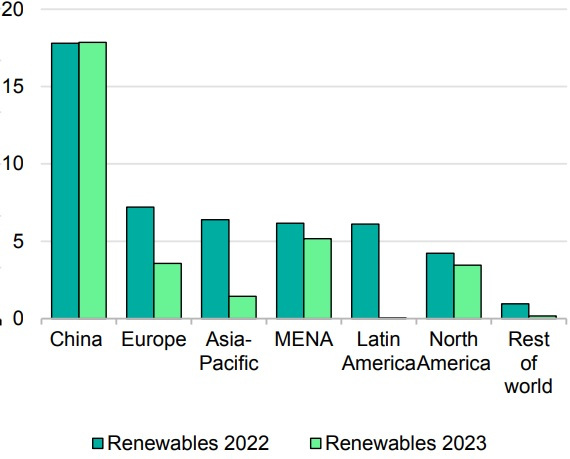
Expected renewable energy capacity for hydrogen production represents just 7% of the capacity pledged for the same period and one tenth the sum of government targets for 2030, IEA said in its report.
Around 75% of expected capacity is based in three countries, with China taking the lion’s share, followed by Saudi Arabia and the United States, the IEA says.
CHART: Revision to renewables for hydrogen forecast in 2023-2028
Advertisement · Scroll to continue
Source: International Energy Agency, January 2024 Acquire Licensing Rights, opens new tab
Seeking demand
The downward revision for hydrogen-dedicated renewable energy growth was mainly due to developers being unable to find hydrogen off-takers or reach financial close last year.
“The main uncertainties are whether there is sufficient demand and offtake which, in part, is due to the higher cost compared to hydrogen produced from unabated fossil fuels or with the use of fossil fuels in applications where renewable hydrogen could replace them,” the IEA says.
“A lack of sufficient demand-side incentives to bridge the cost gap make accelerating the growth a challenge. For exporting markets, there is an added uncertainty over the progress and cost of transport infrastructure.”
Hydrogen is hard and expensive to transport, opens new tab and store, with exceedingly low temperatures needed to create liquid hydrogen and high leakage rates for gaseous hydrogen.
Meanwhile, high inflation across the value chain is increasing capital and financial costs which, in turn, threatens the bankability of projects, the IEA says in its ‘Global Hydrogen Review 2023’.
For hydrogen produced from renewable energy, a cost-of-capital increase of 3 percentage points could raise total project costs by nearly a third, and several projects have revised their initial cost estimates upwards by up to 50%, the IEA says.
Factors such as these, together with a recent fall in natural gas prices and supply chain disruptions, affect the efficiency of much-needed government-backed projects.
“This means that announced government funding will support a smaller number of projects than could be expected previously, as greater investment is needed to close the cost gap between low-emission hydrogen and unabated fossil fuels-based hydrogen,” the IEA warns.
The slow implementation of government-backed schemes – the much-anticipated U.S. Inflation Reduction Act, opens new tab is unlikely to start distributing funds until later this year as clean hydrogen definition rules are drawn up – also leads to delayed investment decisions.
China bucks trends
According to the IEA, global annual growth in renewables for hydrogen production is driven by China which accounts for more than two thirds of net additions between 2023 and 2024, though this decreases by 2028 as other markets begin producing.
China currently hosts more than half of the world’s electrolysis capacity, the process that converts renewable energy into clean hydrogen, and the country’s production capacity for electrolyzer units is increasing rapidly.
The state-backed industry group China Hydrogen Alliance announced its Renewable Hydrogen 100 initiative in 2021, which aims to increase the installed capacity of electrolyzers to 100 GW by 2030 with emission-free hydrogen production capacity of around 7.7 million tons a year.
China has the potential for rapid growth in clean hydrogen production due to a large, existing fossil-fuel hydrogen market and abundant renewable energy sources, according to the report ‘Green Hydrogen in China: A Roadmap for Progress’ by the World Economic Forum, Accenture, and the China Hydrogen Alliance.
“The feasibility of this target depends on several factors, including technological advancements, policy support, cost reduction, and infrastructure development,” says Jorgen Sandstrom, Head of Transforming Industrial Ecosystems, Centre for Energy and Materials, at the World Economic Forum.
“However, achieving this target will require significant efforts in scaling up production technologies, reducing costs, and developing the necessary infrastructure.”
China is also struggling with supporting demand and off-takers, made harder by a lack of transportation infrastructure, though Sandstrom notes that the country is focusing on enhancing hydrogen storage technologies and promoting local utilization in production areas, such as large oil refining and coal chemical enterprises.
For those areas where there is not sufficient industrial demand, projects will convert hydrogen produced into ammonia, opens new tab and methanol for transportation to high-demand areas or for exports.
The country’s ‘going global’ strategy led to accords signed between China Southern Power Grid International Company, MingYang Smart Energy Group Limited and Saudi utility ACWA Power in September 2023.
“This agreement encompasses the production of green hydrogen and ammonia in Saudi Arabia, as well as a global renewable energy plan and comprehensive intelligent energy solutions,” says Sandstrom.
“These initiatives illustrate China’s commitment to advancing clean hydrogen technology and fostering international collaborations in the pursuit of sustainable energy solutions.”
https://www.reuters.com/business/energy/iea-lowers-renewables-forecast-clean-hydrogen-2024-02-01/