



As you know, AI and automation have always been an important area of coverage for Acceleration Economy. But in the last two years, in particular, the world of AI has been speeding down the highway and turning corners at a lightning-fast rate. Executives tasked with growing their business in the age of AI are caught in the passenger seat getting whiplash.
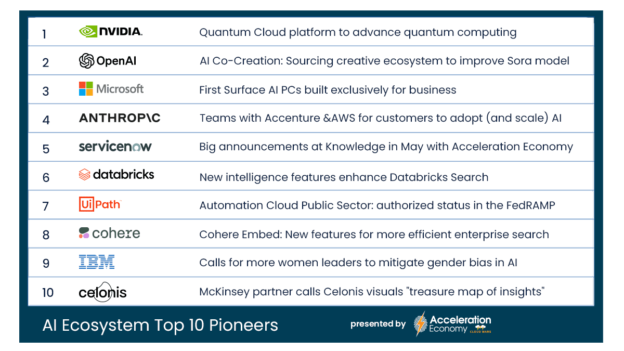
To help business leaders navigate this high-stakes race, we’re excited to announce the Acceleration Economy AI Ecosystem Top 10 companies. This list — to be updated based on our weekly analyses of these companies — is an extension of the popular Cloud Wars Top 10 run by my colleague Bob Evans, who examines the top cloud vendors in the market week-over-week. Similarly, the AI Ecosystem Top 10 list helps you understand the ecosystem in a single snapshot.
We chose the term “ecosystem” because that’s what the world of AI really is. Different species coexist with each other — from platform providers to startups to ISVs and beyond. The food chain is always evolving. Little fish get eaten by big fish. Some species don’t survive while others thrive.
So, here’s the list along with the reasons why each company was selected.
1. NVIDIA
It’s easy to forget but software is not possible without hardware. NVIDIA makes that happen.
Founded in 1993, the company has been building cutting-edge hardware and tech infrastructure products on top of its hardware for decades. A large portion of all model training is done on NVIDIA hardware, such as the NVIDIA A100.
In the age of AI, NVIDIA has gone beyond just hardware. It has forged into software and built models tailored for its chipsets. One such product suite is NVIDIA AI Enterprise. It has set up partnerships to help bring innovative solutions to market, like the recent one with Hugging Face and ServiceNow and, in 2023, with Snowflake. Its offerings work well with the other species in the ecosystem, bringing infrastructural needs for AI implementations. Today’s AI ecosystem would not exist without the contributions of NVIDIA.
2. OpenAI
Everyone saw this coming, I know. Without a doubt, OpenAI has been at the center of the ecosystem for the past few years. OpenAI has been valued at over $80 billion, reached nearly 200 million users for ChatGPT, and kick-started massive GenAI adoption across industries.
OpenAI’s products, team, and research are embedded across countless products, services, and companies in the tech sector and beyond. A new generation of startups was born whose products were a UI skin built on top of its APIs. It has inspired other base layer developers, like Anthropic and Cohere, which we’ll cover soon. Like NVIDIA, the AI ecosystem wouldn’t exist without OpenAI.
3. Microsoft
Microsoft, also a Cloud Wars Top 10 company, is a major backer of OpenAI and, as a result, it controls a lot of the ecosystem. But it has done a lot more than write checks. In the last two years, especially since the Ignite conference in 2023, it has been clear that CEO Satya Nadella intends Microsoft to be a big fish in this pond.
It has pivoted Azure into being an AI platform where copilots are the applications. Similar to Windows, this has spawned its own sub-ecosystem of ISVs, integrators, developers, vendors, and more. Developers can also rely on AI Studio and Copilot Studio which is the AI equivalent of Visual Studio. It has built its own hardware chips for AI-training workloads, launched a marketplace for copilots, rebuilt Bing and 365 with AI at the center, and released Microsoft Fabric and Graph which both help you manage data for AI training.
Without a doubt, Microsoft is a big fish in the AI ecosystem.
4. Anthropic
Unlike industry veterans like NVIDIA and IBM, we picked Anthropic because of its incredibly bright future. Founded in 2021, Anthropic is a responsible AI research company building foundation-level models like OpenAI. Its talented team and approach to responsible development is critical for the rest of the AI ecosystem and humanity at large.
Its main product right now is the Claude family of LLMs. Similarly to OpenAI, it’s a foundation on top of which other ecosystem players can innovate. Anthropic has accepted a large amount of funding from Amazon which has helped bring Claude to market in a variety of ways to drive immediate value.
There’s no ceiling on where a firm like Anthropic can go in the coming years and decades. That’s why it’s so high on this list.
5. ServiceNow
Another Cloud Wars Top 10 company, ServiceNow also made our AI Ecosystem list for a few reasons. ServiceNow is a cloud-based workflow automation platform founded in 2004 and publicly traded with a $160 billion market cap. Its strategic partnerships, such as those with NVIDIA and Hugging Face, to build open-source models for code generation showcase its commitment to working with other players in the ecosystem and building cutting-edge technology. It also has an extensive customer base and a wide array of AI expertise and offerings.
One of ServiceNow’s notable AI features is Agent Intelligence, which utilizes machine learning to categorize and route requests to the appropriate support agent, improving response times and overall efficiency. ServiceNow’s Now Intelligence platform includes predictive intelligence capabilities, leveraging AI and machine learning to anticipate issues and automate resolution processes.
Due to its sheer scale and range of customers, it can bring products to various markets quickly, driving immediate value. It has shown increasing interest in partnerships to accomplish this, and that will make ServiceNow very successful in the ecosystem as it works with other firms like NVIDIA, Hugging Face, startups, and more.
6. Databricks
Databricks is a data management company well known for being the first to combine data warehouse and data lake functionality in the so-called “data lakehouse.” We decided to include Databricks because of its role in helping organizations with a key step in implementing AI systems: data preparation and training.
Databricks has established itself in the AI ecosystem through several acquisitions which we have previously covered on Acceleration Economy. In 2023, it acquired MosaicML, a platform that walks users through custom model training and model fine-tuning on their own datasets. MosaicML helps customers escape vendor lock-in from various platform providers like Meta, Google, OpenAI, and others. Plus, fine-tuned models can often fit your use case much better. It also acquired Lilac AI, a data management and preparation platform for developers.
These tools are now embedded in the Databricks data lakehouse product, making it easier than ever to house data and train your own models.
7. UiPath
UiPath has been one of the leaders in the automation and process automation sector since 2005. It’s a public company with a $13 billion market cap. We picked UiPath because of its diverse customer base spanning enterprises to smaller teams. It has uniquely positioned itself as a leader in using cutting-edge AI to automate processes, with much lower barriers to entry than many other AI platforms.
It’s not aiming to build the next world-changing foundational model or development platform. UiPath has mastered the art of identifying automation opportunities and how to act on them. It released many pre-packaged GenAI applications that teams can use right away, such as DocPATH and CommPATH for document processing and communications, respectively. It also recently released UiPath Autopilot, a set of AI-powered experiences across its Business Automation Platform that makes everyone in the organization more productive.
8. Cohere
Like Anthropic and OpenAI, Cohere is a platform provider building base-layer large language models (LLMs). Founded in 2019, with a soon-to-be $5 billion valuation, this is a smaller fish but one that is rising rapidly in the food chain. It has a unique focus on enterprise customers and is leading in the RAG space. RAG, short for retrieval augmented generation, is a system for bringing real-time datasets into GenAI training flows. This is a key piece of technology unlocking billions of dollars of value for organizations adopting it.
Cohere has set up groundbreaking partnerships, including one with Oracle in 2023 and Accenture more recently, where Cohere supplies the tech and the agility, and the partner brings the enterprise client and the implementation expertise. This model of partnership has become increasingly common in the AI ecosystem as young tech companies look for ways to bring their offerings to big, complex enterprises. It also conducts its own research which helps its products maintain a cutting-edge status. No doubt Cohere is primed to take off in a massive way.
9. IBM
Ranking on both the Cloud Wars Top 10 and AI Ecosystem Top 10 lists, IBM is too big to fail. It has missed a few tech revolutions, but it seems determined to make it in the era of AI.
First off, IBM released its new AI and data platform for the enterprise, called watsonx. This platform is made of three different branches which collectively address enterprise requirements. First, watsonx.ai studio helps users build and deploy machine learning models. Second, watsonx.data is a data store designed for AI built on an open lakehouse architecture. Finally, watsonx.governance is a toolkit that helps customers build AI workflows responsibly. The watsonx suite is industry agnostic and its users already include Wimbledon and NASA.
The company has also launched an innovative new partner program called Partner Plus. IBM has partnered with many ecosystem players to bring custom AI projects to life and has supported partners in a variety of ways, including tech, project management, customer support, consultation, education, and more.
10. Celonis
Since 2011, the bread and butter of Celonis has been process mining and process intelligence. With a valuation of $13 billion, Celonis secured its place on the list for its strategic position to leverage AI in enhancing results and automating processes through its existing process intelligence solutions. Celonis boasts a strong ISV and partner ecosystem, further enhancing its capabilities and reach in the market.
Its proprietary technology, the Celonis Process Intelligence Graph™, integrates process data stored in its Object-Centric Data Model with AI, enabling businesses to identify value opportunities and optimize processes effectively. Additionally, Celonis’ enterprise focus gives customers advantages like robust security, privacy protection, specialized implementation expertise, and reliable client support.
https://accelerationeconomy.com/ai/acceleration-economys-ai-ecosystem-top-10/#