



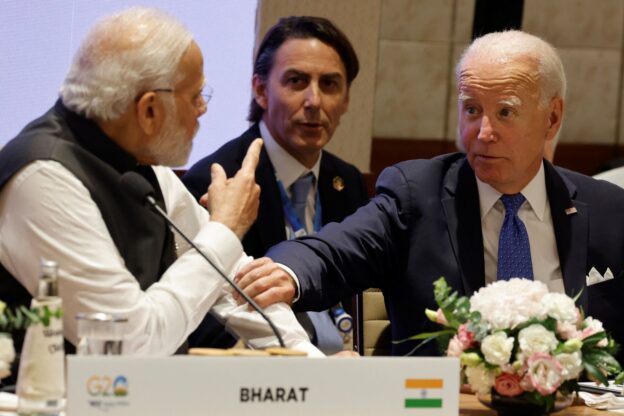
It’s not just China we have to worry about now.
Booming Economy But Foreign Investment Slows
India’s economy may be all the rage right now, but it’s not showing up in foreign direct investment. In fact, FDI slowed for a second year amid hot competition for investors. What’s interesting is that the fight is less with China nowadays, and much more with the US.
FDI this fiscal year is tracking at less than half the $28 billion received on a net basis last year. Inflows have slowed, globally as well. And outflows have picked up, led by private equity cashing out of their investments.
Foreign Direct Investment To India Tapers
Net flows at $8.5 billion in April to December period
Note: Amounts in $ billion
More significantly, India’s share of global net FDI, at just over 2%, has reverted to below 2019 levels, according to data from a recent Kotak Institutional Equities report titled, tellingly, India is not yet the +1 in China +1.
India has done a lot of things right (policy-wise), yet as of now we’re not seeing that much benefit from companies diversifying out of China or from the widening of global supply chains, Sanjeev Prasad, the Singapore-based managing director of the firm told me in an interview this week.
Prasad and other experts I spoke to put it down to a few key reasons.
Overall, competition for investment flows worldwide has intensified, and Bidenomics — the US president’s push to bring manufacturing back home — is seeing India outbid.
If once China was the only big game in town, now India competes with the US and emerging-market countries that may be more closely aligned to the US, Prasad said. “Why would a big company come to India when the US market is so much bigger. That’s the challenge,” he said.
China’s share of global FDI has slumped by nine percentage points in the last five years, whereas the US’s portion is up some 14 percentage points, according to the Kotak report. Brazil, Canada, Japan, Korea, Mexico and Poland have also gained.
Either India aligns with an economic bloc to benefit from friend-shoring, or if it wants to chart its own path, the country needs to work on a transactional approach — offer a lot more money (incentives) to get investments and go after specific companies. Roll out the red carpet, Kotak’s Prasad said.
India’s Share Of Global FDI Slides
Net FDI inflows from overseas entities revert to 2019 level
Other places are better prepared, the US ambassador to India, Eric Garcetti, told my Delhi-based colleague Dan Strumpf in an interview last week, where he also spoke of efforts to boost US pension and private equity investments in India. “I think people find that if they go to Mexico, to Vietnam, there’s more willingness to say, hey, what can we do to bring you here? India is still a little bit more, like, you need to be here and we’ll give you a little bit of help,” said Garcetti.
Help doesn’t always come easy in India.
Recent incentive schemes have seen more investment from Apple contract manufacturers in phones to Dell in laptops. A new electric vehicles policy, with conditionally lower tariffs, hopes to draw the likes of Tesla and rules have been streamlined to attract foreign investment in the space sector.
Still, there is often a gap between policy and implementation, Dinesh Kanabar, CEO of the Mumbai-headquartered Dhruva Advisors, a tax and regulatory services firm, told me.
India will roll out incentives, but there can be bureaucratic hurdles to getting them, the lack of standard operating procedures or even budgetary constraints. “Often the best answer I can give clients on policy matters is a categorical maybe,” Kanabar said.
This year, the Modi government refused to extend a concessional tax rate of 15% to new manufacturing companies even though the scheme’s early years were impacted by the pandemic.
Delays in tax appeals, rectification orders and refunds frustrate investors and are compounded by an over-burdened legal system.
Investors see a huge opportunity in India but it’s difficult for a multinational company boss sitting thousands of miles away to understand why court hearings get repeatedly adjourned in India and why it takes months to get judicial orders, Kanabar said.
Over 5 million cases have been pending for more than a year at India’s higher courts.
India still has many domestic issues to resolve to become more attractive to a wider array of global investors, Richard Rossow, senior adviser at the Washington-based Center for Strategic and International Studies, told me in an email.
They include reducing logistics costs, lowering tariffs on input goods and eliminating some trade blocks. Also, he says, there’s a need for hard reforms by Indian states in areas like labour and land.
India retains FDI caps and other regulatory impediments to foreign investors in nearly 40 sectors from retail trade to insurance, and the government can move on the less-sensitive investment restrictions in pretty short order if it desires, said Rossow, who holds the chair in U.S.-India Policy Studies at the CSIS.
Global FDI Flows Weak In 2023
At $1.37 trillion as estimated by UNCTAD
Note: FDI calculations may marginally differ based on agency and country
The protectionist approach is also evident in the slow pace of signing trade agreements, though it’s picked up recently with EFTA being the latest, and in one-sided bilateral investment treaties. An approach Modi describes as First Develop India.
If a new government does the heavy lifting on policy and implementation, indications are that flows could recover.
Investment intentions in new and futuristic sectors such as AI, data centers, EV and battery, green hydrogen and semiconductors, are rising quickly, Pranjul Bhandari, chief India and Indonesia economist at HSBC wrote in a report earlier this year
Being new, these sectors may take more time than normal to materialize. When they do, she says, a new wave of investments will likely come in.
Watch this space.
What I’m Reading…
- Taiwan’s semiconductor industry restarts operations after worst quake in 25 years.

Read the story here.(Free to read for newsletter readers)
- An ode to Manmohan Singh
- Why the Fed is shielding Wall Street banks from global climate risk rules
- Exxon’s $60 billion fight with Chevron will reshape Big Oil. (Opinion)
- Our exclusive on Apple’s plans after its car dream died
By The Numbers: Scorching Summer
-
10-20 Days
India will witness 10-20 days of heat waves this summer, three times as many as in an ordinary summer, the Met department warned. Overall temperatures will be hotter than usual, raising the risk of water shortages, crop damage and power blackouts. In preparation, the power ministry may invoke an emergency rule to run gas-fired power plants. Bond traders had been hoping for an interest rate cut soon, but the weather is likely to leave them sweating.
Election 2024: (Not) The Economy, Stupid
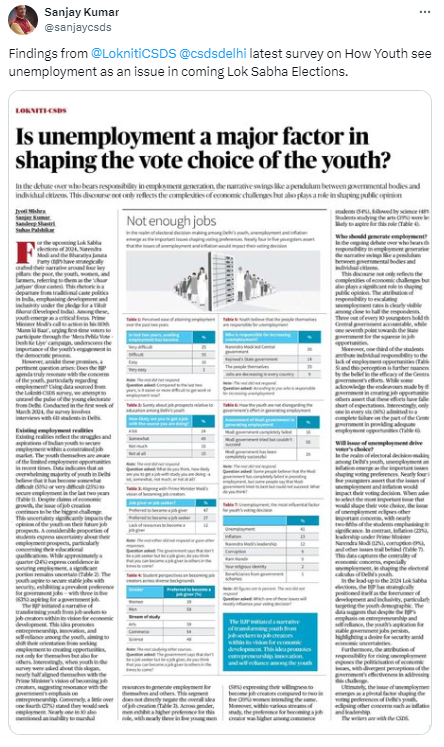
One in three young graduates in India are unemployed, according to a recent ILO report.
Worse still, young Indians are more likely to be jobless if they are educated (29.1%) versus those who can’t read and write (3.4%), according to the report.
That’s the stuff elections are lost on, you’d think. Well, it is and it isn’t.
More young people blame themselves for the lack of a job rather than Prime Minister Modi’s government, according to a Lokniti-CSDS survey of 611 students in India’s capital. Only 30% pointed to the central government when asked who was responsible for their lack of a job.
Meanwhile, 35% put the onus on themselves. The government has tried but could not succeed, according to 55%. And more (25%) believe the government has succeeded in providing jobs than those who said it has failed (16%).
The jury is out on inflation too.
About 87% of over 1,000 Delhi residents surveyed by the same agency said prices had risen by “a lot.” Meanwhile, 56% said their income doesn’t cover their household expenses. And yet, only 35% put inflation as a top poll concern.
Most respondents in this survey were slum dwellers willing to shrug off inflation when casting their vote.
Both surveys are based on small samples. Yet, the responses offer interesting insights in to how forgiving Indian voters can be. Remember Delhi voted BJP in all seven Lok Sabha seats five years ago.
More Bloomberg coverage on the election…
- India’s opposition parties united at a rally demanding fair elections
- The BJP will win the most votes in this key state, a survey shows.
- Supreme Court granted bail to AAP’s Sanjay Singh in his money laundering case.
- Modi uses a 1974 island deal with Sri Lanka to attack the opposition.
Watch: The future of an entire generation is at stake in India, says Bloomberg Opinion’s Andy Mukherjee.
Over the next two months, Building India will be making way for analysis of the election, and this is where you’ll find the best of Bloomberg’s reporting on how India votes. You can also follow the news as it happens on Bloomberg India’s channel on WhatsApp — sign up here .
https://www.bloomberg.com/news/newsletters/2024-04-04/modi-vs-biden-why-foreign-investment-into-india-is-still-declining