


Bloomberg reports that the Kingdom has found itself paying investors to build its ambitious projects and doing most of the financial heavy lifting rather than attracting foreign cash.
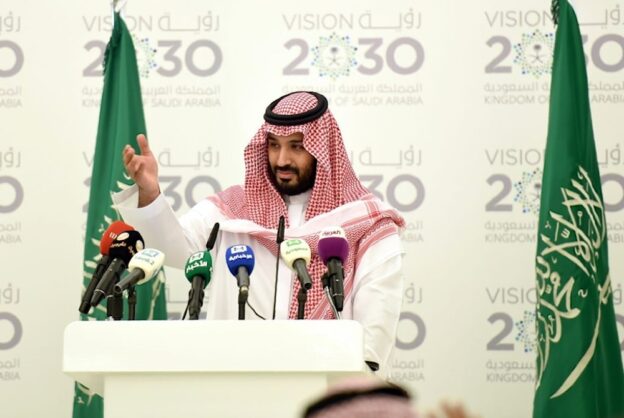
Saudi Arabia’s ambitious Vision 2030 of economic transformation is on shaky grounds as the Kingdom finds itself having to pay out of pocket for investors to come rather than the other way around, leading to a financial bleed in the oil-rich country’s funds, Bloomberg revealed in a report.
According to the report, Saudi Arabia has understood for some time that its funding needs would primarily be supported by local capital, with only a portion coming from foreign sources.
Despite this, the country aims to reach $100 billion in foreign direct investment (FDI) annually by 2030, a goal significantly larger than its historical achievements and about 50% more than what India currently attracts.
From 2017 to 2022, the Kingdom averaged just over $17 billion in annual FDI inflows. Meanwhile, the 2023 FDI target is set at about $19 billion according to the country’s Investment Ministry.
Read more: Saudi Arabia’s foreign reserves dip to 14-year low
Aiming to showcase its departure toward a modernized economy, Riyadh inked a partnership with US-based electric vehicle maker Lucid. But Saudi Arabia found itself required to do all the heavy lifting.
Last week, the EV producer received a $1 billion injection from Saudi Arabia, adding to the $5.4 billion already invested by Saudi Arabia’s Public Investment Fund (PIF).
Lucid, like many other firms, has PIF as its largest shareholder. The company was previously seen as a prime example of a foreign company investing in Saudi Arabia’s Vision 2030 plan, which aims to diversify the country’s economy away from oil dependency.
The initial assembly of EVs in Saudi Arabia with Lucid was meant to demonstrate how a kingdom reliant on one commodity for revenue could attract foreign investment and become a global center for future industries.
However, Lucid’s requirement for the Kingdom’s funding indicates that the country’s hurried economic reform efforts are being financed directly from Riyadh’s own treasure boxes, with Saudi Arabia heavily relying on its oil wealth to attract companies.
“The government had to give Lucid tremendous incentives to come,” said Karen Young, a Gulf-focused political economist focusing on the Gulf at the Columbia University Center on Global Energy Policy.
The Chief Executive Officer of Lucid, Peter Rawlinson, told Bloomberg that the company is “fully committed to our long-term partnership with the PIF and supporting the goals of Saudi Arabia’s Vision 2030” and that it is “creating hundreds, and eventually thousands, of new employment opportunities for Saudi talent.”
Read more: Saudi stockpile of US Treasuries hits its lowest in over six years
Out of reach
Reaching the 2030 goal appears to be unattainable presently, with foreign investors showing caution, Bloomberg reported, citing bankers, legal advisors to investors, and individuals knowledgeable about Saudi Arabia’s fundraising efforts.
This cautious approach has prompted the government to reassess its strategy, considering the possibility of financing a larger portion of its economic transformation itself, within a tight timeline.
Already, there are signs of scaling back on large-scale projects aimed at revitalizing its $1.1 trillion economy. Additionally, the government is issuing billions of dollars in bonds to help address a fiscal deficit that it had not anticipated until late last year.
The government’s decisions on how to allocate its funds will have implications on its domestic and international investments, as well as on its oil policies, which influence global markets, the newspaper said.
A spending cycle
Crown Prince Mohammed bin Salman (MBS) aims to attract foreign investors to contribute expertise and funding for megaprojects, such as the development of Neom—a $500 billion plan to transform a remote north-western desert region into a carbon-free high-tech hub with robotics.
Despite marketing efforts and investor roadshows, Neom has not yet made significant progress in raising capital.
Other projects, like the entertainment city Qiddiya near the capital, also face challenges. While Qiddiya has over 1 trillion riyals ($266 billion) in committed spending, this is solely backed by PIF and a Saudi developer it owns.
https://english.almayadeen.net/news/Economy/saudi-arabia-bleeding-funds-for-vision-2030–broken-economic