



Ranked: 50 Largest Companies in the World in 2025
This was originally posted on our Voronoi app. Download the app for free on iOS or Android and discover incredible data-driven charts from a variety of trusted sources.
Key Takeaways
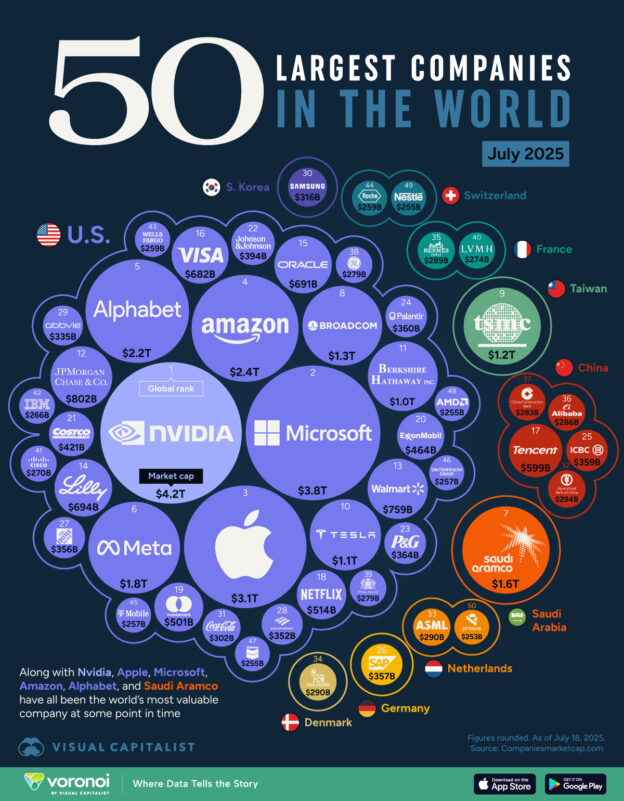
- Nvidia’s market capitalization has crossed $4 trillion, leading the world’s 50 most valuable companies in the world, as of July 18th, 2025.
- There are 34 American companies in the top 50.
- Saudi Aramco is the most valuable non-U.S. company, with a market cap of $1.6 trillion
For the first time ever, a pure-play chipmaker is the most valuable company in the world.
Nvidia’s blistering ascent puts it ahead of long-time titans Microsoft and Apple, and even state-owned oil behemoth Saudi Aramco.
The data for this visualization comes from CompaniesMarketCap.com. It captures the snapshot of listed firms by market value as of July 18, 2025, showing who rules the equity markets, and by how much.
The Most Valuable Company in the World
Nvidia now commands a $4.2 trillion valuation, more than the combined worth of Exxon Mobil, Saudi Aramco, and Chevron.
Investors are betting that generative AI will remain the most demanding workload in data centers for years, and Nvidia’s accelerators are still the go-to silicon solution.
However, Nvidia’s had a rocky ride in 2025. As recently as April, the company’s worth dropped to $2.3 trillion, but has since come roaring back. This Motley Fool opinion piece goes into why.
Briefly put, Nvidia’s stock has benefitted from two things:
- A general reduction in tariff uncertainties as trade deals began to sprout.
- A bumper earnings, where revenue essentially doubled YoY.
Meanwhile, Microsoft and Apple—who have been trading largest market cap back forth for the last few years—now trail the GPU pioneer for the first time.
But more on Nvidia in the last section. Let’s take a look at the country distribution of these companies.
America’s Dominance Grows Even Wider
U.S. firms make up 34 of the 50 most valuable companies in the world.
Big Tech sits comfortably in the top six slots, while stalwarts like Berkshire Hathaway and Walmart anchor the trillion- and near-trillion-dollar tiers.
Financial heavyweights JPMorgan Chase and Visa round out America’s footprint, showing that the country’s economic breadth—spanning chips, cloud, e-commerce, and consumer staples—remains unrivaled.
Combined, U.S. companies in the list exceed $30 trillion in market cap, dwarfing every other region.
Europe and Asia’s Mixed Showing
Asia contributes eight names to the most valuable companies in the world, led by Taiwan’s TSMC at $1.2 trillion and China’s Tencent at just under $600 billion.
South Korea’s Samsung and a clutch of Chinese state-backed banks keep the region in the conversation. But only TSMC sits inside the global top 10.
Europe fields eight companies as well, with luxury houses Hermès and LVMH representing consumer demand, while Novo Nordisk and Roche highlight biotech strength.
Dutch lithography leader ASML remains critical to the semiconductor supply chain with a $290 billion valuation. Yet the continent’s absence from the trillion-dollar club underscores how digital platforms—and their outsized valuations—skew toward the United States.
Does Nvidia Deserve Its $4 Trillion Valuation?
On all other financial fundamentals, Nvidia is the smallest of the Big Tech companies.
Its FY25 revenue was $115 billion, an extraordinary doubling in the last year.
A quick reminder, however, that Apple nearly pulled in a profit of $100 billion two years ago.
So why is Nvidia picking up so much steam compared to its more established Big Tech peers?
Simply put: it’s a reflection of what investors think it can do in the future, not what it’s already done in the past.
Its chip business is seen as fundamental to the next wave of tech innovation, and there is a great deal of optimism for future growth capacity with growing demand for AI services.
However, this optimism brings elevated risk.
The valuation is justified only if Nvidia can maintain its current trajectory and successfully navigate competition, maturation of AI infrastructure, and potential regulatory headwinds.
https://www.visualcapitalist.com/ranked-50-most-valuable-companies-in-the-world-july-2025/