



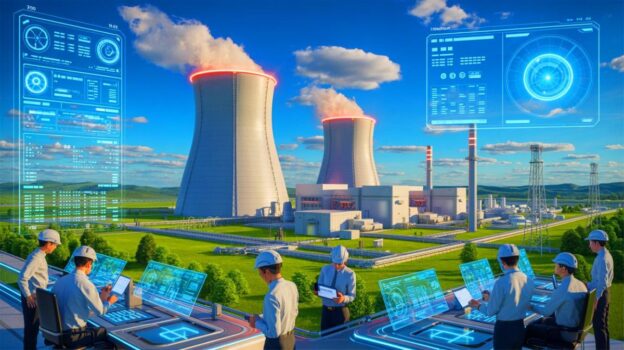
- Trump has announced plans to quadruple U.S. nuclear power by 2050, pushing for rapid approval of new reactors and slashing regulatory barriers.
- Experts warn that undermining the independent Nuclear Regulatory Commission could erode essential safety standards and risk public backlash.
- Critics argue the slow growth of U.S. nuclear energy stems from high costs, not overregulation, citing costly delays at projects like Plant Vogtle.
The President of the United States, Donald Trump, is betting big on nuclear power and aims to fast-track projects to prepare for the massive increase in electricity demand over the next decade. However, experts fear that his plans to accelerate project development could compromise safety standards, particularly as the independent U.S. Nuclear Regulatory Commission comes under threat.
In May, the Trump administration announced a target to deploy 300 GW of net new nuclear capacity by 2050 to quadruple domestic nuclear power, as well as to begin construction on 10 large reactors by 2030 and expand domestic nuclear fuel production. Trump signed three executive orders to support these aims: Reform of the Nuclear Regulatory Commission; Deployment of Advanced Nuclear Reactor Technologies for National Security; and Reforming Nuclear Reactor Testing at the Department of Energy.
Trump’s orders establish arbitrary deadlines for decisions on construction permits and operating licenses, even for new designs that have not yet been assessed; demand a review of all NRC regulations within 18 months; and allow for the construction of nuclear reactors on federal lands without NRC review.
While deploying more nuclear power could help the U.S. respond to the rising domestic electricity demand, there are widespread concerns that President Trump’s rapid approval of new nuclear projects threatens to weaken the independent Nuclear Regulatory Commission (NRC), which assesses projects for health and safety and ensures reactors operate securely. The objective of Trump’s executive orders is to reduce regulations and accelerate the approval of nuclear plants by overhauling the NRC.
Trump has said that he believes the NRC is too risk-averse and has blamed the agency for the how few nuclear plants have been constructed in the U.S. over the last 30 years. He stated in one executive order that the NRC is overly focused on protecting the public from “the most remote risks,” suggesting that such a cautious approach to approving nuclear facilities limits access to reliable electricity. During one press conference in July, Trump said, “We’ll be very safe, but we’ll be fast and safe,” about nuclear plant development. He added that his administration will get a “whole different group of people” to regulate the industry.
However, several former chairs from the NRC have told reporters that the prohibitive cost of building new nuclear plants is to blame for the slow sectoral development, rather than the strict safety standards of the agency. Just two new reactors have been constructed in the U.S. in the last three decades, both of which are at Plant Vogtle in Georgia. Building these reactors cost $18 billion more than originally anticipated and took seven years longer. Meanwhile, two reactors in South Carolina were cancelled in 2017 due to the higher-than-expected price of construction. The nuclear company Westinghouse filed for bankruptcy following several failings in the development of these projects.
For decades, the public perception of nuclear power has been extremely poor in the U.S, following three nuclear disasters at Chernobyl, Fukushima, and Three Mile Island. These incidents have led international and national nuclear regulators to employ stringent safety standards and assess new nuclear projects thoroughly before approval.
The NRC has overseen the sector for 50 years without a single civilian reactor radiation-related death. In recent years, largely thanks to the strict regulations and the safe running of nuclear power plants around the world for several decades, public perception has once again shifted in favour of nuclear power.
However, reducing the powers of the independent nuclear regulatory commission in the U.S. could undermine the safety standards of the industry and spur greater public backlash when developing new projects. In June, Trump fired the NRC chairman, Christopher Hanson, as part of his bid to take away authority from the agency. Hanson said that Trump terminated his role as chairman without cause, contrary to existing law and longstanding precedent regarding the removal of independent agency appointees.”
As part of the shake-up, Adam Blake, a Department of Government Efficiency representative, reportedly told the NRC’s chair that the agency will be expected to give “rubber-stamp” approval to new reactors tested by the departments of Energy or Defence, during a meeting in May.
The NRC has since responded to Trump’s recent executive orders concerning nuclear power. “The NRC is working quickly to implement the executive orders reforming the agency and modernising our regulatory and licensing processes,” said NRC spokesperson Maureen Conley. “We look forward to continuing to work with the administration, Department of Energy and Department of Defence on future nuclear programmes.”
Weakening the powers of the independent NRC to give greater control to the government’s Department of Energy and Defence undermines the stringent safety standards that were previously enforced for the development and running of nuclear plants. At worst, this could lead to another nuclear disaster, which could jeopardise the health, or even lives, of people across the U.S.
https://oilprice.com/Energy/Energy-General/Trumps-Nuclear-Energy-Overhaul-Sparks-Alarms-Over-Safety.amp.html