



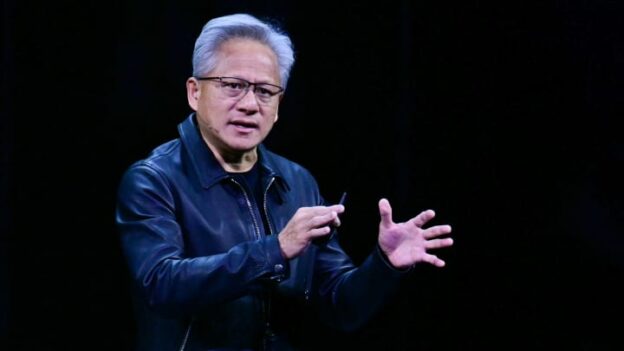
Nvidia CEO Jensen Huang has said he “had no idea how” to start a business when he co-founded the computer chip company from a Denny’s booth in 1993. His lack of experience didn’t stop him from making history by building Nvidia into the world’s first $5 trillion company, a benchmark it achieved on Wednesday.
The tech giant’s stock rose by 3% on Wednesday, closing with a record market value of $5.03 trillion, following Huang’s Tuesday announcement of plans to build a series of supercomputers for the U.S. government. In the announcement, Huang forecasted an additional $500 billion in orders for Nvidia’s AI chips.
Nvidia’s stock is up nearly 50% since the start of 2025, reflecting investors’ enthusiasm for an artificial intelligence boom that’s seen Huang’s Santa Clara, California-based company explode into an industry behemoth, from a relatively small video game processor manufacturer.
It’s been a dizzying ascent for a company that only first reached a $100 billion valuation in July 2017, and overcame significant early struggles that nearly put it out of business in the mid-1990s.
Huang was a 30-year-old engineer at Sun Microsystems in 1993 when he gathered with friends and future co-founders Chris Malachowsky and Curtis Priem in a booth at a Denny’s diner to plot what would become Nvidia. “Frankly, I had no idea how to do it, nor did they. None of us knew how to do anything,” Huang told CBS’ “60 Minutes” about the company’s origins in an April 2024 interview.
DON’T MISS: The ultimate guide to using AI to communicate better
At the time, Huang believed the co-founders could develop a graphics processing unit (GPU) that would revolutionize computer graphics for video games. The company got off to a rough start when, in 1996, Nvidia’s experimental chips turned out to be “technically poor” — jeopardizing an essential contract with gaming company Sega, Huang said in a May 2023 commencement speech at National Taiwan University.
The failure forced Huang to lay off nearly half of his staff. He prevented the company from going under by convincing Sega to buy out their contract, and he used that money to fund the development of a completely new series of chips from scratch. Those new chips became the company’s first hit product in 1997, selling 1 million units in just four months.
Huang has discussed how the difficult experience helped him, and the company, develop enough resilience to become successful. “Greatness is not intelligence. Greatness comes from character. And character isn’t formed out of smart people, it’s formed out of people who suffered,” Huang told students at his alma mater, Stanford University, at a March 2024 event.
Today, Nvidia is a major player in the AI boom after diversifying beyond serving only the gaming industry in the 2010s. Companies including Google, Microsoft and OpenAI use Nvidia’s computer chips to power complex AI models, and the AI investment boom has seen Nvidia’s stock skyrocket in recent years. The company’s market capitalization topping $1 trillion for the first time just two years ago, in May 2023.
For his part, Huang never imagined when he launched Nvidia that his company’s chips could one day help usher in a potential AI revolution.
“That was luck founded by vision,” he said in the “60 Minutes” interview. “We invented this capability and then one day, the researchers that were creating deep learning discovered this architecture. Because this architecture turned out to be perfect for them … Perfect for AI.”
While AI excitement has spurred U.S. stocks to record levels, some analysts have warned of a potential bubble caused by ever-climbing valuations and an increasingly complex web of companies investing in each other, with Nvidia near the center of it. But unsurprisingly, Huang is bullish on AI’s potential and eager for U.S. developers to be at the forefront of the industry’s ascent.
“We are at the dawn of the AI industrial revolution that will define the future of every industry and nation,” Huang said in Nvidia’s press release on Tuesday. “It is imperative that America lead the race to the future — this is our generation’s Apollo moment.”
https://www.cnbc.com/amp/2025/10/30/how-jensen-huang-turned-nvidia-into-the-first-5-trillion-company.html