



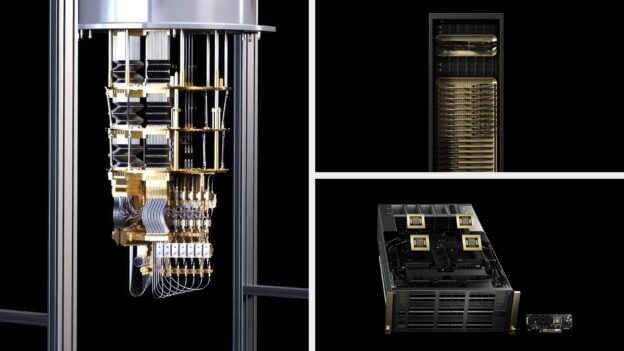
Nobel Physics prizewinner John Martinis has positioned his startup, Qolab, at the top of a quantum-computing alliance with chip industry leaders like Applied Materials and Synopsys, aiming to revamp how quantum devices are made.
Martinis told EE Times in an exclusive interview that the newly formed Quantum Scaling Alliance (QSA) expects to make the world’s first quantum devices with more than a million qubits ahead of larger companies like Google and Amazon by reducing the “forest of wires” in current designs to tiny metal traces on a silicon wafer.
On Nov. 10, Applied Materials, HPE, Synopsys and Qolab announced they are among eight members in the QSA, a global group aiming to make quantum computing scalable, practical and transformative across industries. Masoud Mohseni from HPE Labs, the applied research arm of HPE, will oversee the initiative and serve as quantum system architect. The Alliance is co-led by Martinis, a 2025 Nobel Laureate recognized for his pioneering advances in quantum computing who is also co-founder and CTO at Qolab.
“If we want to make a million-qubit device, there’s a scaling and wiring issue with superconducting qubits,” Martinis told EE Times. “I think the approach everyone’s taking right now is okay, but it’s going to hit a box canyon at some point. It’ll be limited. We’ve been proposing a way to use modern semiconductor fabrication to get around that and to improve things.”


In 2022, Martinis co-founded Qolab in Los Angeles, Calif.
Martinis recalls a few years before when he was designing quantum processors at Google.
“When I worked at Google, they were trying to do everything themselves, and that’s one model. The problem is if you want to have the best manufacturing, someone in the semiconductor world wants to go off to this weird quantum project for a couple of years, and then if it doesn’t work out, well, that’s maybe not so good for their career.”
Martinis wants to work with experts.
“Getting the best expertise to solve these problems is a more efficient way. But it means you have to collaborate and work together, and the lawyers have to work together to sign the IP agreements. It’s not easy.”
Forest of wires
Martinis is focused on reducing a forest of wires in today’s quantum devices to tiny metal traces on a silicon wafer.
“Instead of using co-ax wires, which people are talking about now, we’re using a silicon wafer. The nice thing about a 300-millimeter wafer is you can make half-micron, micron-wide wires and have a hundred thousand wires going from low temperature to high temperature. That way, a very complex, bulky system can be made on a wafer. Then you connect that wafer to your qubits at low temperature. We have an idea how to integrate that.”
Qolab is working with QSA partner Applied Materials to do the fabrication of the quantum devices. Hewlett Packard spinoff HPE will handle what Martinis called the “high end” of the manufacturing stack, combining classical supercomputers with quantum computers.
“We’re experts on the quantum design part. We work with Applied Materials, which does the fabrication,” he said. “We’ll work with Synopsys to develop the tools. For example, we’re going to need a process design kit for the fabrication. They have expertise in that. We’re going to need to have simulation tools, which is something that they do.”
Quantum alliance
The QSA is based on a collaboration between member companies that have been working together for about a year, Synopsys Distinguished Architect Igor Markov told EE Times. More members are welcome, he said.
“The idea is to develop an ecosystem where different members, small companies, large companies, and even academics, contribute to different aspects of quantum computing, which we view as a very vertical enterprise, spanning topics from atomic simulation to supercomputing systems,” Markov said.
Synopsys tools model everything from atoms to systems, Markov noted.
“We literally are working with atoms here, and we’re going all the way up to systems,” he said of the QSA.
The QSA believes that one of the best ways to advance quantum computing is to reuse the huge investments made in the semiconductor fabrication and design ecosystems. Synopsys represents a significant part of that ecosystem, Markov noted.
The main technology under development in the QSA now is superconducting qubits, the tech pioneered by Qolab and Martinis, who won the Nobel prize based on his supercomputing work, according to Markov.
From the Synopsys perspective, a couple of other technologies besides supercomputing qubits are under consideration, Markov said. Synopsys is also evaluating single-electron spin tech for quantum computing because it uses traditional metal-oxide-semiconductor processes, while research and industry efforts have emphasized the use of CMOS-compatible processes for scalability.
“Synopsys’ mission is to help with engineering tools,” Markov said. “If they’re quantum chips, if they’re non-quantum chips, we can help.”
Synopsys, especially with its recent acquisition of Ansys, has a “broad array” of tools for multi-physics simulation, Markov noted.
“For some technology that is non-silicon, we may be able to help. Whereas with the QSA, the emphasis is really on semiconductors and related technologies.”
QSA’s vision sets 2033 as a milestone when quantum computers scale to as many as five million physical qubits. With quantum error correction, physical qubits support a smaller number of logical qubits—up to a hundred times fewer—that “really work” and support algorithms, Markov said.
“We are looking at qubit devices that implement individual qubits and then of course interconnect, scaling them to the chip level and to the wafer-integration level,” he added. “This is somewhat similar to what Cerebras is doing, but of course they’re not doing quantum.”
Synopsys notes that among quantum-computing companies and university researchers, many are using “homegrown” or open-source simulation tools.
Quantum effects are very hard to simulate, Markov noted.
“These tools are limited and even when they’re state-of-the-art for some particular function, the integration of multiple methods and the combination of different numerical techniques only appears in in commercially supported software,” Markov said.
When Martinis was with Google around the beginning of 2020, the company reached 53 qubits.
“They were talking at the time by the end of the decade to get to a million qubits,” Martinis said. “It’s halfway through the decade, and they’re at 100 qubits. If you extrapolate out at that rate, I will certainly be dead by the time they build a general-purpose quantum computer, which is unacceptable for me.”
China is another reason why Martinis feels pressed to accelerate development. He warned that China is “nanoseconds” behind the U.S. in a quantum-computing race, according to a Bloomberg article.
He declined to go into detail on how Qolab is able to run circuits on a silicon wafer under the wide temperature extremes of a quantum computer.
“The field is very competitive, and I’m very concerned about China stealing our things. We’ve talked to various companies in the U.S., and they’re waiting to see if we can get it to work,” he told EE Times. “I’m actually much more concerned about China because they will take our ideas and run with them right away.”
https://www.eetimes.com/nobel-winners-quantum-startup-forms-industry-alliance/