



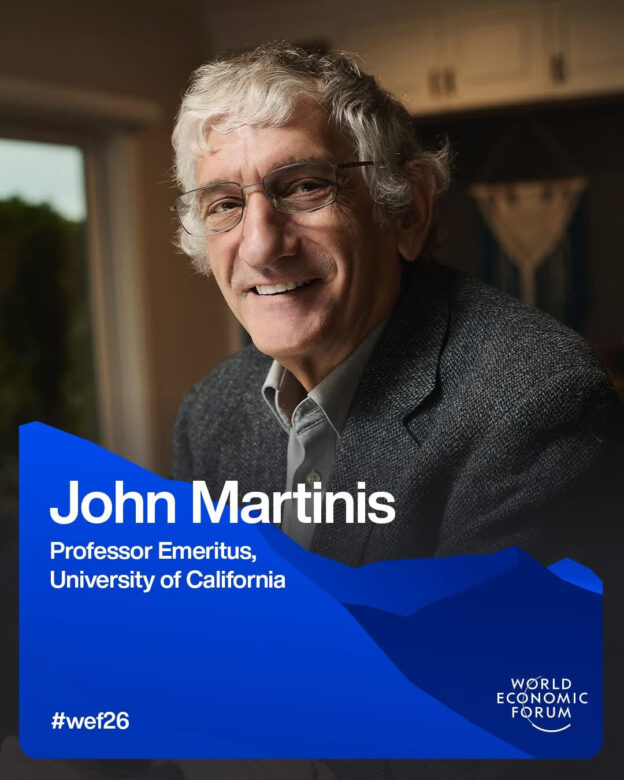
John Martinis has already revolutionised quantum computing twice. Now, he is working on another radical rethink of the technology that could deliver machines with unrivalled capabilities
John Martinis is a hardware guy. He prefers the nitty-gritty of doing physics in the lab over the idealised world of textbooks. But you couldn’t write the quantum computing history books without him: he was central to two of the most pivotal moments in the field. And he is hard at work chasing the next one.
It started in the 1980s, when Martinis and his colleagues ran a series of experiments to probe the edges of what was known about quantum effects – for this work, he won a Nobel prize last year. Back when he was a graduate student at the University of California, Berkeley, we knew that subatomic particles were subject to quantum effects, but the question was whether the world of quantum mechanics could extend to larger scales.
Martinis and his colleagues built and studied circuits made from a mix of superconductors and insulators where, it turned out, many charged particles within the circuit behaved as if they were a single quantum particle. This was macroscopic quantumness, and it laid the foundation for building some of today’s most powerful quantum computers, including those currently championed by IBM and Google. In fact, Martinis’s work set in motion the trend of tech giants using quantum bits, or qubits, made from superconducting circuits – the most widely used qubits in the world today.
Read more
Quantum computers have finally arrived, but will they ever be useful?
The second time Martinis shook up the field, he was leading the team of Google researchers who built the quantum computer that achieved “quantum supremacy” for the first time. For nearly five years, it was the only computer in the world, quantum or otherwise, that could verify the output of a random quantum circuit. It was later bested by classical computers.
https://www.newscientist.com/article/2513239-nobel-laureate-says-hell-build-worlds-most-powerful-quantum-computer/