



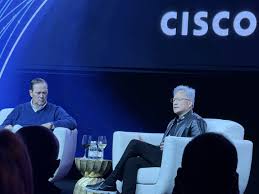
Tech leaders from Nvidia, OpenAI, Microsoft, and Intel examine the many ways AI will change the industry.
Some 15 tech luminaries from companies including Nvidia, OpenAI, Microsoft and Intel took to the stage at Cisco’s second annual AI Summit and talked about how AI technology will change the industry moving forward. The goal of the gathering was to provide a look at how AI is influencing software, compute, infrastructure and IT workers. A number interesting themes emerged from their presentations. Here are some highlights.
Influence vs. control
Software development was the topic mentioned most often, and the main question on many people’s minds is whether or not AI will be the death or rekindling of software development.
“Remember what software is. Software is a tool,” said Nvidia CEO Jensen Huang. The notion that the software industry is in decline and will be replaced by AI “… is the most illogical thing in the world, and time will prove itself,” Huang said.
As with all technology deployments in the beginning, it’s hard to quantify the ROI of a new tool, Huang said. Instead of focusing on ROI, he would instead ask “what is the essence of my company? What’s the most impactful work that we do in our company?” he said. “Don’t mess around with peripheral stuff.” At Nvidia, “we just let 1,000 flowers bloom. The number of different AI projects in our company, it’s out of control, and it’s great,” Huang said.
“Notice, I just said something — it’s out of control and it’s great,” Huang said. “Innovation is not always in control. If you want to be in control, first of all, you ought to seek therapy. But second, it’s an illusion. You’re not in control. If you want your company to succeed, you can’t control it. You want to influence it. You can’t control it.”
Activity is different from progress
“You can produce a lot of code with these coding agents right now, [but] there’s nothing to say that it’s good code,” noted Microsoft CTO Kevin Scott. “People need to really make sure that they’re not getting confused between activity and progress.”
Software development is in an absolute frenzy right now, Scott said. “You have very, very senior people, the best coders you’ve ever met in your life, who are just completely overwhelmed trying to keep up with the rate of progress that’s happening right now.”
Optimizing AI development for agents or humans?
Sam Altman, co-founder & CEO of OpenAI, suggested the future of software development will be directed more at agent use, rather than human use.
“How are we going to rewrite all software to be equally usable by humans and AI? There’s like, a bunch of weird quirks right now about trying to do that with the software. Does that change the architecture of the software itself, where you’re going to optimize it for agents more so than humans? It fundamentally changes how you build software,” Altman said.
“Maybe a lot of software will get rewritten so that it’s primarily or largely used by AI, but also still works for people using it the old-fashioned way. One of the most powerful things about AI is you can do this sort of always-on computing, where you could have an AI listening to your meeting or watching your meeting, and, you know, watching what you’re doing on your computer, and then, just like, add a lot of value and do stuff for you… Existing computer hardware is not really meant for that. Our permissioning system, and how we think about what an AI gets to see and do stuff with and what it gets to keep, is not really meant for that. Our legal system doesn’t really support that. Well, you’d like to be able to record a meeting and learn something from it and delete the recording. So I think there’s a lot of just usability things like that,” Altman said.
Network World Smart Answers
Explore related questions
- How is AI transforming my software development for agents?
- What percentage of Cisco’s AI products use AI-generated code in 2026?
- What are my board of directors’ AI governance questions in 2026?
- How can my enterprise scale AI coding safely in 2026?
- How will AI agents transform my company’s workflows by 2026?
Related to Altman and OpenAI’s Codex platform, Cisco’s president and chief product officer Jeetu Patel said that 100% of Cisco’s AI Defense package will soon be entirely written by Codex. “We are moving toward what Altman called ‘full AI companies,’ where the model builds the product and the infrastructure to run it,” Patel said.
Intel: Memory is an AI killer
AI sucks up a lot of memory, said Lip-Bu Tan, CEO of Intel. “In terms of AI, the biggest challenge for a lot of my customers is memory,” Tan said. “And there’s no relief as far as I know.” In talking to a few key industry players, “they told me that ‘Lip-Bu, there’s no relief until 2028.’”
The industry is suffering the worst memory shortage in history, and that’s with three core suppliers: Micron Technology, SK Hynix, and Samsung. TrendForce, a Taipei-based market researcher that specializes in the memory market, recently said it expects average DRAM memory prices to rise between 50% and 55% this quarter compared to the fourth quarter of 2025. Samsung recently issued a similar warning, according to a recent Network World article.
Does AI need a different kind of security?
The obvious constraints to AI are the biggest ones—energy, manufacturing, and enough hardware, Altman said. “The non-obvious ones are most top of mind for me. One, how are we going to balance the sort of security and data access versus the utility of all of these models? I don’t think anyone has a great answer to this. Yet, it feels to me like there is a new kind of security or data access paradigm that needs to be invented for this,” Altman said.
“This is the first time that security is actually becoming a prerequisite for adoption. In the past, you always ask the question whether you want to be secure, or you want to be productive. And those were kind of needs that offset each other,” Patel said. “We need to make sure that we trust not just using AI for cyber defense, but we trust AI itself.”
AI’s social influence
Looking to the future, there will be new kinds of social interactions with many agents in a space interacting with each other on behalf of people, leading to all sorts of new things, Altman said.
“You can imagine a totally new kind of social network where everybody makes an agent, or many agents, and puts them in there. And the agents are talking and doing stuff and finding them people and information and collaborating with other people’s agents to come up with new ideas… I think the future of social may look something like that, very different than today,” Altman said. Moltbook is an existing example of this activity.
“I can imagine, like, billions of humanoid robots building more data centers and mining for material and building more power plants and all of that. I can imagine just the economy growing at an unprecedented rate as there’s all sorts of incredible new services and scientific discoveries happening,” Altman said.
https://www.networkworld.com/article/4127471/takeaways-from-ciscos-ai-summit.html