



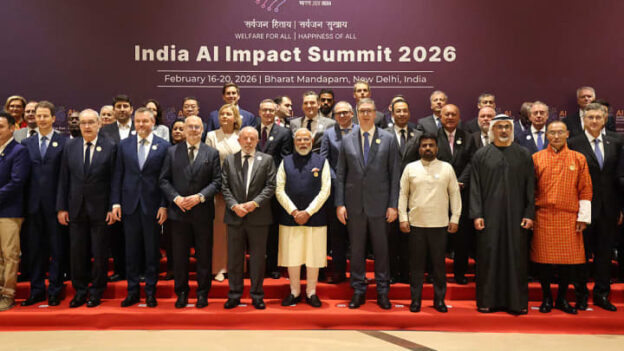
Declaration gets both the U.S. and China as signatories, along with the majority of government participants
Eighty-five countries and three international organisations signed the New Delhi Declaration at the AI Impact Summit, a day after the event’s scheduled conclusion, as officials sought to expand the signatory list to achieve as broad a consensus as possible.
Also Read: India AI Summit 2026 Day 5 highlights
“Guided by the principle of ‘Sarvajan Hitaya, Sarvajan Sukhaya’ (Welfare for all, Happiness for all), the Declaration underscores that the benefits of AI must be equitably shared across humanity,” the government said in a statement about the declaration. Major participants, including the United States and China, endorsed the document.
As with the 2023 G20 Summit, the road to consensus was paved with non-binding and voluntary commitments. While the declaration does mention AI safety and trust—issues the U.S. in particular rejected during last year’s Paris discussions—its commitments lean heavily on knowledge sharing.
Democratising AI
The 900-word statement offers a “Charter for the Democratic Diffusion of AI” as a “voluntary and non-binding framework to promote access to foundational AI resources, support locally relevant innovation, and strengthen resilient AI ecosystems while respecting national laws.” It also introduces a Global AI Impact Commons—described as a voluntary initiative—to exhibit AI use cases for governments to draw inspiration from.

On security and trust, the statement says, “Advancing secure, trustworthy and robust AI is foundational to building trust and maximising societal and economic benefits. Noting that deepening our understanding of the potential security aspects remains important, we recognise the importance of security in AI systems, industry-led voluntary measures, and the adoption of technical solutions and appropriate policy frameworks that enable innovation while promoting the public interest throughout the AI’s lifecycle.”
Human capital
The statement also emphasised that achieving “the full promise of AI requires equipping individuals with relevant skills by expanding AI human resource development, specific initiatives on education, AI workforce development, training of public officials, enhancing public awareness of AI capabilities, increasing AI literacy, as well as upgrading vocational and training ecosystems.”