


Partners with Google and SpaceX to Target Enterprise On-Premise Networks
Dell Technologies announced at its annual conference that its AI Factory product line added 1,000 enterprise customers in a single quarter, pushing the total count past 5,000. Major clients include Eli Lilly, Honeywell, and Samsung. CEO Michael Dell emphasized that traditional enterprises are shifting en masse toward building their own AI infrastructure, and unveiled the new Dell Deskside Agentic AI solution, which runs on internal networks. The company also announced partnerships with Google, SpaceX, and Mistral AI to bring AI models into enterprise environments. However, Michael Dell also warned that AI will intensify near-term hacker threats, urging businesses to immediately harden their systems. Despite the aggressive strategy, Wall Street remains cautious on Dell’s stock, with analyst price targets implying potential downside risk.
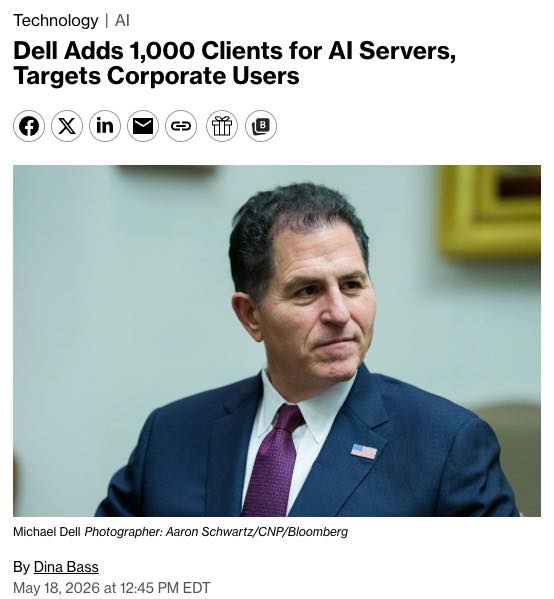
Dell Technologies is seizing the enterprise artificial intelligence infrastructure market at a breakneck pace. CEO Michael Dell announced Monday at the Dell Technologies World 2026 conference in Las Vegas that the company’s AI Factory product line added 1,000 enterprise customers in the past quarter, bringing the cumulative total past 5,000.
The data underscores a massive shift among traditional large enterprises from casual cloud-based AI experimentation to building their own AI infrastructure. Beyond showcasing customer growth, Dell unveiled multiple new products and announced alliances with giants including Google and SpaceX, aiming to bring AI models directly into enterprise internal networks — effectively wresting computing control back from cloud service providers like Amazon and Microsoft.
Customer Count Surges; Dell Claims “Disproportionate Share Gains”
According to official Dell figures, the AI Factory customer count stood at 4,000 when earnings were reported in February this year, climbing to 5,000 just one quarter later. In interviews, Michael Dell did not hide his confidence, asserting that the company’s growth rate in this segment far outpaces peers.
“We’ve clearly grown share disproportionately in this space,” Michael Dell said. “We have a great track record of servicing customers on their existing infrastructure, and that makes them willing to trust us with their AI business as well.”
The known major clients span multiple industry leaders. Pharmaceutical giant Eli Lilly is using Dell AI servers for drug discovery. Industrial conglomerate Honeywell and South Korea’s Samsung are applying them to scenarios such as building AI-optimized semiconductor fabrication plants. Dell has long sold traditional servers and storage equipment to the majority of top-tier U.S. enterprises, and those deep customer relationships are now translating into a critical competitive advantage in the AI era.
Targeting Traditional Enterprise Pain Points with Security-Focused On-Premise Deployments
Despite the global AI wave, Michael Dell observed that traditional enterprises face fundamentally different challenges from AI-native startups when adopting AI. Many large clients have core data buried in decades-old legacy systems, making rapid migration and integration difficult.
“They see the speed of those AI-native companies and want to learn from them, but simply bolting AI onto existing operations and systems doesn’t work,” Michael Dell said.
To address this pain point, Dell launched the Dell Deskside Agentic AI solution at the conference. The product can run directly on customers’ Dell devices, calling Nvidia software to drive AI agents entirely without cloud dependency. This design is particularly suited for enterprise users with stringent data security and network isolation requirements.
On the ecosystem front, Dell announced collaborations with Google, Palantir Technologies, and Elon Musk’s SpaceX to introduce their AI models and tools into enterprise internal networks, deploying them either as private clouds or hybrid public-private cloud configurations. Additionally, French AI startup Mistral AI will announce an expanded partnership with Dell at the conference, using Dell servers equipped with Nvidia GPUs to develop and distribute its AI models.
CEO Warns: AI Amplifies Near-Term Cybersecurity Threats
While aggressively embracing AI opportunities, Michael Dell also issued a stark warning about the accompanying cybersecurity risks. He argued that while AI can dramatically boost programming productivity, it can equally be used to generate malicious code, meaning enterprises will face a significant near-term rise in attack threats.
“If AI is great at programming, it is also great at malware,” Michael Dell noted. “In the near term, massive hardening efforts are fully underway for critical systems.” He stressed that while AI will contribute to better overall security in the long run, businesses may experience a turbulent period before that happens. “System hardening is something we all need to do right now.”
He framed this moment as a pivotal juncture for enterprise development: “AI is clearly a transformative technology, and this is a do-or-die moment for companies and for the world.”
Muted Market Reaction as Analysts Remain Divided
Despite Dell’s flurry of moves in customer expansion and product strategy, capital markets appear not entirely convinced. According to market data, Dell’s stock price still declined after the announcements.
Wall Street analysts are split on Dell’s stock. Overall, DELL stock carries a “Moderate Buy” consensus rating, but over the past three months, analysts have issued 12 Buy, 4 Hold, and 1 Sell rating. The average analyst price target stands at $218.87, implying potential downside risk relative to current share price levels.
Pivoting from Hardware Vendor to Full-Stack AI Platform
The four-day Dell Technologies World conference, held at the Venetian Convention Center in Las Vegas, revolves around server, storage, networking, security, and edge computing strategies for the AI era. The event not only showcased the AI Factory and modern data center blueprint but also made “Agentic AI” a core keyword.
Industry observers note that Dell is attempting to shed its label as a pure hardware supplier and transform into a full-stack AI platform services provider. By integrating Nvidia chips, software, and services, and combining them with the model ecosystems of partners like Google, Dell aims to build an unassailable enterprise moat amid growing demand for AI inference and a resurgence in on-premise deployment needs.
Meanwhile, Nvidia CEO Jensen Huang and the head of Samsung Electronics’ AI Center also delivered video messages at the conference, conveying messages of deep collaboration with Dell in the AI infrastructure space. South Korean companies such as Naver Cloud and Samsung Electronics are also actively participating in related sessions, sharing case studies of AI and cloud integration built on Dell architecture.
https://finance.biggo.com/news/_TRiPJ4BmHHDnbgyPKv7