



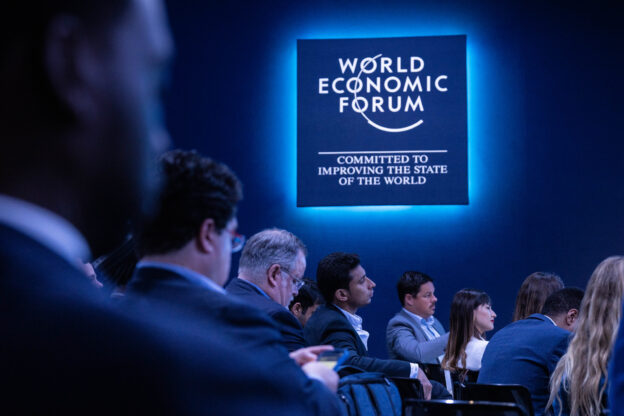
Welcome to Day 1 of the World Economic Forum’s ‘Summer Davos’ in Dalian, China
Day 1 of the Annual Meeting of the New Champions 2026, also known as Summer Davos, is underway in Dalian, People’s Republic of China.
- Today’s sessions include the launch of our flagship ‘Top 10 Emerging Technologies 2026‘ report, and major discussions on AI’s energy demands, global trade and the next generation of jobs.
- One session to watch: ‘No Power, No AI‘ (14:30 CST), featuring Robin Zeng, founder and CEO of CATL, one of the most consequential figures in the global energy transition.
- Follow this blog for live updates, session highlights and key quotes from Day 1.
In case you missed it, here’s our preview of what to expect at Summer Davos 2026.
7 hr. ago 12:45
That’s a wrap on Day 1 in Dalian
The first day of sessions at Summer Davos 2026 has covered a lot of ground: the race to power AI, the limits of self-sufficiency, the economic outlook for the global economy, and where the next billion jobs will come from.
Day 2 starts on Wednesday with an Update on Iran and the Opening Plenary, followed by sessions on the future of supply chains and where climate capital is actually flowing.
Watch in particular for “Inside China’s Energy System” at 17:30 Dalian time, a session that follows directly from today’s energy and geopolitics discussions.
9 hr. ago 11:15
How smart factories put people first in the learning process
A new generation of ‘lighthouse’ factories is folding AI and analytics into the core of manufacturing. The aim? Higher productivity, lower emissions, faster response to disruption.
In the session, ‘Factories that Learn’ panellists explained what makes a smart factory – and people featured prominently.
Zongchang Liu, Chief Digital Officer, Foxconn Industrial Internet, said factories that learn, continuously learn and can self-optimize in real time. But AI is an augmented tool to amplify human operators’ ability rather than replace them.
“People are the purpose,” said Xie Haiqin, Vice-President, Haier COSMOPlat. Factories that learn “also help us to create better factories and a better world for people”.
If we can make machines self-improved, based on the knowledge it learns, then it brings more value, which includes a process for humans to learn, said Jay Lee, Clark Distinguished Professor; Director, Industrial Artificial Intelligence Center, University of Maryland.
Padraig McDonnell is President and CEO of Agilent, which has four lighthouse factories, including one in Shanghai.
“You can put all the technology you want in your stack, but unless you develop your people, it’s wasted,” he said.
“
Technology doesn’t enable itself, but it actually enables the people in the factory to do a better job.
”
— Padraig McDonnell, President and CEO of Agilent
“How are you learning to serve your customer better across the globe? We’re optimizing supply chains in real time.”
Annie Lu, Co-Founder and Chief Executive Officer, Laminar, said: “One of the biggest EBITDA impacts of AI in manufacturing organizations is actually in operations, but it’s also one of the biggest challenges. How do you deploy and scale AI solutions in real core operations?”
Laminar is working on changeover optimization because one of the biggest cause of losses in operations is changeovers – switching to making another product on the same manufacturing line.
The discussion turned to advice for young people entering the world of work.
Xie Haiqin said 22% of job roles will be reshaped by AI in the coming years.
“It’s a tough question for top management. For young people who want to join the industries, you have to show your passion for AI. All jobs now involve AI, from engineering to data analysis. And also deep dive into physics, which is very important for manufacturing.”
There is no training course in the world that will be effective if people don’t have curiosity, added McDonnell.
“You hear companies talking about reshaping jobs, new skills, but having that learning agility and curiosity is really important.”
Tune in here.
Watch our documentary about the Global Lighthouse Network below:
10 hr. ago 10:38
No power, no AI
The energy challenge behind the AI boom looks very different depending on where you’re standing. That was the central tension of a session called “No Power, No AI”, which brought together Robin Zeng of CATL, Samaila Zubairu of Africa Finance Corporation, Vanessa Chan of the University of Pennsylvania and Mongolia’s Prime Minister on one stage.
Zeng, founder and CEO of the world’s biggest battery maker, was direct about China’s position. The grid isn’t the constraint, but storage will play a critical role as the country pushes for 80% renewable energy in new data centres. CATL’s answer is sodium-ion batteries as a bet to reduce lithium dependency, though Zeng said it would take three to five years before sodium production scales enough to fully support AI data centre demand.
He also offered the session’s most striking image. China has more than 40 million EVs, each parked for roughly 23 hours a day. “When you buy a car, it’s not only that you can save money from electricity compared to gas — you can also create a token factory for you.” The idle fleet, in his framing, becomes distributed infrastructure for the AI economy.
Zubairu said Africa holds 60% of the world’s best solar resources but capital isn’t following, and the reason is regulatory. “If you’re investing in OECD countries, there’s no capital charge or a lower capital charge. But if you’re investing in Africa, there’s a much higher capital charge. That is a clear mismatch.” Research shows African default rates are among the lowest in the world, he said. The risk perception simply doesn’t match the reality.
Dig deeper into how China built the energy system the world now needs →
10 hr. ago 09:45
Finding work for billions of young people
The many young people who enter the workforce every year, mostly in emerging economies, could become a vital source of economic growth – depending on the decisions that leaders make now.
The panellists at this session (“The Next Billion Jobs”), including QI Group Executive Chairman Vijay Eswaran, PwC Global Workforce Leader Peter Brown, Automation Anywhere Co-Founder and Chief Impact Officer Neeti Mehta Shukla, Guangzhou Baiyunshan Pharmaceutical President Chen Jiehui, and Algerian Knowledge Economy Minister Noureddine Ouadah discussed where the young people of the world will find work in the future.
Have you read?
Vijay Eswaran said the process of leaving school and starting work has always been a bit of a struggle, though “clearly AI has accelerated the process.”
“By the time the students actually come out and hit the streets, the jobs they prepared for are pretty much in the past.” The advantage they have, he said, is that they’re more flexible than previous generations: “They are a lot more comfortable with AI.”
The elephant in the room, said Neeti Mehta Shukla, is reskilling. “Everybody knows we need it, everybody knows we need to scale it,” she said.
Eswaran said there’s a specific need to instil more entrepreneurial skills. “A 9 to 5 existence has been part and parcel of what we have inherited,” he said, but now young people can no longer take that for granted.
Watch the full session here.
Image: World Economic Forum
10 hr. ago 09:45
Putting humans in the loop brings machines to life
Robots are edging out of the factory and into daily life.
This session focused on how advances in sensing and motion are reshaping how we share space with technology.
Opening the discussions, artist-roboticist Madeline Gannon explored the importance of the emotions we feel through our experiences with machines.
“If you think about robotics today, the tasks they do are the bare minimum,” Gannon explained. “They need to do them in order for them to get out of the lab and into the wild. But for mass adoption, for mass acceptance, how they make us feel is going to be more important.”
She shared an example of a robot named Mimus, which was taken out of its usual factory setting and installed in the Design Museum in London to interact with visitors.
“The magic behind all of this, just by changing how these machines move, is that we automatically begin to project our life force back onto this machine and reflect back onto us,” she explained.
“
The human in the loop is what brings machines to life.
”
— Madeline Gannon, artist-roboticist
Andrew D. Maynard Professor, School for the Future of Innovation in Society, Arizona State University and Ya-Qin Zhang Chair Professor and Dean, Institute for AI Industry Research, Tsinghua University, joined Gannon on stage to discuss their outlooks.
Zhang said that for the convergence of AI and robots to be successful, several gaps need to be overcome:
- The data gap
- The simulated and physical world gap
- The scaling gap
Maynard asked Gannon if a fourth gap could be around human acceptance, as we transition between humans feeling not only comfortable with having robots in their lives, but excited.
Gannon agreed, saying that this is why she is looking for ‘strategic shortcuts’.
“These robots, they don’t feel, they don’t have emotions, but they’re structured in a way to elicit our emotions,” she explains.
Zhang said that with robots becoming more prevalent in our everyday lives – giving the examples of driverless cars and vacuum cleaners – advances in large language models will be critical in unlocking scaling challenges.
“You can… talk with your robots in a way that almost feels human. That’s a huge step because that helps generalize all the other things.”
Watch the session here.
Have you read:
3 shifts shaping how we engage with intelligent systems: A pioneering technologist explains
10 hr. ago 09:45
What next for the Middle East?
The war in the Middle East and the disruption around the Strait of Hormuz have become the biggest single weight on the global economy this year, driving up energy and food prices and unsettling supply chains worldwide.
In this session, “What’s next for the Middle East?”, expert panellists examine the current state of affairs and map out the possible paths forward and their implications for the region and beyond.
“We have made progress,” said Sanam Vakil, Director of the Middle East and North Africa at Chatham House. “The ships will eventually start moving, but an instability should be in your minds over the next few months. I imagine more inflammatory statements, more threats to open and close the Strait of Hormuz, maybe even more tit-for-tat strikes and at the same time diplomacy will tick along.”
Meanwhile, private sector leaders from the region examined how the war has impacted the business resilience and market trends.
“Unfortunately wars create opportunities,” said Mazen S. Darwazeh, Executive Vice-Chairman and Deputy CEO of Hikma Pharmaceuticals. “There will be many opportunities for local companies to pop up and gain what is going on.”
“
You can’t say that the Middle East can be separated from the global economy.
”
— Karen Young, Senior Research Scholar, Center on Global Energy Policy at Columbia University
Khaled Sharbatly, CEO of Desert Technologies added that the “the opportunity is massive,” stating that the “next 10 years for the Middle East will be pivotal and shifting the Middle East from a trade corridor to an industrial and an added value region.”
The panellists noted, however, that tensions and serious divisions still remain in the region that will complicate its recovery. “We do have to understand that this war has set back relations between Iran and the Gulf states in a serious way,” Vakil stated.
Have you read?
11 hr. ago 08:45
China’s renminbi internationalization – what to know
More than $150 trillion flows across borders each year, most still in dollars. But as geopolitical tensions reshape trade and middle powers seek to diversify, alternative currencies are gaining ground – highlighted by the renewed 200-billion-yuan swap line between the Bank of Canada and the People’s Bank of China.
The session “Renminbi and the World” asked whether this shift could begin to redraw the structure, stability and sovereignty of the global financial system?
Diana Choyleva, Founder and Chief Economist, Enodo Economics, Senior Fellow, Asia Society Policy Institute; Zongyuan Zoe Liu, Senior Fellow, China Studies, Council on Foreign Relations; Ashor Nick Sarupen, Deputy Minister of Finance, Ministry of Finance of South Africa and Zhu Ning, Deputy Dean and Professor of Finance, Shanghai Advanced Institute of Finance, joined the FT’s Asia Editor, Robin Harding to discuss.
Zhu Ning said renminbi internationalization has been a long-term process over the past 20 years. China has a stable economy and is keen to open up RMB both onshore and offshore.
It’s not about picking winners and losers, it’s making sure there are no single points of failure said Sarupen. “We are seeing good clearing between the two international banks.”
Liu explained how RMB internationalization has made progress in terms of the functions of money, including commodity trading, the area where “China has huge potential” in a world where oil isn’t dominant.
In the last couple of years, the SWIFT data has shown the yuan has come down in the rankings, said Choyleva. But she cautions against this interpretation “with so much trade moving off the dollar rails” and digital payments difficult to track.
Over the next decade the cost of dollar funding inside and outside the US will go up considerably.
Zhu Ning sees the RMB continuing to appreciate against the US dollar. There’s a strong trading surplus on China’s side and China has a stable economy, which gives the RMB a lift. But he cautions about uncertainty, saying China has been trying to learn from Japan’s lessons.
The central bank has allowed more flexibility in the exchange rate, so it is more responsive to market conditions, said Choyleva. “China has always decided against competitive devaluation” in crises because it wants to present the world with a stable alternative to the dollar.
On the question of what stability means for the RMB from here, Zhu Ning said it’s the mechanism not the precise exchange rate.
In a world where the mentality is about resilience, added Liu, it’s necessary to think about capital control and balancing dependence on exports. The Chinese economy will be the largest economy just by currency appreciation.
As a safe asset, China’s RMB has a unique advantage going forward as the world diversifies away from oil.
Watch the session here.
12 hr. ago 08:15
Storytelling isn’t being reinvented, it’s being expanded
As digital technology continues to converge physical and virtual worlds to create experiences that inspire and connect, how are the boundaries of storytelling being expanded?
In this immersive session, award-winning multidisciplinary artist Victoria Fard showcased how advanced generative tools are transforming spaces to blend nature, cultural heritage and human stories.
“Long before stories were written down, they were shared through gatherings, just like this one, around circles, around tables,” she said.
“People weren’t just listening to the storyteller. They were listening together. Over centuries and across cultures, storytelling was used to exchange ideas and to share different ways of seeing the world.
“Now today, the tools have changed, but that human impulse of sharing stories has not.”
She remembered walking into a cathedral as a child, and says this inspired her journey through architecture, digital fabrication and computational design.
After demonstrating an example of her work in real time, she explained that her work acts as an invitation to pause, be present and “to step into a shared space and experience something personally meaningful with it”.
“
In a world that’s constantly moving, constantly consuming and constantly distracted, sometimes it’s easy to forget to see what’s right in front of us.
”
— Victoria Fard, multidisciplinary artist
She closed her session by reflecting that while she doesn’t believe storytelling is being reinvented, it is expanding as technology allows more immersive experiences.
“The tools will change… but the meaning comes from our human experience, from our intention, our values, our memories, and the things we pay attention to.”
12 hr. ago 08:15
Minilateralism and global trade
With global trade governance under strain, countries are forming smaller strategic clubs to get deals done.
In this session, “Less Talk, More Deals”, panellists explored the proliferation of regional and bilateral trade agreements, and discussed whether so-called minilateralism can serve as an alternative to the global trading system that defined the last century.
“These types of agreements are an important alternative given the crisis in the multilateral trading system and they represent an important effort to try to shore up rules-based trade, but at the same time there are inherent limitations to these as an alternative to multilateralism,” said Kristen Hopewell, Professor and Director of the Liu Institute for Global Issues at the University of British Columbia.
Mark-Alexandre Doumba, Minister of Digital Economy and Innovation of Gabon, noted that for his country, minilateralism is “business as usual.”
For Gabon, Doumba said, bilateral agreements allow the small central African country to have a bigger voice in talks, noting that “bilateral agreements on specific sectoral issues is the easier way for developing economies to balance trade in a way that benefits our people better.”
Canadian Parliamentary Secretary to the Prime Minister Kody Blois noted that Canada has signed over 20 economic and security partnerships with countries and blocs around the world. Blois added that the current Canadian government recognizes that if traditional multilateral systems are unable to deliver, then the country “better get into what we’re referring to as minilateralism.”
What the session here.
Have you read?
12 hr. ago 08:15
What’s next for the global economy
The latest Chief Economists’ Outlook painted a far more pessimistic picture than the previous iteration in January. What changed? The biggest factor was the effective closure of one the world’s most vital transit points for energy and other essentials.
As the status of the Strait of Hormuz is clarified, participants in this Chief Economists Briefing including JD.com’s Shen Jianguang, Africa Finance Corporation’s Rita Babihuga-Nsanze, WIPO’s Carsten Fink, and S&P Global’s Paul Gruenwald shared their latest takes on where the global economy stands now and where it’s likely headed in the future.
Shen Jianguang opened with an upbeat take on an alarming signal. In China, he noted, “a little inflation is actually a positive.”
“In American and Europe I know inflation is a risk,” he said, but in a country where deflation that can reflect sluggishness is a more pressing concern, price increases aren’t necessarily unwelcome.
Have you read?
Rita Babihuga-Nsanze acknowledged the recent signing of an agreement that commits to reopening the Strait of Hormuz, but cautioned that there’s no guarantee it will last.
And the impacts are already being felt; eastern Africa in particular has been affected by the sudden lack of access to fertilizer being shipped through the strait, she said, which has created a far more uncertain planting season.
In general, the chief economists said the resilience of the global economy has been a pleasant surprise. But not all of them focused on the bright side; there will inevitably be lasting impacts.
The closure of the Strait of Hormuz, said Paul Gruenwald, is “another nail in the coffin of globalization.”
Watch the full session here.
Image: World Economic Forum
13 hr. ago 07:00
What’s the limit for AI-first enterprises?
A new generation of companies is trying to build AI into the core of how they operate by using it as a foundation for products, workflows and decision-making.
Black Lake’s Zhou Yuxiang and fellow panellists explore what it takes to build such an AI-first enterprise, where the real value lies, and how to separate lasting transformation from hype.
You can also explore our newly released AI-First Enterprises Playbook, which brings together intelligence from over 50 of the world’s most advanced AI-first enterprises and thinkers.
Have you read?
13 hr. ago 06:45
How the future is green for China’s Belt and Road initiative
The Belt and Road Initiative picked up again in 2025 with increased investment, construction and trade with the Global South, alongside a tilt toward green energy.
In the session “Where Are We on Belt and Road?” a cross-regional panel discussed what the initiative’s next phase means for the countries inside it.
Prime Minister of Kazakhstan, Olzhas Bektenov, said when President Xi Jinping first presented the Belt and Road Initiative in Kazakhstan in 2013, “it marked the beginning of a new chapter in Eurasian connectivity”.
The country has invested more than $35 billion in transport and transit infrastructure to make the initiative possible and has a “natural and strategic” role: “Located in the heart of Eurasia, we represent a bridge connecting east and west as well as north and south.”
Kazakhstan provides access to a market of around 1.7 billion consumers, with around 85% of rail freight between China and Europe moving through it.
He outlined five key directions for the future development of the Belt and Road initiative (BRI):
- stronger infrastructure connectivity by expanding and modernizing and transport infrastructure, but this requires greater cooperation.
- a digital middle corridor, with electronic documentation, smart customs procedures, real-time data exchange and the use of AI to optimize transport flows.
- industrial cooperation along the route, with potential for joint industrial zones, technology parks, and manufacturing clusters, particularly in machinery, petrochemicals, energy equipment, batteries, and green technologies.
- the green dimension. “The belt and road framework can and should become a platform for raising environmental standards across energy, transport, and agriculture.”
- trade, investment and finance, with reforms to reduce barriers, simplify procedures and make cross-border trade more predictable and efficient.
“
When connectivity expands, opportunities multiply.
”
— Olzhas Bektenov, Prime Minister of Kazakhstan
In closing, he said: “The Silk Road has always thrived on openness, trust, and willingness to join efforts. Kazakhstan remains committed to that spirit.”
Hainan is an important hub along the marine Silk Road as well as a demo area for China’s 15th 5-year plan. Liu Xiaoming, Governor, The People’s Government of Hainan Province, said in the first decade of BRI, it attracted 150 countries and 30 international organizations. 3,000 cooperation projects were launched, which attracted over 1 trillion RMB investment.
After a decade of momentum, China is entering “a new era for BRI and the future is even more promising”. Hainan Island is building a free trade port, which will be a pioneer in digital technology and green transformation.
Guinea entered into a cooperation agreement in 2018. “Guinea and China have also engaged in strategic cooperation, which has generated fiscal revenue for Guinea and also benefited our infrastructure,” said Amadou Oury Bah, Prime Minister of Guinea.
Liu Jun, President, Industrial and Commercial Bank of China (ICBC) explained how the bank is playing a key financing role in the BRI, particularly for those emerging countries with low sovereign credit ratings. He outlines how the bank is lowering financing costs through a number of mechanisms.
Erica Downs, Senior Research Scholar, Center on Global Energy Policy, Columbia University, highlighted some of the changes that have happened in the past decade, including the greening of the BRI and an increase in the number of renewable energy projects being developed in BRI countries.
There has also been a “shift away from some of the really large infrastructure projects that characterized the early years” such as rail projects, to smaller, more sustainable projects.
In closing, the panellists discussed the impact of the US-Iran conflict and the closure of the Strait of Hormuz, agreeing that “crises go hand-in-hand with opportunity”.
Focus on the green transition is the answer to rising global uncertainties, and the BRI has played a big role in enabling renewable energy projects.
Using one word to describe the Belt and Road Initiative, the panellists said innovation, cooperation, adaptability, speed and resilience.
You can watch here.
13 hr. ago 06:45
Meet the founders on the frontier
Fast-scaling new businesses are redefining the global economy, gaining influence once dominated by established players.
Today, eight of the world’s 10 largest listed companies are tech firms, many built on innovations unheard of a generation ago.
Seven leading Technology Pioneers unpacked what sets their models apart and how they will drive the next decade of growth and transformation.
Kieran Donovan, Co-Founder and Chief Executive Officer, k-ID; Hannan Happi, Co-Founder and Chief Executive Officer, Exowatt; Kathleen Alexander, Co-Founder and Chief Executive Officer, Savor; Le Song, Co-Founder and Chief Technology Officer, Genbio AI; Xiong Yinjiang, Co-Founder and Chief Executive Officer, Lightstandard; Michael Liu, Founder and Chief Executive Officer of Pheno Innovations; Annie Lu, CEO & Co-Founder of Laminar, explained what their companies do.
They discussed the opportunities they’re gaining from being at the Annual Meeting of the New Champions.
“As a founder, you can get tunnel vision,” Alexander said. The Forum offers us a high-level opportunity to pull up a level and see how the technologies we’re developing fit into the ecosystems of our economy as they’re evolving. To make sure they’re ready to receive what we’re building and that we’re building to fit into how the world is changing.”
Liu said as someone working in the material discovery space, it’s been useful to discuss opportunities and challenges on an international scale. Other founders in the space have common issues around protecting IP and the policy around discovery, such as who gets to patent a new material. He says the cohort has set up a small alliance to pioneer a way to track IP.
In closing, they discussed common challenges, such as silos in AI and how to build technology that works for the end user as well as for the manufacturing enterprise.
Watch the session here.
Catch up on the latest cohort of the Forum’s Technology Pioneers below:
Have you read?
14 hr. ago 06:12
‘Davos on Air’ is back in Dalian
The Forum’s dedicated podcasting space has returned to Summer Davos, giving creators a place to record conversations from inside the Meeting.
Here, Sinica host Kaiser Kuo sits down with economic historian Adam Tooze to record a new episode.
15 hr. ago 05:15
They’re much more than cars now
Vehicles have become software-defined systems on wheels, making them more of a distinct class of technology than a means to get from here to there.
Panellists for this session, “When Cars Became Software,” including Harvard University’s Elaine Buckberg, Indonesian Chamber of Commerce and Industry Chairman Anindya Novyan Bakrie, Contemporary Amperex Technology Chief Manufacturing Officer Ni Jun, and Motovis CEO Zhenghua (Jack) Yu, dug into how this development is shifting roles in the auto industry and who will likely control different aspects of global supply chains.
Anindya Novyan Bakrie said Indonesia’s size creates opportunities where software-defined vehicles are concerned. Its roughly 285 million people need the jobs the industry can provide, and its post office – with some 5,000 outlets – is a great candidate for deploying software to manage large fleets of vehicles.
Have you read?
Elaine Buckberg said the rise of electric vehicles means the proliferation of cars inherently more dependent on electronic engineering. The average buyer of an EV, she said, is usually more “technology-forward” than the average car buyer.
The average Chinese car buyer is also relatively technology-forward, Buckberg said, if for no other reason than their age. While the average new car buyer in the US is 55 years old, she said, in China the average buyer is 35 years old.
Buckberg attributed China’s ability to more quickly transform its auto industry at least in part to the proliferation of “all-new companies that are starting with a clean sheet of paper,” which creates more opportunity for innovation.
She noted that the dramatic technology revamp of passenger vehicles does come with risks – not least, potential cybersecurity threats.
Made with Flourish • Create a chart
15 hr. ago 05:15
Women are using AI. But if they’re not building it, biased products follow
The session “Are Women Missing Out on AI?” turned its own question around within the first few minutes. “Instead of asking, ‘Are women missing out on AI?’, is AI missing out on women?” said Joanna Riley, CEO and Co-Founder of Censia.
Women are adopting AI tools, the panel agreed but using the technology is not the same as deciding how it is built, funded or governed. “A lot of times when we talk about this topic, we talk about women’s participation,” said Carol Yu of Shenzhen InnoX Academy. “But participation is not the same as having power over influencing the future.”
The real question, she said, is whether enough women are becoming founders, investors and policy-makers. “Can women really catch this moment to be not just users, but shapers of the future?”
Sabrina Peng Yijie of Ant Group offered a practical example of why that matters. More than half of the product managers working on one of the company’s health products are women, she said, and their involvement changed the design.
“When women design the product, it’s totally different,” she said. “It’s a different angle, a different view.”
Riley was blunter about what happens when women are absent from the building process.
“If not, we are going to build biased products,” she said. “Products built on fundamentally male data — if you think about women’s skin, women’s health — women are not going to have the same outcome, even though the vast majority of those consumers are going to be women.”
Yet women-led companies still receive only around 2% of venture capital, Riley said, despite delivering what she described as 2.5 times better outcomes than male-led companies.
Her message to women considering building their own companies was equally direct: rejection is part of the process.
“If women could say, ‘I’m OK getting kicked in the teeth a couple of times’ — every time I get kicked in the teeth, I choose to move forward,” she said. “If we’re not OK with that, we are going to build biased products.”
15 hr. ago 04:45
Nature and economics: ‘Going green cause it’s good business’
Biodiversity loss and ecosystem degradation are not only environmental concerns but also economic ones, affecting agricultural output, water security and supply chain stability.
In this session, “Nature Is Infrastructure”, panellists explored how nature-positive models can unlock significant business value.
“The nature of the challenge is that for too long we’ve viewed economic growth, human well-being, climate, and nature as separate things,” said Angela Moles, Professor of Ecology and Chair, NSW Threatened Species Scientific Committee at the University of New South Wales. “Our real challenge is to bring it together.”
André Hoffmann, Vice-Chairman of Roche Holding and Co-Chair of the World Economic Forum, added that “we have these mental blocks which tell us we are separated from nature,” noting that nature is “something that we need to look after if you really want to construct long-term models for sustainability and prosperity.”
Meanwhile, Andrew Forrest, Executive Chairman and Founder of Fortescue, stressed the business case for protecting nature, urging private sector leaders to embrace the mentality of “we’re going green cause it’s good business.”
Watch the session here.
Have you read?
16 hr. ago 04:05
Your audio guide to Day 1 at Summer Davos
Here’s your audio briefing for Day 1 in Dalian.
Listen to Radio Davos Daily here on the live blog, or on any podcast app.
16 hr. ago 03:45
Which numbers tell the clearest story about the economy?
Economies and financial markets have been generating some seriously mixed signals, making things more difficult for central bankers, political decision-makers, and anyone trying to gain a clear sense of where things are headed.
The participants at this session (“A World Out of Balance”), economics commentator and author Matthew Klein and president of the National School of Development at Peking University Huang Yiping, took a hard look at what’s out there on growth, consumption, and production – and discussed which numbers actually matter.
Klein said one potentially misleading data point that people often see mentioned is US economic growth being almost wholly dependent on the AI boom. In fact, he argued, almost everything being loaded into newly built AI data centres in the US is imported from other countries – so the boom’s contribution to growth is far less than what most people imagine.
In terms of China-related statistics, he said that while the country’s exports of electric cars have drawn a great deal of attention, up until about last year most of its car exports were of internal-combustion engine vehicles.
Huang Yiping said one thing impeding clarity on the economy is a failure to acknowledge that size matters. China’s economy is already rebalancing between exporting and consuming, he said, but its sheer size is what’s drawing complaints about the export side. “20 or 30 years ago external surplus was less of an issue for the rest of the world,” he said.
Made with Flourish • Create a chart
Klein said there’s an issue with word choice, and one word in particular: “overcapacity.” While it’s often used to describe the way China goes about producing things like solar panels or other green technology, “I strongly dislike this word,” Klein said.
That’s particularly true when using the word to describe China’s production of green technology relative to what global demand should be, in light of the current climate situation. “I get why people use it,” Klein said, “but I don’t think it’s helpful.”
Have you read?
16 hr. ago 03:45
Exploring new energy corridors
The geography of global energy is being redrawn, from renewable scale-up in India and Brazil to China’s lead in clean technology and the Gulf’s investment strength. Moreover, emerging markets, home to the critical resources underpinning the energy transition, are becoming the centre of global energy growth.
In this session, “Energy Corridors, Reshuffled“, expert panellists discussed how energy corridors are shifting and explored the various chokepoints that continue to impact the global energy system.
“Some of these developments globally actually represent an opportunity for [Africa],” said Bajabulile Tshabalala, Lead Board Member of Eskom Holdings. “But in order for that opportunity to be leveraged we have to address these chokepoints.”
Panellists noted that the series of recent shocks, which include the COVID-19 pandemic, the war in Ukraine and the war in the Middle East, have forced governments worldwide to rethink energy supply chains.
“
The global energy landscape is going through profound changes defined by geopolitical tensions and energy restructuring.
”
— Liu Xiaoming, Governor of China’s of Hainan Province
Leila Benali, Minister of Energy Transition and Sustainable Development of Morocco, noted that there are two major ingredients needed to develop alternative energy infrastructure: policy stability and the international finance community making investments. Liu Xiaoming, Governor of China’s Hainan Province, added that technology and global standards must also be taken into consideration.
Watch the full panel here.
Have you read?
-
The energy transition’s foundations are weakening. The US-Iran crisis shows why that matters now
-
Middle East war: 6 ways countries are responding to the historic energy shock
17 hr. ago 03:15
Top 10 Emerging Technologies 2026
The Forum has been surveying experts on technologies with the potential to reshape economies for more than a decade.
The 2026 list has landed today, unpacked by the World Economic Forum’s CTO Stephan Mergenthaler, Frontiers’ Frederick Fenter and Dubai Future Foundation’s Abdulaziz Al Jaziri. Worth watching for the entries that weren’t on anyone’s radar last year.
Watch the session here, or explore the full publication→
17 hr. ago 02:45
Creative inquiry and scientific exploration
Where creative inquiry meets scientific exploration, new things happen.
This session, “Curiosity as Catalyst“, brought together science gallery directors from around the world to explore how artists and scientists turn research into sensory experiences. Panellists included Ryan Jefferies, Director of Science Gallery Melbourne, Miguel Alejandro González Virgen, Director of Science Gallery Monterrey, Jahnavi Phalkey, Director of Science Gallery Bengaluru and Vanessa Chan, Inaugural Vice-Dean of Innovation & Entrepreneurship at the University of Pennsylvania.
Image: World Economic Forum
“Curiosity and innovation begins with a willingness to ask the hard questions and can succeed through creative and often unexpected collaboration,” Jefferies said.
The directors examined how artists and scientists have collaborated across disciplines, transforming biomedical questions into sensory encounters and translating climate data into immersive environments, among other initiatives.
“One thing that I found that joins science and art is that both like to experiment,” said González Virgen.
Watch the full session here.
18 hr. ago 02:35
What is ‘Summer Davos’? 6 things to know about the Annual Meeting of the New Champions in China
18 hr. ago 02:15
At what price self-sufficiency?
More trade barriers are up, and governments are taking far a more active hand in the flow of investments and supply chains. This maiden session at Summer Davos 2026 started with a question: how much can the world’s biggest economies turn inward before the costs outweigh the benefits?
The panellists assembled for the session (entitled “Resisting Autarky”), including Yuen Yuen Ang, a professor of political economy at Johns Hopkins University, Matthew Klein, an economics commentator and author, Elizabeth Thurbon, a professor of international political economy at the University of New South Wales, and Yasushi Sasaki, the Asia Pacific Chair at Boston Consulting Group, discussed the optimal balance between protecting national interests and pursuing the cooperation necessary for growth.
Yuen Yuen Ang noted that only about decade ago the notion of a World Economic Forum session with “autarky” in the title would’ve been almost unthinkable: “It is quite a statement of our times that this word has been brought back.”
She cautioned against presuming countries can balance self-sufficiency with an outward embrace. “I’d be careful about making this assumption that we’re able to have it both ways.”
Matthew Klein wasn’t so sure. The idea that countries might pursue self-sufficiency to a large extent while keeping some of their economies on the open market isn’t inconceivable: “I suspect that will be something we’ll see for a long time.”
Made with Flourish • Create a chart
Elizabeth Thurbon noted that for a place like her home country, Australia, the idea of pursuing autarky is a non-starter; the country has relied on exporting fossil fuels to Asia, and due to environmental security concerns it will now have to focus on sending decarbonized commodities like green iron to a rapidly decarbonizing Asia. “This is a kind of open-economy economic nationalism,” she said, “which is where the future lies.”
Ultimately, the definition of “national security” isn’t necessarily clear, Klein said. It may rely on things we’re not focused on at the moment.
One example: the surgical masks that did not become a major health-security concern in most places until the onset of the COVID-19 pandemic.
“In a sense we were all traumatized by the pandemic,” Yuen Yuen Ang said; governments are still grappling with that harsh reminder of the things we came to take for granted in a globalized world.
Watch the full session here.
18 hr. ago 02:15
AI is everywhere but why aren’t we seeing enough impact?
One of the first major sessions of Summer Davos opened with a paradox that’s keeping executives up at night: 97% of organisations are deploying AI, yet most aren’t seeing it move the needle on profit and loss.
Panellists on stage for the “AI Everywhere, Not at Once” session agreed it’s not the technology that’s the bottleneck. It’s the readiness. “If AI is the ocean, we are now on the surface,” said Feng Junlan. “The enterprise is not ready in terms of data, in terms of their system. But you shouldn’t try to solve all those basics before going to AI… it will take you a couple of years. You have to jump in.”
Xue Lan reached for an analogy. When the car was invented, she said, it didn’t immediately transform society because the roads didn’t exist yet. AI is in that moment now. “The infrastructure — data centres, energy, regulation — is catching up much slower compared to frontier model development. That’s where we need to move much faster.”
Roli Agrawal talked about her organization’s ‘1234 strategy’. For every dollar organisations invest in AI, she argued they need to spend two on change management, three on architecture and governance, and four on data readiness. “If you build AI on top of chaos, it will still be chaos. Just super fast on GPUs.”
Jonas Prising, whose firm works with hundreds of thousands of employers, was the most direct about where things actually stand: “We’re in the tools phase of AI. Coding, content generation, writing documents faster. It’s not a transformational phase at this point.” On the broader labour market, he was equally clear: “There are no discernible effects of AI on the broader labour markets today.”
On governance, the session pushed back on the idea that regulation is the brake on adoption. The real risk, Agrawal said, was deploying without governance, not the other way around. “The brakes in a car weren’t put there to slow it down. They were put there so you can drive super fast without the fear of crashing.”
20 hr. ago 23:58
Welcome to Day 1 of the World Economic Forum’s ‘Summer Davos’ in Dalian, China
Day 1 of the Annual Meeting of the New Champions 2026, also known as Summer Davos, is underway in Dalian, People’s Republic of China.
- Today’s sessions include the launch of our flagship ‘Top 10 Emerging Technologies 2026‘ report, and major discussions on AI’s energy demands, global trade and the next generation of jobs.
- One session to watch: ‘No Power, No AI‘ (14:30 CST), featuring Robin Zeng, founder and CEO of CATL, one of the most consequential figures in the global energy transition.
- Follow this blog for live updates, session highlights and key quotes from Day 1.
In case you missed it, here’s our preview of what to expect at Summer Davos 2026.
https://www.weforum.org/stories/2026/06/summer-davos-amnc-2026-day-1-live-updates/