



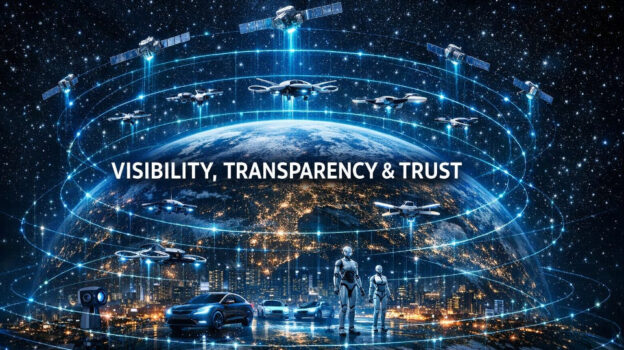
TLDR: Radical transparency is coming. A future where you can know anything, anytime, anywhere. A future where no one can hide. We are wrapping the planet in an “Sensor Ecosystem”: a living, multi-layered sensing system that runs from the cameras in your home, to the phone in your pocket, to autonomous cars and humanoid robots on the ground, to drones and flying cars in the air, all the way up to a constellation of satellites imaging every square meter on the Earth every single day. By 2030, there will be roughly 40 billion connected devices, each packing multiple sensors, generating a flood of data that AI can finally read. In Part 1 of this newsletter I’ll show you the scale of what’s being deployed, layer by layer. In Part 2, I’ll share what it means, because when everything becomes visible, it gets very hard for anyone to hide, and that changes how humans behave.
PART-1: THE TRILLION-SENSOR ECOSYSTEM
Earlier this week, I hosted a conversation with Will Marshall, CEO of Planet, on my Moonshots podcast. Planet operates the largest fleet of Earth-observing satellites in human history and Will walked me through what’s coming. We are constructing a planet-scale sensing organism, and most people have no idea how big it’s already gotten.
OUR ELECTRIC SKIN, LAYER BY LAYER
Layer 1 – Space: Planetary Intelligence from Orbit
There are roughly 13,800 active satellites in low Earth orbit today. Analysts at consulting firm Analysys Mason predict that this number will climb to somewhere between 27,000 and 100,000 by 2030. SpaceX’s Starlink alone has about 10,400 operational satellites today, on the way to a licensed 42,000.
But the satellites that matter most for transparency are the ones that image us. Planet runs about 200 of them, collecting 25 terabytes of imagery a day and a 150-petabyte archive, roughly 3,000 images of every point on Earth’s land surface over the past decade.
And it’s getting sharper. Planet’s next-generation Pelican satellites, launching in late 2026, will hit 30-centimeter resolution with a 32-satellite constellation revisiting any point on Earth up to 10 times a day, delivering imagery in 30 minutes.
Layer 2 – The Air: Drones and Flying Cars
Drop down from orbit into the atmosphere and you hit the aerial layer. The FAA already has more than a million drones registered in the United States. Globally, the commercial drone market is headed past $50 billion by 2030, with Asia-Pacific alone projected to field around 9 million commercial units.
Delivery is where it gets wild. The number of package-delivery drones (each with a suite of cameras and sensors) is forecast to jump from about 32,000 in 2024 to over 275,000 by 2030 (MarketsandMarkets). Inspection and survey drones routinely resolve the ground at 1 to 3 centimeters, sharper than any satellite. And above them, the eVTOL “flying car” layer is arriving: Aviation Week projects roughly 2,000 eVTOLs delivered by 2030, scaling into a market Morgan Stanley once pegged at over $1 trillion by 2040. Every one of these aircraft carries lidar, radar, and electro-optical cameras to navigate. They don’t just fly, they see.
Layer 3 – The Road: Autonomous Vehicles
Now we’re at street level. Waymo runs about 3,000 robotaxis today, delivering 500,000 paid rides a week. Goldman Sachs projects roughly 35,000 robotaxis on US roads by 2030, with global autonomous vehicle counts running into the tens of millions.
Here’s what stops me cold. A single Waymo vehicle carries 13 cameras, 4 lidar units, and 6 radar, with 17-megapixel imagers that out-resolve almost anything in consumer hardware. One autonomous car generates on the order of 4 terabytes of data per hour of driving. Recent engineering analysis puts the lidar stream alone at up to 8 petabytes per year, per vehicle. Multiply that by tens of thousands of cars, each mapping every street, every pedestrian, every pothole, in real time. We are accidentally building the most detailed, continuously updated map of the physical world that has ever existed. And down on the sidewalk, ground-delivery robots (e.g., Starship already runs about 2,700, heading toward 12,000) are filling in the gaps the cars miss.
Layer 4 – The Walking Layer: Humanoid Robots
This is the newest layer, and it may become the densest. Humanoid robots are about to walk through our factories, our streets and our homes. And every one of them is a mobile sensor platform with eyes.
I’m going to use the builders’ own numbers here, not an analyst’s. Elon has said he’s confident Tesla can reach 1 million Optimus units per year by around 2030. Figure has built BotQ, a factory designed to produce up to 12,000 humanoids a year on its first-generation line, roughly one robot per hour. Both Elon and Brett Adcock’s long-term vision predict >10 billion humanoids globally.
Each of these machines is vision-first: multiple onboard cameras, inertial sensors, force and torque sensors in every joint, tactile sensors in the hands, all capturing continuously. A humanoid working an 8-hour shift is plausibly generating data on the scale of an autonomous car. Now picture millions of them, then tens of millions, walking through the world and recording it.
Layer 5 – The Pocket: 7 Billion Smartphones
The layer you’re holding right now. There are about 7 billion smartphone subscriptions on Earth, and the average phone carries somewhere between 14 and 20 sensors: multiple cameras, GPS, accelerometer, gyroscope, magnetometer, barometer, microphones, proximity and light sensors. This is, by a wide margin, the largest sensor network humanity has ever deployed, and we did it by accident, one upgrade at a time. Every person becomes a roving, multi-spectral data node.
Layer 6 – The Ground: Home Cameras & Industrial IoT
Finally, the ambient layer woven through our buildings, streets, and homes. There are already over 1 billion surveillance cameras in use worldwide. Add the Ring doorbells, the Nest cams, the Arlo and Wyze units multiplying on every porch. Then add the industrial layer: the sensors on pipelines, factory floors, shipping containers, and power grids.
Tie it all together and you get the number that frames everything: total connected IoT devices stand at about 21 billion today and are projected to reach roughly 40 billion by 2030, each one carrying multiple sensors. That’s where the “trillion sensor” world stops being a metaphor.
 |
Sources: Planet Labs; FAA; MarketsandMarkets; Goldman Sachs; Waymo; Tesla; Figure AI; Ericsson; IoT Analytics; Video Experts Group (2024–2026)
THE EXPONENTIAL, IN ONE NUMBER
Stack the layers and the trajectory is unmistakable. As of 2025 we had about 21 billion. By 2030, around 40 billion. By 2040, as humanoids, autonomous fleets, and orbital constellations compound on top of everything else, we move from billions of devices into the realm of trillions of individual sensors, each one streaming a slice of reality into AI systems that can finally make sense of all of it.
 |
Source: IoT Analytics (2025); The Future Is Faster Than You Think (Stanford/Accenture)
That’s the engine. Now here’s why it changes everything about human behavior.
PART-2: WHAT HAPPENS WHEN NO ONE CAN HIDE
During my conversation with Will Marshall, he began to layout the consequences: “No one can hide anymore,” he said. “If you build a school, we’re going to see the school. If you build a data center, we’re going to see the data center. And the accountability is going to be there for the whole world to see, no matter what.”
And the human behavioral consequences are profound. When people know they’re being watched, they behave different, they behave better. And we now have hard data proving it.
WHEN PEOPLE KNOW THEY’RE WATCHED
The cleanest evidence comes from one of the best natural experiments in social science: police body cameras.
In 2012, the police department in Rialto, California ran a randomized controlled trial with Cambridge criminologists. Over the course of a year, officer shifts were randomly assigned “camera on” or “camera off,” collecting more than 50,000 hours of police-public interactions. The result was use-of-force incidents dropped 60%, and citizen complaints against officers fell 88%, from dozens the prior year down to a grand total of three.
 |
Source: Rialto, CA randomized controlled trial — Ariel, Farrar & Sutherland, Cambridge (2015)
Researchers call it the “civilizing effect.” When both the officer and the citizen know the encounter is on the record, both sides regulate themselves. Nobody wants to be the person on the tape. Cambridge has since replicated the work across ten more forces, and the core finding largely holds.
“When both sides know they’re on the record, both sides behave better. Sunlight is becoming infrastructure.”
And it’s not just cops. The definitive 40-year meta-analysis of closed-circuit television, led by Eric Piza with Brandon Welsh and David Farrington, found CCTV associated with about a 13% reduction in crime overall, and a much steeper drop, over a third, in settings like car parks.
 |
Source: Piza, Welsh, Farrington & Thomas — 40-year meta-analysis, Criminology & Public Policy (2019)
The pattern runs all the way up to governments. A 2023 review of 114 studies in Public Administration and Development found that transparency and disclosure measurably reduce corruption, especially when citizens can act on what they learn. Alina Mungiu-Pippidi has shown that in countries with weak rule of law, financial disclosure and freedom-of-information access work as a substitute for honest institutions. Citizens become the enforcement mechanism when the courts won’t be.
TRANSPARENCY AS A DETERRENT TO WAR
Will Marshall next argued that transparency doesn’t only civilize individuals. It actually can prevent wars. “Throughout history,” he said, “wars happened mainly when there’s been misinformation, a lack of information, and people had to guess or made mistakes. Transparency drives accountability and reduces the probability of war.”
He gave a concrete example. In the run-up to the invasion of Ukraine, Vladimir Putin massed troops on the border believing the buildup would go unnoticed. Planet’s imagery put it on the front page of every newspaper on Earth. “Putin thought he could get away with it,” Will said. “We put that to bed.”
It didn’t stop the invasion. But it changed the information environment around it. For most of human history, the fog of war was literal: leaders started wars because they couldn’t see what the other side was doing, and they guessed wrong. We’re now building a world where everyone can see the troops massing and the treaties breaking, in near real time. You can monitor a peace accord from orbit. You can’t claim the bridge is standing when 200 satellites photographed it fall.
Governments own the map.
But Planet owns the sky above the map.
THE OTHER EDGE OF THE BLADE
I’d be doing you a disservice if I sold you only the utopian version. An electric skin that registers everything is also an electric skin that registers you and can dissolve privacy.
The hard truth is that transparency is a tool, and tools don’t have ethics. A surveillance state and an accountable democracy can run on the identical sensor network. What separates them is who can see, who is seen, and whether the watching runs in both directions. The world I worry about isn’t the one where everyone is visible. It’s the one where the powerful can see everyone, while no one can see them. Transparency only builds trust when it points both ways.
WHAT THIS MEANS FOR YOU
If you’re an entrepreneur: Assume your operations, supply chain, and claims are about to become independently verifiable by anyone with an API key. Build the company you’d be proud to have photographed from orbit or an overhead drone. The brands that win the transparency era are the ones that were already telling the truth.
If you’re an executive: Radical transparency is a moat, not a threat… if you move first. Open your data, your sourcing, your numbers, before a satellite or a sensor does it for you. Disclosure you volunteer builds more trust than disclosure that’s extracted from you.
If you’re an investor: A new asset class is forming around verifiable ground truth: counting cars in lots, ships in ports, construction in progress. Alpha is shifting to whoever can see the physical world in real time. Planet (PL) is one way to play it, and there will be many more.
If you’re a student: The most valuable skill of the next decade is turning oceans of sensor data into honest answers. Learn to work where AI meets the physical world. For the first time, the library is being connected to the window.
If you’re a parent: Your kids will grow up in a world with no “off the record.” Teach them that the best privacy strategy is integrity, living so that being seen costs you nothing. And fight, hard, for a world where the watching goes both ways.
Will Marshall is building the crystal ball. The sensors are going up by the billions, and they are not coming down. So here’s the question I’ll leave you with, the one I’ve been chewing on since we turned the mics off: in a world where no one can hide, do we become our better selves because we choose to, or only because we’re being watched?
To a future of Abundance,