




CIA Director Ratcliffe, Energy Secretary Wright, and UK CTO Patel joined the AWS Summit D.C. keynote for major classified cloud and AI announcements.
- AWS Secret Cloud for Industry gives defense contractors classified cloud access for contractor-owned workloads the first time.
- A $1 billion framework gives intelligence agencies credits to accelerate their move to AWS cloud.
- A $1 billion investment puts thousands of AWS AI engineers on-site with customers to build in days.
- AWS partners with the UK’s Fleming Initiative to combat antimicrobial resistance.
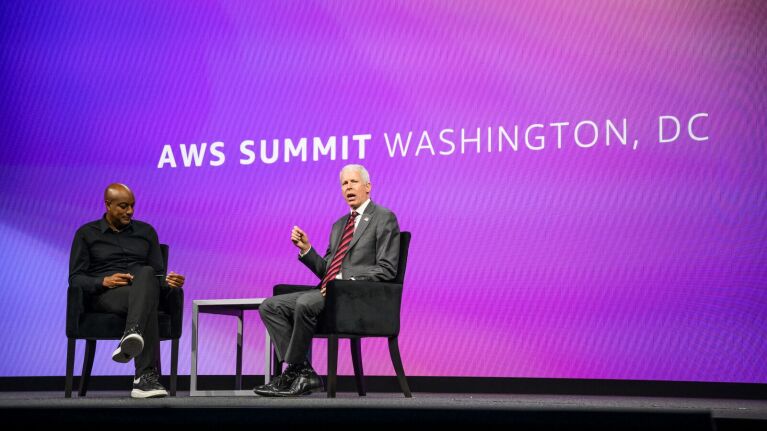 U.S. Secretary of Energy Chris Wright (right) speaks with Dave Levy, Vice President of Worldwide Public Sector at AWS, during a keynote at AWS Summit in Washington, D.C.
Historically, cleared defense contractors have been required to build and maintain separate on-premises infrastructure to support classified programs. These systems are costly to deploy, rigid to operate, and can’t support the latest cloud capabilities like generative AI.
AWS Secret Cloud for Industry (ASCI) changes that. For the first time, defense contractors can run contractor-owned classified workloads on the same AWS infrastructure trusted by the Department of War, in their own physically and logically isolated environment purpose-built to meet the most demanding security and compliance requirements.
Organizations can move to the cloud without adopting a new security model; AWS handles authorization and private connectivity from their existing secure facilities. Northrop Grumman is the first partner to deploy, and AWS is investing up to $20 million in credits over three years to help customers in the defense sector take advantage of all the benefits of the cloud.
This matters because the missions our defense partners support don’t stop at the network boundary. When an engineer needs to run AI inference on classified data or train models on sensitive operational information, they need infrastructure built for classified workloads and the secure-by-design standard that AWS provides to accomplish their mission.
The U.S. Intelligence Community (IC) made AWS its longest-standing cloud partner because of our unmatched scalability, security, and ability to handle classified data across multiple security levels. But many workloads have yet to migrate, so we’re launching the IC Accelerated Modernization Framework (ICAMF), a $1 billion program designed to eliminate the migration costs that have kept some locked in on-premises systems.
The program is simple: migrate qualified workloads to AWS, receive credits. Up to $1 billion is available through October 2030 for all IC agencies on the existing AWS contract.
The ICAMF will help agencies overcome upfront hardware costs, ongoing power and facility expenses, and rigid vendor lock-in by tying credits directly to successful migrations. The more workloads agencies move, the more they save. That frees budget for what matters most: deploying AI tools that help analysts work faster, surface hidden insights, and stay ahead of evolving threats. Together with the $50 billion infrastructure expansion we announced last fall, ICAMF reinforces our commitment to delivering the infrastructure, reliability, and economics needed to modernize at scale.
Learn more: IC Accelerated Modernization Framework
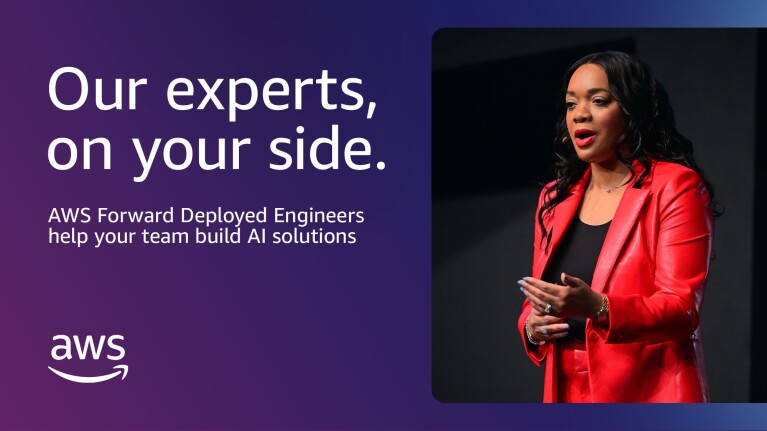
AWS Forward Deployed Engineering (FDE) is a new global organization that will embed thousands of expert engineers with customers to co-develop and deploy AI solutions.
Backed by a $1 billion investment, the team partners with customers’ business, engineering, and security teams to create production AI systems that operate on top of an organization’s data, governance, and processes. Companies worldwide, including the Allen Institute, Cox Automotive, the NBA, Ricoh, Southwest Airlines, and the NFL are already working with AWS FDE.
AWS FDE uses purpose-built agents to compress the development and launch of AI applications from months into days, with each deployment making the next one faster. At the center is the AI-Driven Development Lifecycle, a new approach to software development that combines AI-powered execution with human oversight and dynamic team collaboration that builds intelligence for a customer’s next project.
Companies leave AWS FDE engagements with powerful new solutions, as well as new AI engineering capabilities. Every engagement is designed to leave organizations self-sufficient and delivering on their own. Along with new agentic systems running in their own AWS environment, customers gain lasting AI skills, workflows, and knowledge graphs to keep innovating independently. It is fundamentally different from traditional consulting, focused on shared goals and business results, not billable hours.
For government organizations and commercial customers alike, this makes realizing value from AI faster and more affordable.
Secretary of Energy Chris Wright joined me on stage for a fireside chat to share the latest on the Genesis Mission—a Department of Energy initiative uniting National Labs, industry, and academia to harness AI for breakthroughs in energy, science, and national security. Through the Genesis Mission, AWS is collaborating with Idaho National Laboratory (INL) in using AI to develop a digital twin of a small modular reactor, ultimately enabling what INL calls “nuclear energy AI at scale.” AWS technology is being used to compress nuclear reactor design cycles, generate digital twins for advanced simulation, and advance autonomous reactor operations that will define America’s energy future.
AWS has proudly supported American science at the Department of Energy for more than ten years. That partnership has only deepened. When DOE launched the Genesis Mission, AWS stood side-by-side with the Department from day one—because we believe this is the most important scientific initiative of our generation. We’re now providing real-time access to Amazon silicon and frontier AI models, putting the most advanced tools available into the hands of our nation’s top engineers, scientists, and researchers across the National Laboratories. Today, the National Nuclear Security Administration (NNSA) announced a significant milestone in its digital modernization efforts with the establishment of a Secret/Restricted Data (S/RD) Enterprise Cloud environment in collaboration with AWS. This marks the first cloud environment to receive enterprise authorization to process S/RD, which will house the NNSA’s inaugural Genesis Mission workloads. That’s a commitment to security and trust that we take very seriously, and it’s foundational to everything we do together.
United Kingdom (UK) Chief Technology Officer Sonia Patel joined our keynote to share how the UK is using AWS to deploy AI at national scale, across hundreds of government departments and 67 million citizens. Her message was clear: the UK chose AWS for the security, reliability, and flexibility that lets every department move faster without compromising citizen trust.
Patel shared how this is already delivering results. HMRC, the UK’s tax authority serving 50 million taxpayers, is investing over £450 million to migrate three legacy data centers to AWS, using AI and data to help close a £47 billion tax gap while improving the taxpayer experience.
The UK’s approach demonstrates that government AI doesn’t have to mean years of planning and pilot programs. With the right infrastructure and the right economic model, it means AI is improving citizen services today.
Every year, more bacteria, viruses, fungi, and parasites are evolving to resist the drugs designed to stop them—a phenomenon called antimicrobial resistance (AMR). The result: common infections become harder to treat, and deaths associated with AMR are predicted to reach 39 million between 2025 and 2050. Fighting back requires global coordination, but fragmented surveillance, siloed research, and a lack of integrated data are making it nearly impossible to detect resistance patterns quickly enough.
The Fleming Initiative, a partnership between Imperial College London and Imperial College Healthcare NHS Trust, selected AWS to power its new AMR intelligence platform. Fighting AMR requires connecting fragmented data across borders without compromising patient privacy, and AWS is the only cloud provider with the global infrastructure, security, and purpose-built AI tools to do that at scale. We’re committing millions in cloud and AI technology and hands-on technical support to help researchers, clinicians, and public health stakeholders coordinate the global response to AMR.
Learn more: Fleming Initiative selects AWS to power global intelligence platform to tackle antimicrobial resistance
AWS Summit Washington, D.C. takes place June 29–July 1, 2026, at the Walter E. Washington Convention Center. It is a three-day, no-cost event tailored to the public sector community.
Trending news and stories
- Amazon announces it will invest $48 billion in India by 2030
- Amazon continues to help employees and delivery drivers stay safe this summer
- The farthest livestream in history: How AWS helped NASA stream 4K from the Moon
- Amazon invests in one of the world’s largest carbon removal projects, creating 11,000 jobs and restoring nature