



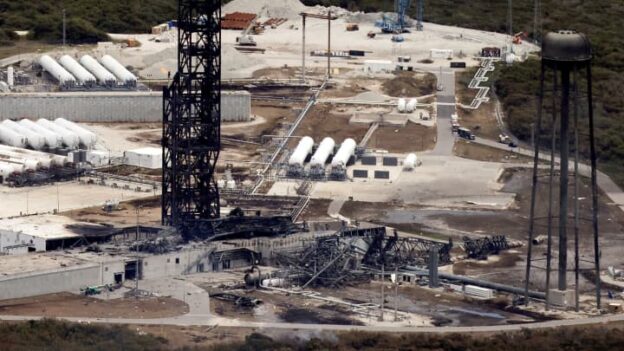
- Blue Origin CEO Dave Limp said the startup is determined to return to flight “by the end of this year” after one of its New Glenn rockets exploded on the launchpad in May.
- The rocket company won’t be “rebuilding the same pad,” but is using the same site and will use another configuration that was already in development.
- Limp said Blue Origin continues to “actively investigate” the cause of the hot-fire mishap.
Blue Origin CEO Dave Limp said the company is “not rebuilding the same pad” where one of its New Glenn rockets recently exploded, in order to make way for a return to flight this year.
The company, started by Amazon founder Jeff Bezos, was conducting a hot-fire test of its massive New Glenn rocket at its Florida launch site May 28 when the aircraft erupted into a fireball. New Glenn is a key part of Blue Origin’s effort to compete with Elon Musk‘s SpaceX, which has established a significant lead with its reusable rockets and launch services.
In a note posted to Blue Origin’s website, Limp said the company intends to adopt a “horizontal/vertical hybrid” launch configuration, using existing infrastructure that was already in development for its larger, more powerful New Glenn variant, called the “9×4.”
“We take our responsibility as a launch provider very seriously, and we are committed to returning to flight with the reliability our mission demands,” Limp wrote.
Limp wrote in a post on X that the new pad configuration “has the added benefit of increasing our flight cadence as well.”
Blue Origin’s New Glenn mishap was inconveniently timed. Blue Origin is a critical partner for NASA’s Artemis program, which aims to return humans to the moon. The agency tapped Blue Origin to launch an uncrewed Blue Moon lander atop New Glenn later this year.
NASA Administrator Jared Isaacman said Tuesday that Blue Origin has made “great progress” on recovery, adding that it remains “plan A” for the agency to use New Glenn for the cargo lander launch.
“They are very committed to getting back in the business of launching New Glenn before the end of the year,” Isaacman said during a briefing on NASA moon base plans. “We’ve got time beyond that point into 2027 before we’re getting nervous.”
Isaacman said the agency “does not sit on our hands and wait for hardware to show up,” so it has explored “plan Bs” should it need another provider to step in.
“Plan A was always New Glenn and plan A is looking a lot better today than it was a few weeks ago, just based on the progress that the Blue Origin team is making,” he said.
Companies including Amazon and AST SpaceMobile are also reliant upon Blue Origin for rocket launch capacity to deliver their internet satellites into orbit. The May explosion occurred just days before Blue Origin was set to launch a slate of Amazon Leo satellites.
Low-Earth orbit satellite internet services have seen a surge of development in recent years, but that growth has been constrained by a shortage of rocket launch supply. Blue Origin had emerged as a potential heavy-lift rocket alternative to SpaceX, with the New Glenn capable of ferrying bigger payloads.
Limp said Blue Origin continues to “actively investigate” the cause of the May launch anomaly. Early results suggest the “aft section of the first stage” of the rocket may be to blame, he added.
Reconstruction of the damaged launchpad is underway, and the company has determined that it lost the lightning tower, the transporter-erector and the hydraulic cylinders.
“But we caught a lot of breaks, too, and intend to make the most of them,” Limp said.
https://www.cnbc.com/amp/2026/06/30/blue-origin-explosion-launchpad.html