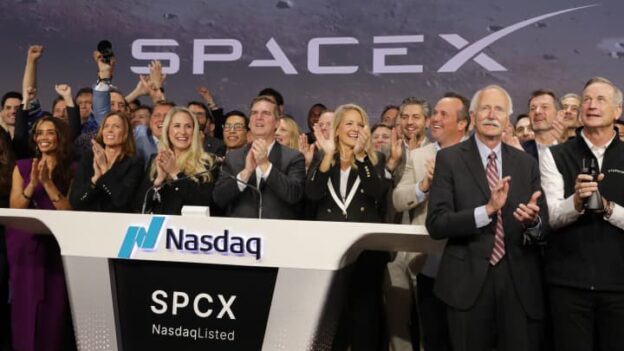



I’ll be on CNBC this afternoon (4Aug), commenting on the expected SpaceX earnings report, their first as a public company following the IPO. As you might expect, I’m very bullish about SpaceX, and I thought I’d lay out the reasons in some detail. Here’s my core thesis. The Street doesn’t fully understand how to value SPCX, because it keeps trying to price one company. It’s actually five, stacked on top of each other and wired together by Elon’s particular genius for compressing time. Look at each one on its own and the picture changes completely. 1. THE FIRST TRULY GLOBAL COMMUNICATIONS COMPANYStrip away the rockets and SpaceX is already one of the fastest-scaling telecom utilities on Earth. Starlink connects 8 billion people to gigabit internet from orbit, a backup and a replacement for terrestrial comms in the same box. And direct-to-device (satellite straight to your cell phone) turns every smartphone on the planet into an always-on, always-available terminal, no dish required.
2. A HYPERSCALER SELLING THE WORLD’S SCARCEST RESOURCESpaceX’s second business is compute, and the world is starved for it. This is the part the market is sleeping on. Google, Anthropic, and Reflection AI are already buying, and the contracts are signed:
That’s roughly $28 billion of annualized, contracted compute revenue in 2026. Not a projection. Signed backlog. Here’s what most people miss: nobody moves faster than Elon, and it isn’t close. xAI stood up a 100,000-GPU H100 cluster in 122 days, roughly 5x faster than a conventional hyperscale deployment. Then it doubled Colossus to 200,000 GPUs in another 92 days, reaching a full gigawatt in about 13 months. Meta’s new 1-gigawatt Indiana campus will take 22 to 24 months. Most remarkable of all: the gap from installing the first servers to starting AI training was about 19 days. Comparable clusters often take many months. Then comes the orbital layer. Around 2028, Elon plans to begin launching Starmind, dedicated solar-powered AI-compute satellites, scaling toward up to a million satellites and roughly a terawatt of compute in orbit by 2030. The most-cited Wall Street number is ~$322 billion in 2030 AI revenue for SpaceX, and worth knowing on air, that figure blends terrestrial and orbital compute. The Starmind-specific piece hasn’t been broken out. So the $28 billion you can see today is the floor, not the ceiling. 3. TERAFAB: A CHIP MANUFACTURER AT A SCALE NOBODY ELSE IS ATTEMPTINGThird, SpaceX is becoming a chip company. Elon’s plan for the Terafab (his gigafab in Texas) targets over 1 terawatt of AI compute capacity a year, on the order of 50x more than the entire world produces today. Instead of standing in TSMC’s line behind every other buyer, SpaceX stamps out its own GPUs and then launches them into orbit. Own the chip, own the data center, own the rocket that carries it. 4. THE LAUNCH PROVIDER THAT REWROTE THE PHYSICS OF COSTFourth, the original business, and still the moat. Watch what has happened to the cost of a kilogram to orbit. The Space Shuttle flew at about $54,000/kg. Falcon 9 dropped it to ~$2,500/kg, a 20x improvement. Starship is designed to take it below $100/kg, another 25x. When you drop the cost of access to space by more than 500x in a generation, you don’t get a better rocket. You get a new economy, and SpaceX owns the on-ramp. 5. THE VERTICAL STACK IS THE WHOLE POINTWhich brings me to the fifth company, the one that isn’t a segment at all. It’s the integration.
Every competitor rents one piece of that stack from someone else. That vertical integration is why the multiple looks crazy, and why it might be justified. The rocket launches the satellites. The satellites carry the compute. The fab builds the chips the compute runs on. The connectivity business funds all of it. No one else has even one full column of that stack, let alone all of it under a single roof moving at Elon’s clock speed. ABOUT THOSE LOSSESYes, SpaceX is losing billions, and I know that’s where the skeptics start. Think about those losses as the investment needed to build a $10 trillion business. Amazon did exactly the same thing, bleeding money for 6 years while it quietly built the future. (Just as an FYI, today Amazon is valued at over 7,000 times its original IPO pricing.) The question isn’t SpaceX’s current profitability. It’s who else is even in this race. Nobody is. And the best predictor of Elon’s future success is his past. People said Tesla was impossible too. Never, ever bet against Elon. I’ve watched people do it for 20 years, and every single time, they’ve been wrong. THE THREE QUESTIONS I EXPECT ON AIR WITH CNBC“It’s losing billions, how is it worth $1.4 trillion?” Fair. But Starlink alone is already profitable and growing 30%+. The company is choosing to reinvest every dollar into Starship and AI. That’s a choice, not a constraint. “Average revenue per user (ARPU) is collapsing from $99 to $66.” Real, but deliberate. They’re trading price for scale in emerging markets, then raising prices on the installed base, they just hiked plans up to $10/mo in May. Land-grab first, monetize second. “The stock cratered from $225 to $108.” Short-term noise. The people who built this company aren’t cashing out of the future. Musk and the major holders are locked up until June 2027. What you’re seeing is early employees taking a few chips off the table, which is healthy. So step back from tonight’s quarter. The market is paying, right now, for maybe one and a half of these five businesses. It’s getting the other three and a half as free call options. That’s the setup I find genuinely thrilling: not one company having a good or bad quarter, but five exponential businesses compounding on a shared launch backbone, each aimed at a trillion-dollar market, run by the one person who has proven he can bend timelines the rest of us treat as fixed. That’s how a company becomes the first to $10 trillion. Watch tonight, but don’t lose the forest for one quarter’s trees. To a future of abundance, |