



- Your regular round-up of news and analysis on the global economy from the World Economic Forum’s Centre for the New Economy and Society.
- Top stories: How robust is global growth, why the AI boom masks growing concentration risks and what could test global resilience next.
Ongoing conflicts, high borrowing costs, and persistent geoeconomic and energy shocks continue to buffet the global economy. So far, it has held up better than expected.
Global business activity reached a 27-month high in August, with the global composite PMI rising for a fifth consecutive month. Headline GDP growth also remained remarkably firm in the second quarter: the US expanded at a 1.5% annualized rate, both the euro area and the UK grew 0.4% quarter-on-quarter, while several emerging economies, including India and Indonesia, continued to surprise on the upside. The IMF estimates that global growth has now firmed at around 3% for 2026, before picking up to 3.4% in 2027.
Global trade and investment flows are also proving more durable than expected. Global FDI was 42% higher year-on-year in the first quarter, with strong AI-related electronics trade helping offset the initial drag from the Middle East conflict.
What’s really driving global growth?
Look beneath those aggregate numbers, however, and growth rests on a surprisingly narrow base.
The IMF’s reading of the picture reveals that much of the recent upside has been concentrated in economies closely integrated into AI and technology value chains: the four largest exporters of AI hardware grew an average 4.4 percentage points faster than projected in the first quarter, compared to a slight shortfall elsewhere.
This makes for an increasingly uneven global outlook, with energy exporters and technology-linked economies enjoying stronger momentum, while others face weaker growth and greater exposure to geoeconomic, policy and technological uncertainty.
Growth is also becoming more concentrated across sectors. Rising AI and defence spending are providing a strong boost to parts of the economy, with high-tech and AI-related activity generating nearly half of US private sector GDP growth over the past year, according to S&P Global. Surging demand for AI hardware has also accounted for more than 70% of Asia’s export growth as of July 2026.
Investment has been clustering in many of the same areas: strategic sectors – including semiconductors, AI infrastructure, data centres and critical minerals – captured 44% of the announced global greenfield investment in 2025, up from 16% in 2020, while project values declined across most other sectors.
Buoyant asset prices have provided an additional cushion against shocks, supporting financial conditions and bolstering spending among affluent households.
Outside these pockets of strength, however, resilience may look more patchy. Export strength in China continues to contrast with anaemic consumption and falling fixed-asset investment. Across emerging markets more broadly, business confidence reached near-record low in July. Emerging markets services growth, in particular, slowed to its weakest since December 2022 as higher energy, food and living costs continued to squeeze consumers.
What could test global resilience next?
AI valuations and balance-sheet pressure: Financial markets wiped over $1 trillion from chip stocks in late July over valuation doubts. Beneath those market jitters, financing strains are also building: six largest hyperscalers are projected to post negative free operating cash flow in 2026-2027 as AI capital expenditure heads to reach $1.3 trillion by 2027. Meanwhile, off-balance-sheet commitments across major hyperscalers and chipmakers have already reached $3.1 trillion, with increasingly circular financing raising the risk of broader spillovers in case of market correction.
A decoupling labour market: Technology-intensive growth may be weakening the traditional link between output growth and job creation. Labour’s share of US output fell to 52.8% in the second quarter, its lowest level since 1947. Across OECD countries, employment remained high, but jobs growth has flattened and real-wage gains have slowed. Looking ahead, AI may open new productivity opportunities, particularly in developing economies, while making growth less job-intensive where uptake is fastest.
Compounding real-economy shocks: Global foods prices rose in August to their highest since late 2022, with geopolitical conflicts and climate extremes directly straining vital commodities. The continued closure of the Strait of Hormuz threatens pushing global oil demand to a 1.6 million bpd drop in 2026, alongside a 410-million-barrel global stock draw and nearly 10% drop in Middle East merchandise trade volumes in Q1. Climate risk could compound price shocks too. With the UN warning that a “supersized” El Niño this year could become the strongest on record, its economist toll could reach $1 trillion in its first year and at least $7.2 trillion over six years.
Tightening fiscal space: Governments are actively stepping in to secure defence supply chains, technological competitiveness and critical inputs. Washington announced $3 billion in new critical mineral and battery investments in August, while the European Commission proposed five new joint defence projects in July under its Readiness 2030 plan. However, financing the fiscal bill is growing far costlier: US 30-year Treasury yields rose above 5.3% on 18 August, with global bond sell-off in early September pushing borrowing costs to multi-year highs in Germany, France, the UK and Japan.
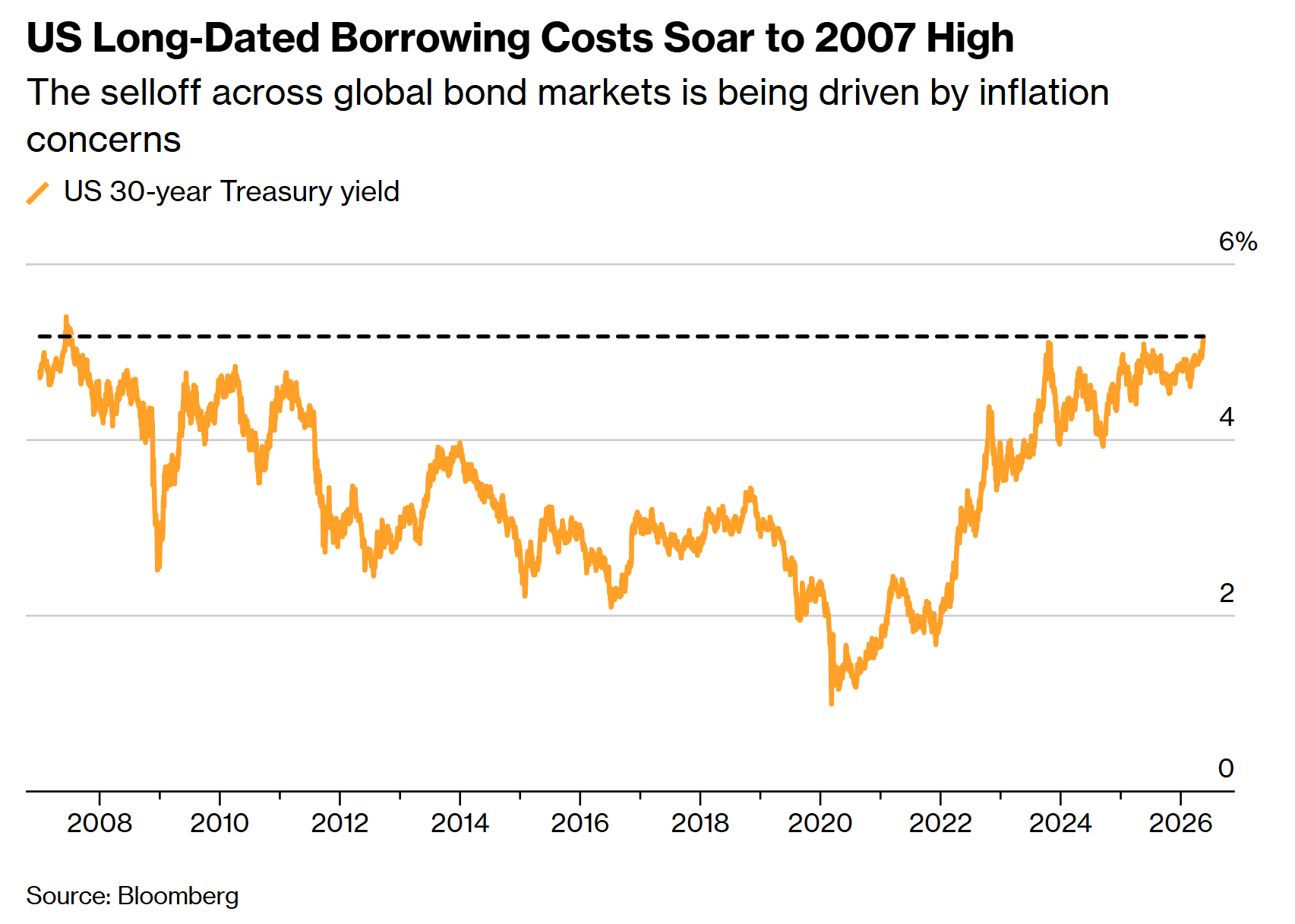
Image: Bloomberg
These new strategic demands are landing on already-constrained policy space, with rising social and climate costs narrowing fiscal headroom just as renewed inflation risks bring interest rate hikes back on the central banks’ agenda.
How the Forum helps leaders understand change in global financial systems
Other news in brief
Jackson Hole tilts hawkish. New Federal Reserve Chair Kevin Warsh used his first major address, at the 28 August symposium, to strike a notably hawkish tone, warning that inflation – running at 3.7% on the Fed’s preferred PCE gauge – remains well above target. Warsh stressed that short-term rates remain the Fed’s primary tool and that price stability “is not self-executing,” language markets read as leaving the door open to a rate rise rather than a cut.
AI’s growth shortcut for developing economies? The World Bank’s World Development Report 2026 finds AI could let developing countries achieve in a decade what once took a century – if governments close gaps in power, connectivity, skills and institutions. Jobs there are far less exposed to automation than in rich countries (4.5% versus 14.2%), while productivity gains are comparable, favouring workers over replacement. But frontier AI remains concentrated in few hands, risking wider inequality without urgent investment.
US launches “economic D-Day” on Iran: Treasury Secretary Scott Bessent unveiled sweeping new sanctions on 24 August, targeting Iran’s aviation, digital assets, gold, technology and shipping sectors, alongside 60 individuals, entities and vessels, as the US war with Iran nears six months.
Canada braces for prolonged trade war. Canada’s retaliatory tariffs on roughly C$28 billion of US goods took effect on 8 September, hitting steel, furniture and cotton T-shirts at rates up to 50%, with no trade deal in sight since talks stalled in late August. Fresh fish and lobster were dropped from the list after seafood-sector pushback. The US already taxes Canadian cars, steel, aluminium and lumber, plus 50% tariffs on dairy, alcohol and other goods imposed in late August. Both sides say they want to negotiate, but talks haven’t resumed.
https://www.weforum.org/stories/economic-growth/global-growth-resilience-and-more-top-economic-stories/