



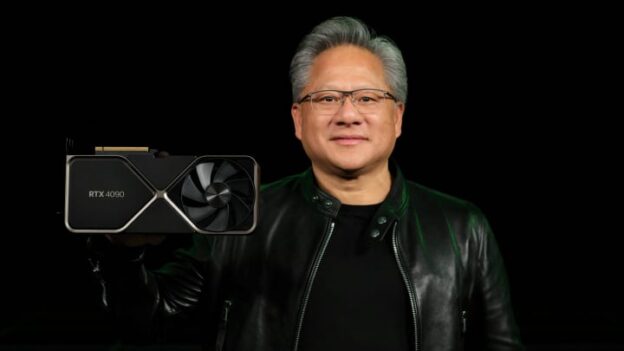
How do you turn an idea into a company that changes the world? That burning question is top of mind for most entrepreneurs who remain CEO of the companies they founded. To remain CEO throughout the journey from idea to a fast-growing company, you need what I call cognitive hunger — an unending search for new skills and knowledge to solve the new problems a leader encounters during their entrepreneurial journey.
One person who seems to have limitless cognitive hunger is Jensen Huang, In 1993, he co-founded Nvidia at a Denny’s in San Jose, California. Thirty years later, the chip design giant controlled about 85 percent of the market for graphics processing units used to train and operate AI chatbots like ChatGPT. That helped propel Nvidia’s stock up 245 percent in 2023 — so the company ended the year with a stock market capitalization of $1.2 trillion.
Odds are good you will not achieve that level of success, but there are still valuable lessons you can learn from Huang’s entrepreneurial journey. Here are four that strike me as the most universally applicable ones.
1. Don’t let setbacks get you down.
One of the most important characteristics distinguishing successful entrepreneurs from their peers is the ability to handle setbacks effectively.
Huang has faced and overcome such setbacks effectively. According to the Wall Street Journal, Nvidia survived two periods of time — in 2002 following the dot-com crash and at the beginning of the 2008 financial crisis — when Huang endured bone-crushing pressure due to a plunge in demand for its products.
Huang’s crucible of fire taught him how to manage when you are “one month away from going out of business.” During that second crisis period, Nvidia developed the GPU strategy on which the company’s current success depends.
Huang said he would not have started Nvidia if he had known how painful and embarrassing he would find those setbacks. Fortunately, for Nvidia’s customers and investors, when he was in the middle of these challenges, Huang led the company in the right direction, the Journal noted.
2. Keep innovating.
No industry is immune from changing technology, upstart competitors, and changing customer preferences. To survive and sustain growth, companies must keep innovating. Indeed the need to innovate is essential especially when a company has achieved market dominance, because that is when some leaders begin to rest on their laurels and fight harder to protect the past rather than to create a bright future.
Between 2006 and 2023, Nvidia’s accumulated capabilities enabled the company to build a difficult-to-surmount lead in the market for generative AI GPUs.
These competitive advantages include:
Creating software for programming GPUs. Beginning in 2006, Nvidia created software — dubbed CUDA — to enable developers to apply its GPUs in diverse fields such as physics and chemical simulation. In 2012, researchers used the chips to identify a cat with precision, according to Forbes.
Building faster chips every few years and expanding to complete computers. Nvidia consistently delivered faster chips every few years. In 2017, it began tailoring GPUs to handle specific AI calculations, sold chips or circuit boards for other companies, and provided complete computers aimed at faster AI processing. In September 2022, Nvidia announced the production of H100 chips to enhance transformer operations that trained ChatGPT and other generative AI chatbots, noted Forbes. In November 2023, Nvidia — facing competition from rival AMD — introduced the H200, an even faster GPU, reported Ars Technica.
These advantages gave Nvidia what Moor Insights semiconductor analyst Patrick Moorhead called a double moat — based on the fastest hardware and the best software, Forbes noted.
3. Collaborate with others to win and keep customers.
To win and keep customers, you may need skills that you lack. To get access to those skills, you must collaborate with firms that are best-in-class in capabilities you perform less effectively.
To that end, Nvidia collaborates with large technology companies such as ServiceNow and Snowflake and it funds startups. For example, in June 2023 Nvidia invested in a $1.3 billion financing for Inflection AI, which used the money to help finance the purchase of 22,000 H100 chips, according to Forbes.
While you may not possess Huang’s technical and leadership chops, these three lessons underlying Nvidia’s success can be valuable to any entrepreneur who applies them.
https://www.inc.com/peter-cohan/3-leadership-lessons-from-ceo-who-turned-an-idea-into-a-14-trillion-company.html