


Quick Read
-
Nine tech giants carry $3 trillion in off-balance-sheet AI obligations, a figure triple their reported debt and nearly double a July estimate of $1.65 trillion.
-
Deferred depreciation could exceed $520 billion over three years, pushing Oracle’s revenue share from 7% toward 28% and Meta’s from 9% toward 19%.
-
Meta hides $27 billion in Hyperion data center debt by making Blue Owl Capital the majority owner while Meta serves only as tenant.
-
It sounds nuts, but SoFi1 is giving new Active Invest users up to $3,000 in stock for a limited time, and all it takes is a $50 deposit to get started.2 See for yourself (Sponsor)
Every bull market eventually asks investors to squint past a number they’d rather not look at. In 2000, it was cash burn rates at dot-coms with no revenue. In 2008, it was mortgage-backed securities nobody could quite value. Today, it’s the financing behind the AI buildout — and specifically, how much of it never shows up on a balance sheet at all.

For most of 2026, the story was that Big Tech’s free cash flow couldn’t keep pace with AI capital expenditures. Then it became a story about off-balance-sheet arrangements. Now, thanks to new reporting, the number attached to that second story has nearly doubled.
From $1.65 Trillion to $3 Trillion in Six Weeks
In July, Nikkei estimated that Microsoft (NASDAQ:MSFT), Amazon (NASDAQ:AMZN), Alphabet (NASDAQ:GOOG), Meta Platforms (NASDAQ:META), and Oracle (NYSE:ORCL) were carrying roughly $1.65 trillion in obligations that don’t appear as debt on their balance sheets — mostly future spending tied to data centers, chips, and power. That was startling enough. But a Wall Street Journal analysis published this month found the real figure across nine companies — those five plus Nvidia (NASDAQ:NVDA), Broadcom (NASDAQ:AVGO), Advanced Micro Devices (NASDAQ:AMD), and SpaceX (NASDAQ:SPCX) — sits closer to $3 trillion, based on filings mostly current through June 2026.
SoFi Active Invest is offering a limited-time promotion. Open an account, fund it with $50 or more, and you could receive up to $3,000 in complimentary stock for Active Invest accounts. See for yourself by clicking here now.
That’s not a rounding error. It’s the difference between a concerning trend and a systemic one. The Journal’s breakdown shows roughly $1.9 trillion in purchase commitments — contracts to buy chips, servers, and hardware from suppliers — plus another $1.2 trillion in leases that have been signed but haven’t yet commenced, meaning they still sit outside reported balance-sheet liabilities. Alphabet alone disclosed $811 billion in purchase commitments and contractual obligations as of June 30, up from $322 billion just three months earlier. That’s a 152% jump in a single quarter.
Here’s the number that should give investors pause: this $3 trillion is roughly triple what these same companies currently report as outstanding leases and long-term borrowings on their actual balance sheets. And it’s growing faster than traditional capex, which totaled about $600 billion over the trailing year. In short, the shadow ledger is expanding faster than the visible one.
24/7 Wall St.
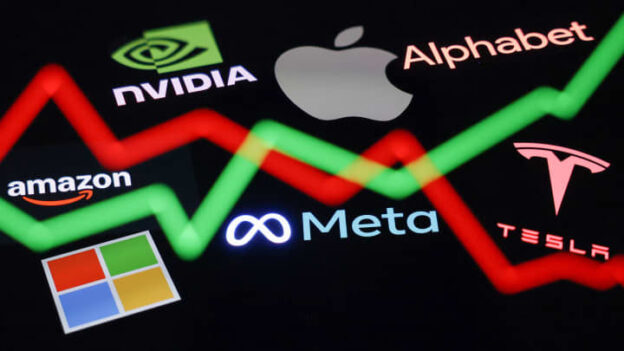
Investors are looking at the wrong numbers. Big Tech’s real debt is triple what’s on the books—a $3 trillion shadow ledger that’s ballooning in real time. © 24/7 Wall St.
Where the Debt Is Hiding
It is important to remember none of this is accounting fraud. It’s standard treatment for purchase commitments and unstarted leases, which accounting rules don’t require companies to book as liabilities until the underlying asset or service goes live. The risk isn’t legality — it’s timing and visibility.
Some of it is getting creative. Meta’s Hyperion data-center project in Louisiana carries about $27 billion in debt that never touches Meta’s balance sheet, because funds managed by Blue Owl Capital (NYSE:OBDC) own the majority of the joint venture that owns the campus. Meta is just the tenant and a minority partner.
Vendor financing works similarly — suppliers extend credit, or buy back equipment through repurchase-style arrangements, but a problem at a single counterparty can ripple across several balance sheets at once. It is called “rehypothecated leverage:” the same underlying capacity, financed and re-financed across multiple books.
|
Metric |
Figure |
|
Total off-balance-sheet commitments |
~$3 trillion |
|
Purchase commitments |
~$1.9 trillion |
|
Unstarted leases |
~$1.2 trillion |
|
Reported on-balance-sheet leases/debt |
~$1 trillion |
|
Trailing 12-month capex |
~$600 billion |
Disclosure is inconsistent, too. Nvidia quantified $30 billion of cloud-service commitments and Oracle disclosed $10 billion, while Meta declined to quantify the cloud-capacity portion of its $238 billion in commitments. That inconsistency means comparing “true” leverage across companies rests on differing materiality judgments — the aggregate numbers, large as they are, remain uncertain.
What Investors Should Actually Watch
These companies aren’t about to go bankrupt. Instead, it’s a set of timing mismatches. Depreciation on this spending is deferred — construction-in-progress balances at Oracle and Meta are up roughly 200% and 90% year-over-year, respectively — and when it finally lands, cumulative depreciation across Microsoft, Oracle, Meta, and Alphabet could exceed $520 billion over three years. That could push Oracle’s depreciation as a share of revenue from 7% toward 28%, and Meta’s from 9% toward 19%, by fiscal 2028. Margins can only hold up if revenue rises to match — and so far it hasn’t kept pace.
That question gets more complicated, not less, if demand shifts toward cheaper Chinese models delivering roughly 90% of frontier performance at a fraction of the cost. For example, Microsoft holds a stake in OpenAI worth tens of billions of dollars, and Amazon and Alphabet have each committed billions to Anthropic. Nvidia is discussing $3 billion in an Ohio data center as part of its OpenAI agreement, and launched a new $500 billion financing platform with six institutions for AI infrastructure.
A pivot toward discount alternatives doesn’t just threaten hyperscaler revenue from external customers — it undercuts the equity stakes and circular purchasing arrangements that helped justify the spending in the first place. Pull one thread, and the sweater unravels faster than a standalone-demand story alone would suggest.
Key Takeaway
Smart investors shouldn’t panic, but they should stop pricing these stocks as if capex were the whole picture. The $3 trillion figure means real leverage is roughly triple what balance sheets show, concentrated in a handful of long-duration supplier contracts, and inconsistently disclosed enough that no analyst can fully size it.
The key will be free cash flow relative to committed spending, not just reported debt — that’s where the real risk to Microsoft, Amazon, Alphabet, Meta, and Oracle shareholders is actually building.
https://finance.yahoo.com/markets/stocks/articles/alphabet-meta-microsoft-hiding-3-135343885.html