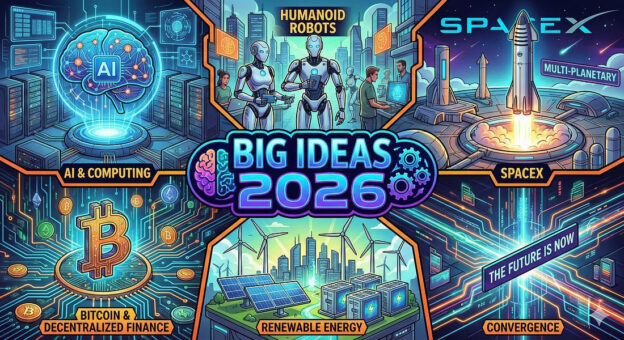



I just wrapped an incredible WTF episode with Cathie Wood, the Founder and CEO of ARK Invest, diving deep into their 2026 Big Ideas report. This is the conversation that matters. Not the hand-wringing you hear at Davos. Not the doom-scrolling pessimism of legacy media. This is what the smartest capital allocators on the planet are betting on: with real money, real models, and real conviction. If you remember Mary Meeker’s legendary Internet Trends reports that became the bible for a generation of tech investors, Cathie’s Big Ideas deck has taken over that role. But with one critical difference: while Meeker looked backward at what happened, Cathie looks five years forward with Wright’s Law projections. That takes guts. And she’s been remarkably right. Let me break down the eight biggest insights from our conversation. NOTE: Cathie has been a past Faculty Member at my Abundance Summit, where leaders like her share insights years before the mainstream catches on. In-person seats for the 2026 Summit next month are nearly sold out. Learn more and apply. 1/ The 7% Global GDP Growth SingularityHere’s the number that should keep you up at night – in a good way. ARK is projecting 7% real global GDP growth by 2030. That’s more than double the 3% we’ve been stuck at for 125 years. And Cathie thinks even that is conservative. Look at history: from 1500 to 1900, global GDP growth was roughly 0.6%. Then came railroads, telephones, electricity, and the internal combustion engine. We stepped up fivefold to 3% for the next century and a quarter. Now we have five converging platforms: robotics, energy storage, AI, blockchain, and multiomic sequencing. Each one is exponential on its own. Together? They’re creating entirely new industries at machine speed. When I asked Elon about this on a recent Moonshots episode, he was even more aggressive: 5x GDP growth in two years, triple-digit growth within the decade. The skeptics at Davos—the 80% who don’t believe—are anchoring on 125 years of linear experience. They’re not wrong about the past. They’re catastrophically wrong about the future. 2/ Data Centers Are Moving to OrbitSix months ago, nobody was talking about data centers in space. Now everybody is. Here’s why this matters: Elon’s plan to merge SpaceX and xAI isn’t about rockets or chatbots. It’s about building the computational infrastructure of the 21st century where it makes the most sense – in orbit, powered by solar panels that are six times more efficient than on Earth. The cost curve on reusable rockets is plummeting. Wright’s Law is doing what it always does: for every cumulative doubling in the number of units produced, costs decline at a consistent percentage. In the case of industrial robots, that’s 50% per doubling. But here’s what Dave pointed out that most analysts miss: the fundamental constraints aren’t rocket launches anymore. It’s access to sand (for chips), access to power, and the margin structure in the GPU value chain. TSMC takes 50%. NVIDIA takes 80%. Elon is quietly planning his own fabs to bypass all of it. When you combine collapsing launch costs with vertically integrated chip production and unlimited solar power, you get a compute advantage that’s difficult to comprehend. The convergence here is massive: rockets + AI + energy + manufacturing. This is what happens when you stop thinking in silos and start thinking in systems. 3/ The Commoditization of CognitionThis is the most important chart in the entire Big Ideas report. Inference costs have fallen 99% in the last year. Software costs dropped 91%: from $3.50 to $0.32 per million tokens. Let that sink in. The cost of intelligence is collapsing faster than any technology in human history. AI agent task reliability increased 5x during 2025, from 6 minutes of reliable autonomous operation to 31 minutes. Still not perfect… 80% success rate means you’d fire a human employee with that track record. But we’re on the steep part of the curve. Now here’s Jevons’ Paradox in action: when the price of something drops, demand for it explodes. We’re not heading toward less AI usage. We’re heading toward intelligence that’s “too cheap to meter.” The question everyone asks: Can OpenAI, Anthropic, and the frontier labs maintain revenues while prices race to zero? Cathie’s consumer analysts are already seeing cracks. OpenAI is planning $60 CPM advertising—three times Facebook’s rates—while Gemini can afford to hang back and steal share because Google’s cash flows subsidize the build-out. The race is on. And it’s just beginning. 4/ The US vs. China AI Cold WarChina has stolen the march on open source AI. And we forced them into it. Here’s what happened: American companies stopped selling software into China because of IP theft. So China built its own, and open-sourced everything. DeepSeek. Qwen. Models that are competitive with the best American closed-source labs. The DeepSeek moment was a wake-up call. Sam Altman and Jensen Huang both admitted the algorithm was clever – and that it gave American labs the opportunity to distill those insights into their own models. But there’s a deeper dynamic here: the number of researchers actually working on core algorithms inside Anthropic and OpenAI is tiny. When you move all research behind closed doors, you throttle the flow of ideas. China’s 1.4 billion people trying things in open source will innovate faster, even if some of that innovation is dangerous. Meanwhile, China is investing 40% of GDP into what Xi Jinping calls “new productive forces.” They’re building 28 large nuclear reactors simultaneously while the US isn’t building one. Their clinical trials in biotech are outpacing the West. This isn’t about fear. It’s about competition. And competition makes both sides better. The good news? Open source flows both ways. What China builds, we can use. What we build, they can use. The winner will be determined at the application layer. And Silicon Valley still dominates applications everywhere except TikTok. 5/ Bitcoin’s Next Big RunCathie’s bull case: $1.5 million per Bitcoin by 2030. Here’s the thesis: Gold has outperformed Bitcoin royally in the last year, doubling over 24 months. Historically, gold leads Bitcoin. And with intergenerational wealth transfers accelerating, the younger generation will diversify into digital gold rather than physical bars. The October 10th flash crash—caused by a Binance software glitch—wiped out $28 billion in leveraged positions. That deleveraging has largely cleared. The runway is open. But the more interesting insight is the deflation hedge. Most people understand Bitcoin as an inflation hedge: mathematically metered to top out at 21 million, rising only 0.8% per year. But what about deflation? Think 2008-2009. Catastrophic deflation. Asset prices cratering. Counterparty risk everywhere. In that scenario, Bitcoin’s value proposition is not protecting against too much money printing – it’s protecting against systemic financial collapse. No counterparty risk. No seizure. No censorship. As emerging market wealth grows and people move from hand-to-mouth survival to savings, they’ll increasingly move into Bitcoin. El Salvador was the beginning. Not the end. 6/ The Nuclear Renaissance Is HereIf we had stayed on Wright’s Law with nuclear from the 1970s to today, electricity costs in the United States would be 40% lower. Let that sink in. Forty percent. What happened? The US and Japan started over-regulating nuclear after Three Mile Island. Construction costs—which had been falling on a learning curve—suddenly inverted and started climbing. We killed the industry just as it was hitting its stride. Now the math has changed. AI data centers need baseload power. Lots of it. Cumulative investment in global power infrastructure needs to reach $10 trillion by 2030. China is building 28 large nuclear reactors simultaneously. The US is re-engaging mothballed plants and investing in small modular reactors. The depreciation schedules in the new tax law are astonishing – you can depreciate a manufacturing structure completely in its first year of service if you start before 2028. Economic activity is energy transformed. Anyone who tells you energy is bad is telling you they want to return to the dark ages. The question isn’t whether we use more energy. The question is where it comes from. Nuclear. Solar. Orbital solar. Fusion. We need all of it. 7/ Robotaxis Will Destroy the Auto Industry (As We Know It)I’m counting Waymos on my drive through Santa Monica. Ten to twelve per day right now. In five years? I expect 80% of vehicles on the road to be autonomous. Here’s the math that should terrify legacy automakers: Uber accounts for 1% of all urban miles traveled today. To accommodate that 1%, you need only 140,000 cars. To accommodate 100% of urban miles? You’d need 24 million. The US currently has 400 million cars. We sell 15 million new ones per year. The capacity utilization increase from robotaxis will obliterate personal car ownership as we know it. Tesla will win this race… and it won’t even be close. Why? Vertical integration. Waymo depends on suppliers like Zika and Hyundai. They have fewer than 3,000 cars in the entire US. When demand explodes, their supply chain becomes the bottleneck. Tesla builds the machine that builds the machine. Every component under one roof. Elon figured this out in his first master plan—maybe his second—and legacy auto still hasn’t caught up. The cost differential? Tesla will price at 20 cents per mile at scale. Uber’s average with surge pricing is $2.80 per mile. That price umbrella is going to generate explosive cash flow for autonomous operators. And here’s the convergence nobody talks about: millions of cyber-taxis are also inference engines and distributed energy storage devices moving around cities. They’re not just cars. They’re mobile data centers and grid stabilizers. 8/ Autonomous Delivery Is Already HereWe’ve been so focused on robotaxis that we’ve missed the delivery revolution happening right now. Zipline is crushing it: 4 million autonomous drone deliveries per year. They started in Rwanda, delivering medical supplies, and cut maternal mortality from internal bleeding by more than 50%. Now they’re scaling globally. On the ground, I see dozens of Coco robots in Santa Monica every day. Starlink. Maitwan. The streets are getting crowded. The ground is congested. The airways are wide open, but they’re three-dimensional. Noise will be the major issue. Whoever invents a quieter drone wins a massive market. Autonomous trucking is next. The long-haul routes are perfect for autonomy: predictable, highway-dominated, high-volume. The driver shortage isn’t a bug. It’s the market signal that automation is inevitable. What This Means for YouIf you’re an entrepreneur or investor, here’s what matters:
The TakeawayWe’re not in a normal business cycle. We’re at an inflection point that happens maybe once every 125 years. The last time technology created a step-function increase in GDP was the industrial revolution. Railroads. Electricity. Internal combustion. That took us from 0.6% to 3% growth. This time, it’s five platforms converging simultaneously. Robotics. Energy storage. AI. Blockchain. Multiomics. Each one exponential. All of them reinforcing each other. Most investors are anchored on recency bias – 125 years of 3% growth. Most policymakers are measuring with broken metrics. Most analysts are siloed into sectors that are blurring and merging in real-time. The opportunity isn’t in predicting this future. The opportunity is in building it. Cathie and the ARK team have been taking arrows for years – predicting things that seemed crazy until they happened. Bitcoin at $100,000. Tesla at $400. AI agents writing code. Their 35% annualized return target for disruptive innovation over the next five years sounds aggressive. But if even half of what we discussed comes true, it might be conservative. The question isn’t whether this future arrives. The question is whether you’re positioned for it… or watching from the sidelines. I vote for building. To an Abundant future, Peter |