



The $110 Trillion Cost of the Clean Energy Transition
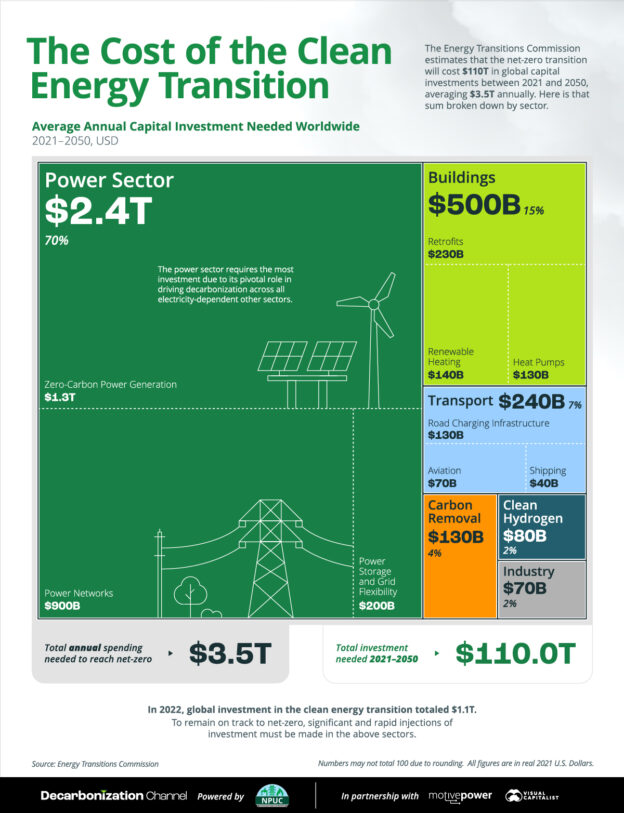
The Energy Transitions Commission estimates that achieving net-zero by 2050 requires an average annual investment of $3.5 trillion globally between 2021 and 2050.
That’s a total of $110 trillion in capital investment, or 1.3% of projected global GDP, over the next three decades.
The question then arises: where should this substantial sum of money be allocated?
In collaboration with the National Public Utilities Council, this graphic delves into the answers to that question utilizing data from the Energy Transitions Commission.
How Much Will the Clean Energy Transition Cost?
Of the $3.5 trillion dollars that needs to be invested annually into a net-zero economy, around $2.4 trillion should flow into the electricity sector, according to the Energy Transitions Commission. This accounts for 70% of the annual investment.
Decarbonizing the electricity sector holds significant importance as it can serve as a catalyst for the decarbonization of all other sectors, including:
- Buildings, which are becoming increasingly electrified through the growing use of heat pumps
- Electrified road transportation
- Electricity-intensive industrial activities, such as cement, steel, and chemical production
- Green hydrogen production
Now, let’s take a collective look at the avenues of investment needed to reach net-zero by 2050 in more detail.
| Sector | Subsector | Average Capital Investment Needed Per Year 2021-2050 | Total Sector Investment Needed Per Year 2021-2050 |
|---|---|---|---|
| The Power Sector | Zero-Carbon Power Generation | $1300B | $2400B |
| Power Networks | $900B | ||
| Power Storage and Grid Flexibility | $200B | ||
| Buildings | Retrofits | $230B | $500B |
| Heat Pumps | $130B | ||
| Renewable Heating | $140B | ||
| Transport | Road Charging Infrastructure | $130B | $240B |
| Aviation | $70B | ||
| Shipping | $40B | ||
| Carbon Removal | Natural Climate Solutions (NCS) | $100B | $130B |
| Hybrid and engineered carbon removal solutions | $30B | ||
| Clean Hydrogen | Production | $40B | $80B |
| Transport and storage | $40B | ||
| Industry | Chemicals | $40B | $70B |
| Steel | $10B | ||
| Cement | $10B | ||
| Aluminum | $10B |
All figures are in real 2021 U.S. dollars
Overall, the diversity of the table above underscores the multifaceted approach required for a low-carbon transition.
Is the World on Track to Reach Net-Zero?
In 2022, the global capital investment in the clean energy transition totaled $1.1 trillion—approximately one-third of the required annual average to reach net-zero.
With that said, it’s important to note that the $3.5 trillion figure is an average across 29 years. Opportunities to catch up still exist, although the window is closing quickly.
According to the Energy Transitions Commission, investments must double from their current levels to around $2 trillion by 2025 and peak at around $4.2 trillion by 2040.
To remain on track to net-zero, therefore, we must make significant and rapid investments in all sectors, with a primary focus on the power sector.
Learn more about how electric utilities and the power sector can lead on the path toward decarbonization here.
https://decarbonization.visualcapitalist.com/breaking-down-the-cost-of-clean-energy-transition/