




Microsoft’s Azure-based AI development and deployment platform shines with a strong selection of models and agent types and an excellent playground for experimenting with agents.

At first glance, Microsoft Foundry looks like a big grab bag of every AI-adjacent service that Microsoft has offered in the last decade, plus some new ones. In Microsoft’s own words, “Foundry consolidates several previous Azure AI services and tools into a unified platform” and “unifies agents, models, and tools under a single management grouping.”
Microsoft Foundry helps application developers to build and deploy agents, which may use models and tools. It also helps machine learning (ML) engineers and data scientists to fine-tune models, run evaluations, and manage model deployments. Finally, it helps IT administrators and platform engineers to govern AI resources, enforce policies, and manage access across teams. It isn’t quite a floor wax and a dessert topping, but it does try to serve three distinct audiences.
Key capabilities of Microsoft Foundry for building agents include multi-agent orchestration, workflows, a tool catalog, memory, knowledge integration, and publishing. Key capabilities for operation and governance include real-time observability, centralized AI asset management, and enterprise controls.
Microsoft Foundry competes directly with the Google Cloud Agent Development Kit (ADK), Amazon Bedrock AgentCore, and Databricks Agent Bricks. Additional competitors include the OpenAI Agents SDK, LangChain/LangGraph, CrewAI, and SmythOS.
Microsoft Foundry Agent Service
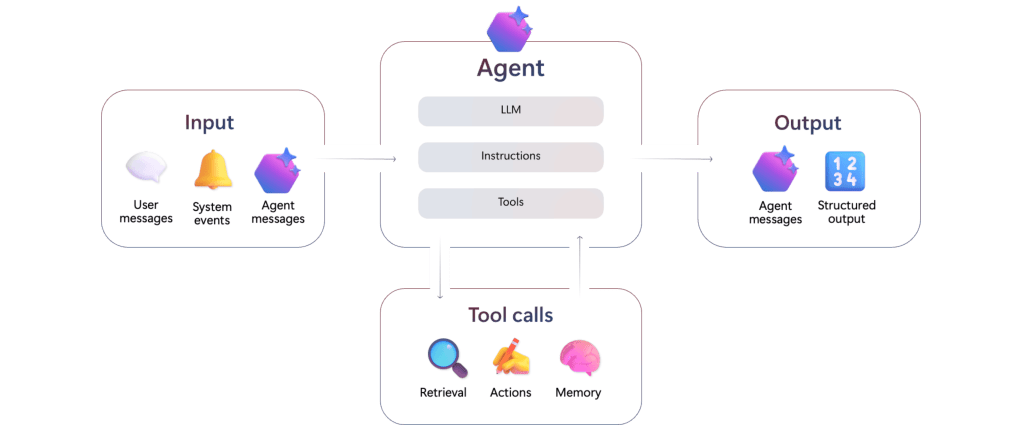
The Microsoft Foundry Agent Service is a helpful platform that guides you through the development, deployment, and scaling of AI agents. These agents use large language models (LLMs) to handle tricky requests, connect with other tools, and do tasks on their own.
The service groups agents into three main types: prompt agents, which are easy to set up and great for quickly trying out ideas; workflow agents, which are visual or YAML-based tools that make automating several steps easier; and hosted agents, which are containers that let you manage your own code as well as frameworks like LangGraph.
Microsoft Foundry also has a model catalog with both new and well-known models, and a tool catalog that includes web search, memory management, and code execution.
The platform uses guardrails and controls to keep things secure, like stopping prompt injection. Plus, it supports private networks, versioning, managing the infrastructure, and full monitoring.
Microsoft
Microsoft Foundry Models
Microsoft Foundry Models is a collection of AI architectures, including foundational models, reasoning models, and models tailored for specific domains, brought to you by Microsoft and other companies. These models are grouped into those you can buy directly from Azure and those shared by the community. This grouping helps you figure out how much direct support Microsoft will give you and how well they’ll fit into your existing cloud setup.
Models from Microsoft come with official service level agreements and are well-integrated, while models from partners like Anthropic and Meta let you explore innovations under their own rules.
https://www.infoworld.com/article/4165766/building-ai-apps-and-agents-with-microsoft-foundry.html