



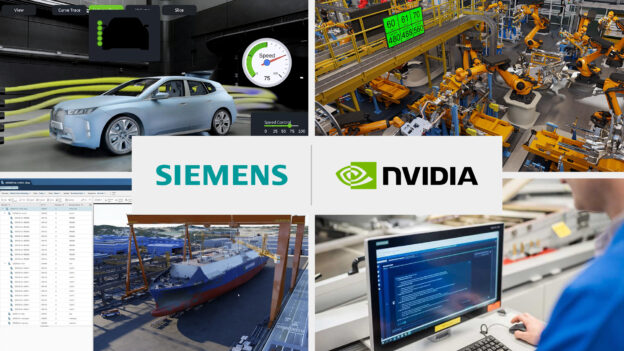
At CES 2026, Siemens and NVIDIA outlined plans for AI-driven factories that adapt in real time using digital twins.
Siemens and NVIDIA said they are expanding their partnership to build what they call an Industrial AI Operating System, a foundation intended to embed artificial intelligence across the entire industrial lifecycle.
At CES 2026, the companies said the platform will span design, engineering, manufacturing, operations, and supply chains, allowing industrial systems to simulate changes virtually, test improvements in real time, and translate validated insights directly onto the shop floor.
The first fully AI-driven, adaptive manufacturing site based on this approach is expected to launch in 2026 at Siemens Electronics Factory in Erlangen, Germany.
Under the expanded partnership, NVIDIA will provide AI infrastructure, simulation libraries, models, and frameworks, while Siemens will deploy hundreds of industrial AI experts alongside its hardware and software portfolio.
Together, the companies aim to create AI-native workflows that accelerate innovation while reducing cost, risk, and commissioning time.
Roland Busch, President and CEO of Siemens AG, described the effort as a shift in how physical systems are designed and operated.
“Together, we are building the Industrial AI operating system – redefining how the physical world is designed, built, and run – to scale AI and create real-world impact,” Busch said.
Factories become adaptive systems
At the core of the initiative is the idea of factories that continuously analyze their own digital twins. Using an AI Brain powered by software-defined automation, industrial operations software, and NVIDIA Omniverse libraries, facilities can test process changes virtually before applying them in the real world.
The companies said this approach enables faster, more reliable decision-making from early design through deployment, while raising productivity and reducing risk. Siemens and NVIDIA plan to scale these capabilities across multiple verticals, with customers including Foxconn, HD Hyundai, KION Group, and PepsiCo already evaluating elements of the technology.
A major component of the partnership is the full GPU acceleration of Siemens’s simulation tools. Siemens said it will complete GPU acceleration across its entire simulation portfolio and expand support for NVIDIA CUDA-X libraries and AI physics models, enabling customers to run larger, more accurate simulations faster.
Building on that foundation, the companies plan to advance toward generative simulation using NVIDIA PhysicsNeMo and open models. The goal is to create autonomous digital twins capable of real-time engineering design and continuous optimization.
Jensen Huang, founder and CEO of NVIDIA, said the collaboration is turning digital twins into active intelligence. “Generative AI and accelerated computing have ignited a new industrial revolution, transforming digital twins from passive simulations into the active intelligence of the physical world,” Huang said.
AI from chips to plants
The partnership also extends deep into semiconductor and AI infrastructure design.
Siemens said it will integrate NVIDIA CUDA-X libraries, PhysicsNeMo, and GPU acceleration across its electronic design automation portfolio, targeting 2x to 10x speed-ups in key verification, layout, and process optimization workflows.
The companies are also jointly developing a repeatable blueprint for next-generation AI factories, designed to balance high-density computing demands with power, cooling, and automation requirements.
This blueprint is intended to optimize the entire lifecycle of AI infrastructure, from planning and design to deployment and operations.
Beyond systems and infrastructure, Siemens said industrial AI is moving closer to workers.
The company is expanding its portfolio of AI-powered copilots across design, manufacturing, and operations, and is collaborating to bring industrial AI to Meta Ray-Ban AI Glasses, enabling hands-free guidance, safety insights, and real-time feedback on the shop floor.
Siemens and NVIDIA said they will first deploy these technologies within their own operations before scaling them across industries, using internal adoption as proof points for customers evaluating industrial AI at scale.
You can explore all CES 2026 stories and coverage from the IE team by clicking here.
https://interestingengineering.com/ai-robotics/siemens-nvidia-industrial-ai-operating-system