



Hydrogen production derived from renewable energy sources is poised to surpass the 200,000 target set for 2025
Making significant strides in advancing green energy, China is poised to surpass its national hydrogen targets ahead of schedule.
A Rystad Energy report indicates that the hydrogen output made using renewable energy is on track to exceed 200,000 tonnes, a target set for 2025.
China is advancing its target of using hydrogen more extensively for decarbonization. The report states that it will install nearly 2.5 GW of hydrogen electrolyzer capacity by the end of this year.
The capacity is expected to produce 220,000 tonnes of green hydrogen per annum (tpa) this year, 6 ktpa more than the world’s combined production.
For reference, the European Union is targeting 10 million tonnes domestically and importing another 10 million by the decade’s end. However, in 2022, Europe’s renewable hydrogen production stood at a mere 20,000 tonnes.
Sustainable hydrogen economy
Mainland China solidified its global leadership in electrolyzer capacity in 2023 by cumulatively installing 1 GW, which is a significant milestone for the country’s hydrogen technology uptake.
To create green hydrogen, producers require an electrolyzer, which splits water molecules into hydrogen and oxygen.
Despite that, a massive part of China’s hydrogen output is still represented by grey hydrogen manufactured through the gasification of coal or steam methane reforming.

The report maintains that to meet its dual carbon goals—for peaking emissions by 2030 and for carbon neutrality by 2060—China will need to make an escalated push toward greener, that is, low-carbon ways of making hydrogen.
Midway through the year, China’s National Development and Reform Commission announced its ‘Medium and Long-Term Strategy for the Development of the Hydrogen Energy Industry’.
The national hydrogen plan is a broad blueprint from 2021 to 2035 that includes some ambitious targets that are relatively easily met; however, the set of targets connotes the adoption of sustainable hydrogen production methods.
The report states that China’s proposed standards and solutions signify advancement, yet they presently lag behind the stricter benchmarks set by European counterparts.
“To truly catalyze meaningful change, it is imperative for China to adopt clear and stringent definitions that align with global best practices, such as those seen in Europe,” said Minh Khoi Le, Head of Hydrogen Research, Rystad Energy, in the report.
East-west energy alignment
In terms of hydrogen generation, China features a geography mismatch. The hydrogen demand hubs are located in the east, while renewable energy resources are abundant in the north, including regions like Inner Mongolia and Gansu.
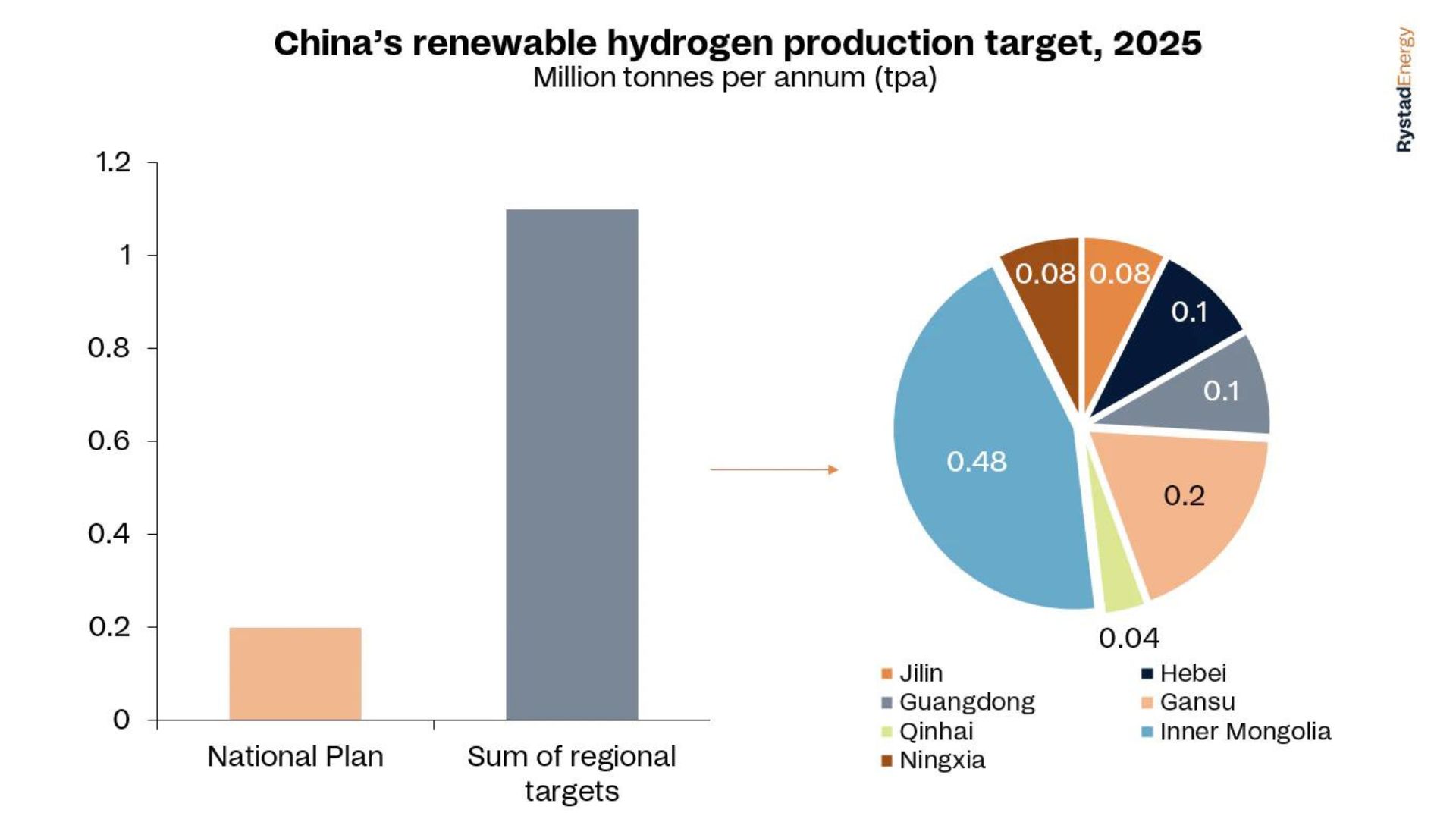
These regions are set for significant development in green hydrogen, with plans surpassing national targets. These include Inner Mongolia and Gansu, where over 1 million tpa of renewable hydrogen production has been targeted for 2025.
To overcome disparities, China is expanding its hydrogen pipeline network with projects such as Sinopec’s 400-kilometer conduit from Ulanqab to Beijing and a 737-kilometer pipeline from Zhangjiakou to Caofeidian by Tangshan Haitai.
According to the report, this is in line with China’s strong solar and wind potential, which will see new installations reach 217 GW for solar and 76 GW for wind in 2023, primarily in Inner Mongolia, Xinjiang, and Gansu.
Since the northern provinces have a renewable capacity, with Inner Mongolia targeting 480,000 tpa, and Gansu, on the other hand, is targeting 200,000 tpa of hydrogen production by 2025, they have an influential place in China’s regional hydrogen journey.
Overcoming operational hurdles
While recent projects have been built in China, optimizing the operational performance of electrolyzer facilities to full capacity remains a challenge. A major operation bottleneck is the huge renewable capacity required to sustain the electrolyzers’ operations.
The report points out that the production of 1 million tpa of green hydrogen needs around 20 GW of onshore wind capacity, which already brings competition with other significant national needs in electrification.
Operation of electrolyzers at less than rated capacity can become a safety issue. Most of the alkaline electrolyzers in operation in China are operated at 30 percent to 100 percent capacity.
RECOMMENDED ARTICLES


Electrolyzers automatically shut down if power availability reduces the hydrogen production below 30 percent of capacity to avoid gas mixing, which in turn avoids potential explosions—a greater risk at suboptimal operational levels.
Given such conditions, Rystad Energy believes that China’s green hydrogen sector will continue its rapid expansion, encouraged by its quick pace of installing new electrolyzer capacity.
This trajectory is similar to that observed in the solar PV and wind industries, where China is the world leader in terms of capacity. The four biggest facilities alone will contribute up to half of China’s total green hydrogen production capacity by 2030.
https://interestingengineering.com/energy/china-surpasses-2025-green-hydrogen-goals