



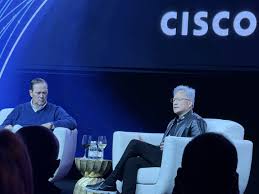
At Cisco’s AI Summit, Chuck Robbins and Jensen Huang used a wide-ranging onstage conversation to outline how enterprise computing is being reshaped by AI—and why infrastructure, networking, and software platforms must be rethought together. The discussion centered on the concept of “AI factories,” a term NVIDIA uses to describe purpose-built systems that convert data into intelligence at scale, and Cisco’s role in making those systems manageable, secure, and operable inside enterprises.
Huang argued that AI represents a shift from explicit programming to implicit computing, where users express intent and models infer solutions. That transition, he said, forces a reinvention of the entire stack—not just processors, but storage, networking, security, and software operations. He emphasized that earlier generations of AI, including chatbots, demonstrated capability but limited utility, and that current progress in reasoning, planning, tool use, and agentic workflows marks the point where AI becomes operationally useful for enterprises.
Both executives stressed that enterprise AI adoption has lagged hyperscalers not because of lack of demand, but because organizations tried to over-optimize for early ROI instead of learning by doing. Huang encouraged companies to allow broad experimentation—“letting a thousand flowers bloom”—while focusing deep AI investment on the most mission-critical workflows. Over time, he said, enterprises can then consolidate onto platforms and architectures that prove durable, rather than locking in too early.
- Cisco and NVIDIA are co-developing AI factory architectures that integrate NVIDIA’s accelerated computing and AI networking with Cisco’s Nexus control plane, security, and enterprise networking stack
- Huang described AI as collapsing the cost of intelligence by orders of magnitude, enabling real-time reasoning and analysis that previously took months or years
- Enterprises were urged to prioritize experimentation over near-term ROI models, especially in areas central to their competitive advantage
- AI software was positioned as tool-centric rather than replacement-centric, with future systems relying heavily on existing enterprise applications and workflows
- Huang advised enterprises to build and operate at least some AI infrastructure themselves—alongside cloud usage—to understand system behavior, protect sensitive data, and retain sovereignty over their most valuable IP: internal questions and context
“Every company should have AI in the loop, not just humans in the loop,” Huang said. “Those AIs will capture experience, context, and learning every day—and that becomes the company’s intellectual property.”
https://convergedigest.com/cisco-ai-summit-cisco-and-nvidia-on-the-enterprise-path-to-ai-factories/?amp=1