



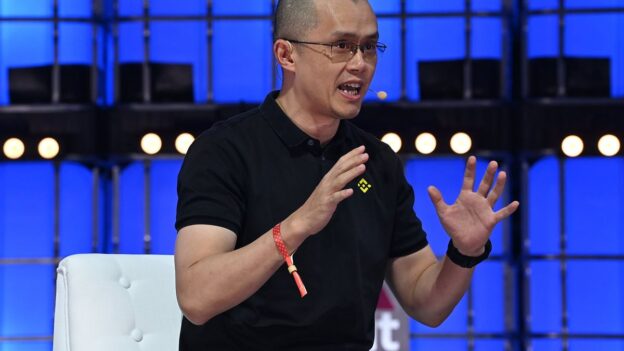
- The U.S. Department of Justice has brought criminal charges against Binance and its billionaire founder and CEO, Changpeng Zhao.
- The former Binance chief will personally plead guilty to violating and causing a financial institution to violate the Bank Secrecy Act, according to the plea agreement.
- The U.S. DOJ said in its filing Tuesday that Binance “knowingly and wilfully” caused the supply of servgices to Iran, in breach of U.S. sanctions.
Binance chief Changpeng Zhao will plead guilty to criminal charges and step down as the company’s CEO as part of a $4.3 billion settlement with the Department of Justice, according to court documents. The plea arrangement with the government resolves a multi-year investigation into the world’s largest crypto exchange.
Zhao and others are charged with violating the Bank Secrecy Act by failing to implement an effective anti-money laundering program and for willfully violating U.S. economic sanctions “in a deliberate and calculated effort to profit from the U.S. market without implementing controls required by U.S. law,” according to the Justice Department.
Zhao said in a post on X, formerly Twitter, that he had “made mistakes” and “must take responsibility,” adding that Richard Teng, the company’s former global head of regional markets, has been named the new CEO of Binance.
The action against Binance and its founder was a joint effort by the Department of Justice, the Commodity Futures Trading Commission and the Treasury Department. The Securities and Exchange Commission was noticeably absent.
Treasury Secretary Janet Yellen said in a release Tuesday the exchange allowed illicit actors to make more than 100,000 transactions that supported activities like terrorism and illegal narcotics. And it allowed more than 1.5 million virtual currency trades that violated U.S. sanctions.
It also allowed transactions associated with terrorist groups like Hamas’s Al-Qassam Brigades, Palestinian Islamic Jihad, Al Qaeda and ISIS, Yellen said in the release, noting Binance “never filed a single suspicious activity report.”
U.S. Attorney General Merrick Garland said in a press conference on Tuesday afternoon that the fine is “one of the largest penalties we have ever obtained.” Yellen said it’s the largest enforcement in the Treasury’s history.
“Using new technology to break the law does not make you a disruptor. It makes you a criminal,” continued Garland.
“Binance prioritized its profits over the safety of the American people,” he added.
The former Binance chief will personally plead guilty to violating and causing a financial institution to violate the Bank Secrecy Act, according to the plea agreement. The DOJ is also recommending that the court impose a $50 million fine on Zhao.
Zhao was scheduled to appear before Judge Brian Tsuchida for a hearing in a Seattle courtroom at 10:00 a.m. Pacific Time (1:00 p.m. ET).
Binance will continue to operate but with new ground rules. The company will be required to maintain and enhance its compliance program to ensure its business is in line with U.S. anti-money laundering standards. The company is required to appoint an independent compliance monitor.
The case against Binance, which was unsealed on Tuesday afternoon, shows that the exchange faces three criminal charges, including conducting an unlicensed money-transmitting business, violating the International Emergency Economic Powers Act, as well as a conspiracy charge.
Binance has agreed to forfeit $2.5 billion to the government, as well as to pay a fine of $1.8 billion.
The U.S. DOJ said in its filing Tuesday that Binance “knowingly and willfully” caused the supply of services to Iran, in breach of U.S. sanctions. It follows a report that Binance processed billions’ worth of Iranian transactions.
“Let me be clear: We are also sending a message to the virtual currency industry more broadly, today and for the future,” Yellen wrote in a press brief.
The settlement comes just after FTX founder Sam Bankman-Fried was found guilty of several criminal counts of fraud and conspiracy following just three hours of deliberation by the jury. For a high-profile monthlong trial that involved nearly 20 witnesses and hundreds of exhibits, experts told CNBC they’d never seen such a speedy decision.