



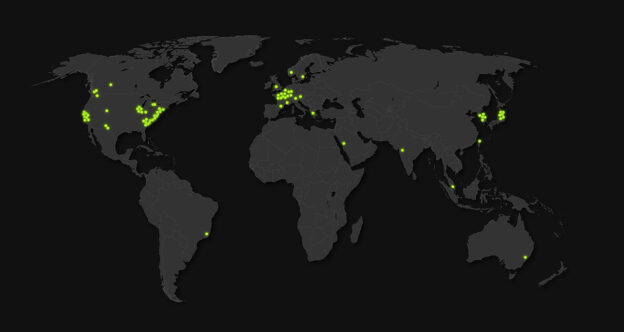
America has more data centers than the rest of the world combined. The US has 5,426 versus Germany’s 529 and China’s 449.
But as we’ve heard from Eric Schmidt, the limiting factor to AI today isn’t GPUs or people, its power. Microsoft can’t power hundreds of thousands of GPUs sitting idle in their data centers. Ground-based infrastructure is maxing out. Environmental opposition is rising.
So, what’s the solution? Unlimited solar energy in space. No atmosphere. No day-night cycle. No weather. And, no regulators.
This isn’t decades away. The first orbital data centers launch in 2026…
1/ Elon’s already planning on Starlink hosting data centers
“SpaceX will be doing this,” Musk declared when asked about space-based computing.
His plan: scale up Starlink V3 satellites launching in early 2026.
 |
Starlink v3 will be much larger than its predecessors
The numbers speak for themselves. Starlink V3 delivers 1 terabit per second: 10x more capacity than the current generation. SpaceX will launch 60 of these satellites on every Starship. That’s 60 Tbps of orbital compute capacity per launch.
Compare that to the old model: Viasat contracted with Boeing for nearly a decade and spent hundreds of millions to build a single 1 Tbps satellite. SpaceX is deploying 60-times the capacity in a single launch—and they’re planning a weekly Starship cadence.
But leave it to Musk to think even bigger. As he puts it:
“100 TW/year is possible from a lunar base producing solar-powered AI satellites locally, and accelerating them to escape velocity with a mass driver.”
Translation: We’re going to be manufacturing satellites on the Moon using lunar materials, power them with solar, and launch them with electromagnetic catapults.
No rockets required.
2/ Beyond Musk, Bezos, Schmidt… Starcloud and Crusoe are planning their orbital data centers
This isn’t one visionary’s Moonshot, it’s now a competitive race.
Jeff Bezos predicts gigawatt-scale orbital data centers within 10 to 20 years. At the same time, Eric Schmidt acquired the launch company called Relativity Space as a means to support a vision of space-based data centers.
When three of the world’s wealthiest technologists independently bet on the same “impossible” idea, pay attention.
Add to this, the launch of Starcloud‑1 earlier this month carried the first-ever NVIDIA H100 GPU into orbit as a proof-of-concept for space-based data centers.
What’s more, on October 22, 2025, Crusoe and Starcloud publicly announced their plan to launch the first public cloud in space together, with Crusoe’s “Crusoe Cloud” platform deployed on a Starcloud satellite in late 2026, offering GPU capacity from orbit in 2027.
3/ Space wins: building towards a Kardashev Type I civilization
On Earth, we have some limitations… fighting for power grid access, environmental permits, cooling infrastructure.
In orbit, the equation flips entirely: free, limitless solar power.
This is our first step towards a Kardashev Type I civilization.
In 1964, Russian astrophysicist Nikolai Kardashev proposed a bold new way to classify civilizations: not by their morality, technology, or intelligence, but by their ability to harness energy.
His framework, now known as the “Kardashev Scale,” imagined three ascending tiers of cosmic mastery.
A Type I civilization would capture and use all the energy available on its home planet—roughly 10¹⁶ watts, encompassing the full potential of sunlight, wind, oceans, and geothermal heat that reach or arise from the Earth.
A Type II civilization would command the total output of its star, perhaps by building vast orbital collectors like Dyson spheres.
A Type III civilization would wield the energy of an entire galaxy.
Today, the plans to begin capturing solar energy in space-based data centers are the first major step toward a Type I civilization and ultimately a Dyson swarm (nested spheres of computation that represent humanity’s ultimate infrastructure).
The 2026 inflection point is here.
https://blogs.nvidia.com/blog/starcloud/