




- The global food system is under increasing pressure from major challenges such as climate, trade and geopolitical volatility.
- The First Movers Coalition for Food’s white paper, CEO Lessons for the Future of Food Procurement, outlines how some companies are looking closer to their buying practices to secure more resilient value chains.
- The traditional procurement playbook, which manages play-offs across cost, quality and availability, may not guarantee a reliable and quality food supply.
Food systems, accounting for roughly 10% of global GDP and providing around 40% of jobs worldwide, have been designed for a stable climate, with predictable costs and consumer demand.
For a century, the world’s food systems have delivered unprecedented scale, efficiency and economic development to feed a growing global population. But today we face tremendous pressures and uncertainty from extreme weather, water, trade and geopolitics.
Rising conflicts, shifting trade policy and energy price volatility are disrupting the availability and price of agricultural commodities and inputs. The dependence on a narrow set of staple crops, concentrated input markets, and a handful of breadbasket regions amplifies this fragility.
Warming temperatures and extreme weather can impact supply and reduce yields in established growing regions, while shifting patterns make other regions potentially viable, reshaping where crops are produced and increasing year-to-year volatility.
In this context, businesses face increasing risk and pressure to adapt – and so do the farmers and suppliers they rely on – making resilient procurement a strategic imperative. The choices companies make in what they buy and how they buy it will define the future adaptability and resilience of our food systems.
The World Economic Forum, through its flagship initiative the First Movers Coalition for Food, has launched a white paper to explore this issue. The CEO Lessons for the Future of Food Procurement white paper offers a vision to help leaders drive that change.
The report asks how CEOs and senior leaders can use procurement to better manage risks in their supply chains, aiming to move faster on decarbonization and delivering tangible value for their organizations, suppliers and the global food system.
Practical approaches to resilient food procurement
The traditional procurement playbook, based on managing trade-offs across cost, quality and availability, may not guarantee reliable and affordable food supplies, the report says.
Findings from working group discussions and interviews with chief procurement officers (CPOs) showed that a vision for procurement is needed in food systems – one that recognizes the economic priorities of quality, availability and cost, while ensuring continuity of supply, considering sustainability needs and systemic resilience.
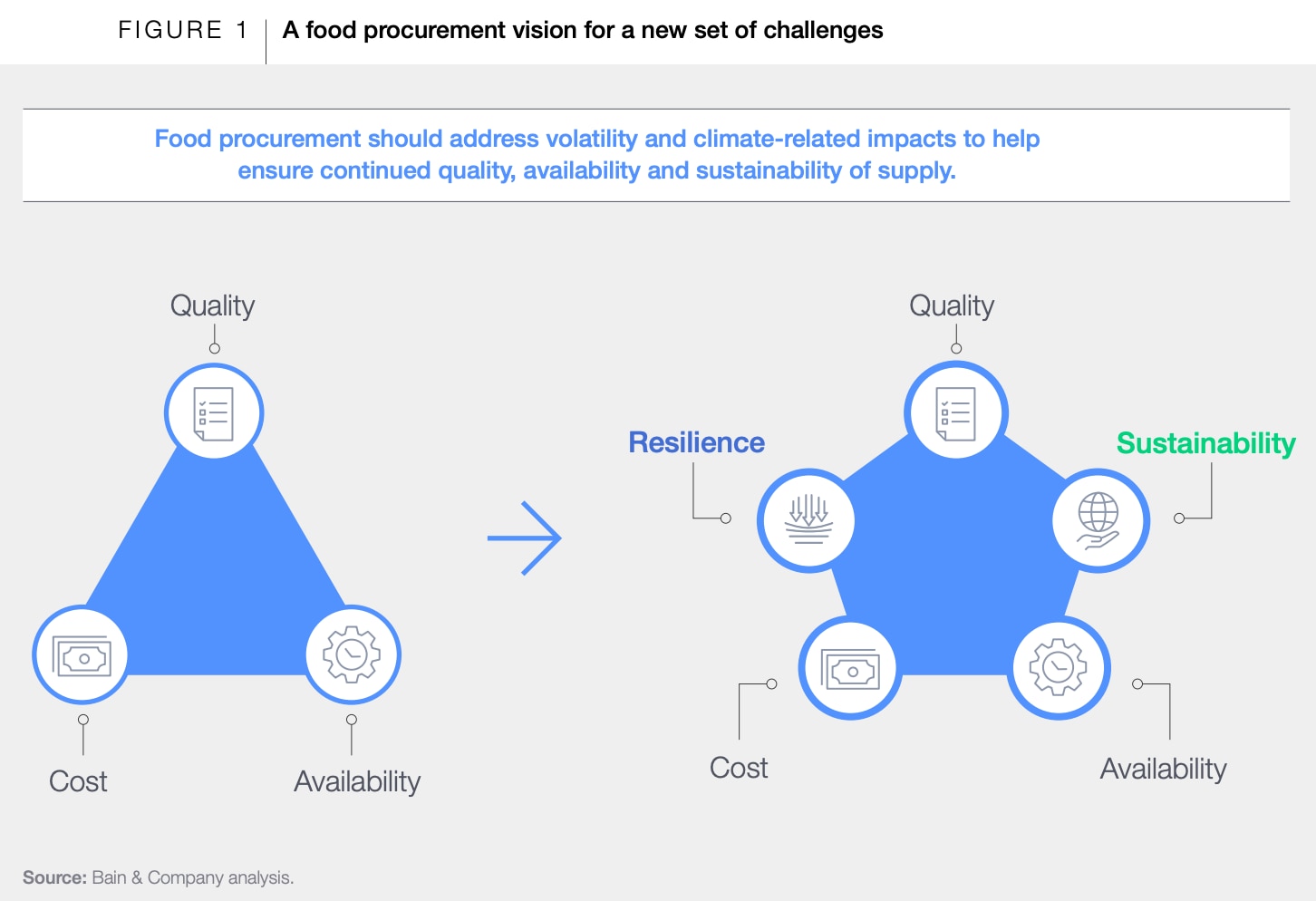
A food procurement vision for a new set of challenges.Image: World Economic Forum
The report helps companies to chart a practical idea to continue moving forward based on the following strategies:
1. Build sourcing maturity to scale up for success
The CPOs we interviewed often began their efforts by supporting farmers and engaging their wider supply chain resilience with pilot projects. However, they quickly learnt that scaling resilient sourcing requires a more systemic approach.
The core idea is simple: start, learn and expand what delivers results. But critically, commercial and environmental benefits need to reinforce each other. Programmes become more affordable to operate at larger scale, without relying as much on consumer premiums, paving the way for greater system-wide participation.
For example, Cargill’s SustainConnect programme offers direct financial incentives to Australian farmers who adopt regenerative practices. Through one-year agreements, participating farmers receive compensation based on enrolled acreage and verified implementation of agreed regenerative agricultural practices. Farmers can choose from a range of regenerative practices best suited to their operations.
Meanwhile, DFI Retail Group has begun a five-year programme to increase availability of low-emissions rice in the Hong Kong and Macau consumer markets, scaling-up their 2026 procurement target to 1,000 tonnes – five times the 2025 level.
DFI Retail Group’s programme focuses on supporting climate-smart practices in their sourcing regions such as alternate wetting and drying irrigation (which brings co-benefits of water conservation, productivity gains and methane reductions), optimized soil management and a ban on all straw burning.
This programme has seen a 25% increase in in-store sales, reductions in scope 3 emissions, and farmers empowered to adopt sustainable practices that benefit both the environment and their livelihoods. Importantly, the programme shows that low-emissions rice can be delivered with no cost premium or consumer price increase, demonstrating its affordability.
2. Identify strategic sourcing pathways for scale
Executives also stressed the need for clear pathways that translate their resilience ambitions into practical and smart procurement action. The report identifies two potential sourcing pathways which have helped companies already: spec-anchored sourcing and decoupled sourcing.
Spec-anchored sourcing embeds sustainability into sourcing specifications, contracts and supplier evaluations, often paired with closer supplier collaboration and stronger verification. For example, JBS, the world’s largest meat-processing enterprise, is investing over $7 million in cattle traceability and support for small producers in the Brazilian Amazon, and aims to provide 2 million ear tags to help enable individual animal identification.
The effort supports a Pará state law requiring ranchers to identify cattle and aligns with a broader public-private push to trace the state’s full herd of roughly 26 million cattle. This kind of tagging can help processors link animals back to registered farms and strengthen checks intended to reduce the risk of purchasing cattle connected to deforestation.
Decoupled sourcing focuses sustainability investments in the same supply-sheds that companies source from, while separating sustainability efforts from procurement specifications and the commodity purchase itself. Nestlé, for example, is partnering in a long-term, large-scale cocoa agroforestry project in Côte d’Ivoire to diversify agricultural production, reduce fossil fuel inputs and costs, and sequester carbon, covering some 11,500 hectares and 6,000 farmers.
The partnership is expected to reduce and remove up to 1.3 million tonnes of carbon dioxide-equivalent over 25 years. Importantly, the companies can claim these savings as reductions to their scope 3 footprint, whilst helping both buyers and suppliers boost the resilience of their production and purchasing.
3. Calibrate strategy and prioritize sourcing pathway
When selecting the right sourcing pathway, the CPOs often pointed to how difficult or costly it is for a buyer to switch suppliers (dependency).
In practice, a company’s level of dependency determines whether on-farm robustness or sourcing flexibility should be prioritized in its resilience strategy – and therefore which strategic pathway, spec-anchored or decoupled, is best suited for their needs.
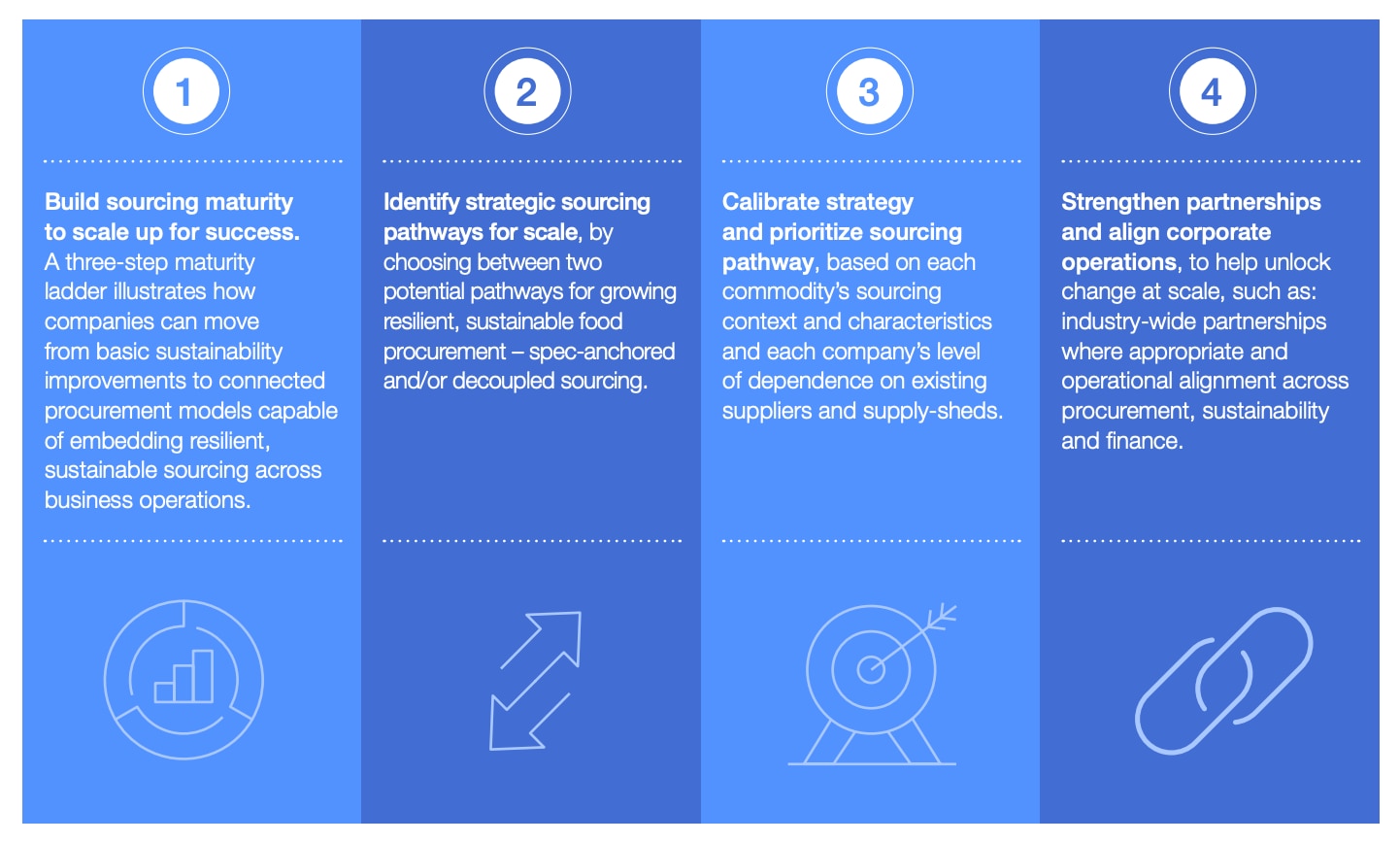
Best practices to scale up resilient, sustainable food procurement.Image: World Economic Forum
Higher dependency reflects a reality in which a limited number of suppliers can meet product expectations for price, quality and availability. This normally applies to highly perishable commodities or those found within highly concentrated growing regions. Examples include fresh milk, which needs to be sourced daily and locally.
Meanwhile, some commodities can be sourced from many suppliers across multiple regions that can all meet cost, quality and availability requirements. Commodities in this category often do not allow for easy farm-level traceability, due to aggregation, mixing or commodity spot-trading. For example, wheat for boxed cereals is widely produced with a diversified supply base and long storage life.
4. Strengthen partnerships and align corporate operations
The top corporate experts told us that adopting best practices in food procurement requires alignment and partnerships both externally and internally.
Externally, partnerships across the value chain with peers, adjacent industries and financiers create the collective effort that supports durable change. For example, global dairy co-operative Fonterra’s collaboration with Nestlé and Mars incentivizes low-emissions dairy production through financial rewards for farmers.
https://www.weforum.org/stories/2026/05/companies-procurement-food-systems-resilient-value-chains/?utm_source=sfmc&utm_medium=email&utm_campaign=2872215_ForumStories-22May2026&utm_term=&emailType=Forum%20Stories