



- The Middle East war has caused a historic disruption to global oil supply, triggering sharp price increases and a widespread energy crisis.
- Governments around the world are implementing measures to reduce fuel demand and protect consumers.
- The crisis highlights the growing impact of geoeconomic tensions on global energy systems and broader economic stability.
The war in the Middle East has triggered what the International Energy Agency (IEA) describes as the largest disruption in global oil supply in history, pushing governments worldwide to rapidly deploy emergency measures to curb demand and protect consumers.
At the centre of the crisis is the Strait of Hormuz, a critical chokepoint through which 20% of global oil supply normally flows. Following the outbreak of war, flows through the strait have been reduced to a fraction of normal levels, significantly limiting the global energy supply.
The impact has been immediate and severe. Global oil supply fell by more than 10 million barrels per day in March and the price of oil surged above $100 per barrel, while the price of refined fuels like diesel and jet fuel rose even faster, according to the IEA.
“The war in the Middle East is creating a major energy crisis, including the largest supply disruption in the history of the global oil market,” IEA Executive Director Fatih Birol said in a statement. “In the absence of a swift resolution, the impacts on energy markets and economies are set to become more and more severe.”
In response, governments are taking action to save energy and lower domestic demand. Drawing on an IEA energy crisis policy tracker, here are six of the most common ways countries are responding.
1. Work and study from home
Encouraging or mandating remote work and study has emerged as a primary way to reduce fuel demand as it lowers consumption by cutting both commuting and on-site facility use.
Indonesia, for instance, has imposed a work-from-home requirement for public-sector employees on Fridays while Myanmar mandates remote work on Wednesdays. Other countries such as Pakistan and the Philippines have imposed four-day working weeks for public officials.
Meanwhile, countries like Sri Lanka, Peru and Bangladesh have shortened school weeks or increased remote learning.
2. Limit cooling in buildings
Governments are eyeing the use of buildings and facilities to limit energy consumption.
Thailand, Bangladesh and Cambodia have imposed or encouraged temperature limits on the use of air conditioners in public offices. Jordan has banned the use of air conditioners in government offices entirely.
Cooling restrictions are particularly important in warmer climates, where electricity demand spikes can strain already tight energy systems.
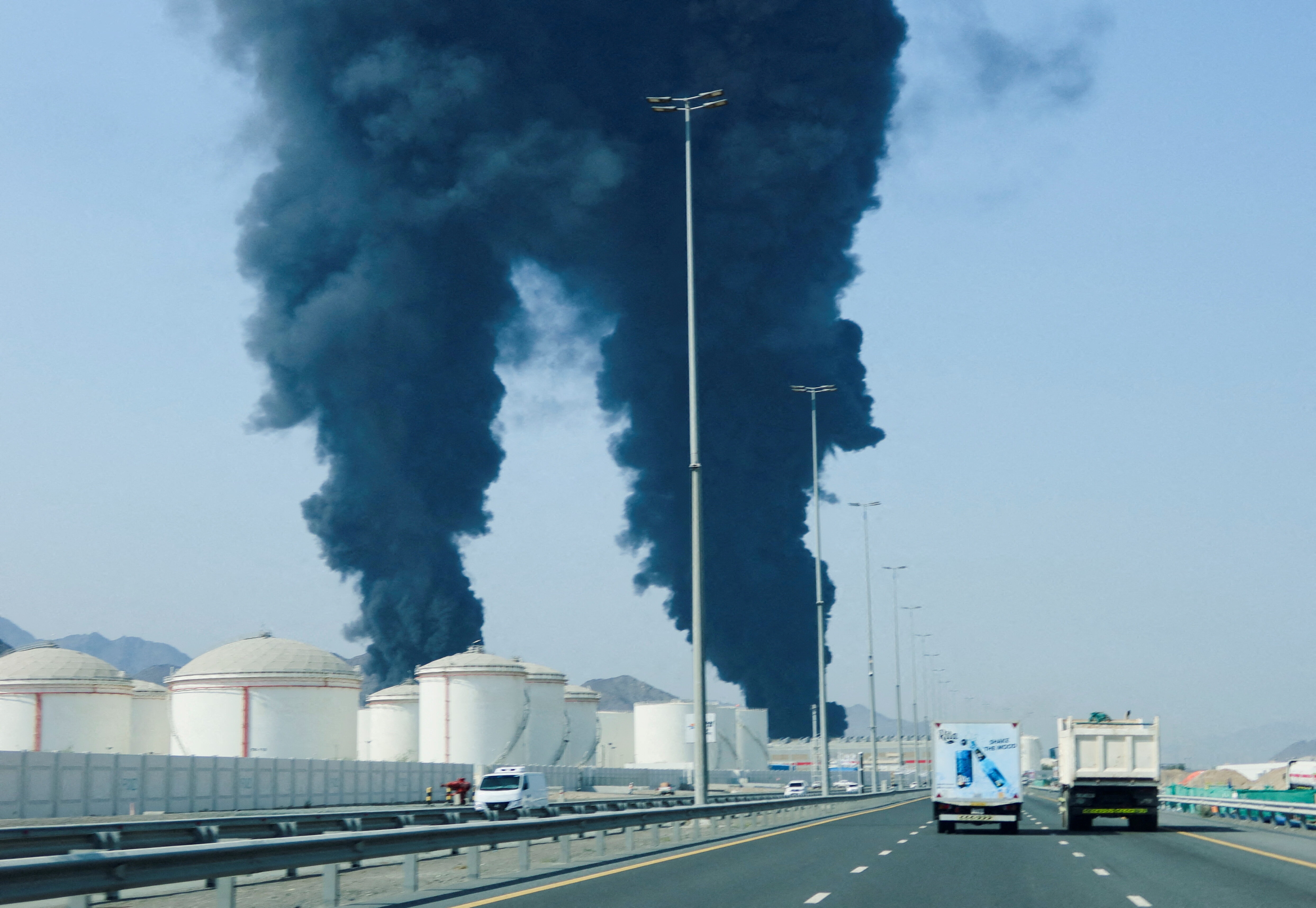
Smoke rises in the Fujairah oil industry zone in the United Arab Emirates in March.Image: REUTERS
3. Promote public transportation
Transport remains one of the largest levers for cutting oil demand, and governments are taking action to reduce private travel and increase the use of public transport.
Lithuania, for instance, has cut local train fares by 50% for two months while the Philippines has provided free bus rides for students and workers in selected cities. France, meanwhile, has renewed social leasing schemes for electric vehicles for low-income individuals reliant on private cars for work. Chile has also offered financial assistance to taxi drivers buying electric vehicles.
Other countries such as Thailand and Argentina have changed regulations to allow higher bioethanol content in gasoline blends.
4. Restrict government travel
Public-sector travel is being scaled back to reduce fuel consumption and set an example.
South Korea has mandated driving restrictions for public-sector workers while Jordan and Pakistan have banned international travel for public officials. Jordan has curbed the hosting of foreign delegations, too.
Sri Lanka has also limited travel for government officials, encouraging them to take public transportation.
5. Mandate price caps and provide subsidies
Some governments are intervening directly in fuel markets to shield households and businesses from rising costs.
Croatia and Hungary, for example, have imposed fuel price caps, while Czechia has limited retailers’ profit margins. China has capped domestic refined oil prices, and Japan has introduced a subsidy-backed fuel price ceiling.
Although these measures provide immediate relief, they carry fiscal trade-offs and may weaken incentives to reduce consumption.
6. Launch nationwide energy-saving campaigns
Alongside policy mandates, governments are appealing directly to citizens to change behaviour.
Australia has encouraged voluntary reductions in fuel use and energy consumption through its “Every Little Bit Helps” campaign, while Egypt has asked the public to limit private and commercial lighting and reduce shop hours on weekends.
Several other countries including Mozambique, Lao PDR, Ethiopia and Viet Nam have urged the public to take energy-saving actions.
Geoeconomic confrontation and global risks
The global energy-saving measures mark one of the most widespread demand-reduction efforts in decades. Moreover, they underscore the significant impact that geopolitical and geoeconomic conflicts are increasingly having on the global economy.
In January, the World Economic Forum’s Global Risks Report 2026 ranked geoeconomic confrontation as the foremost concern for risk professionals in the short term, with survey respondents identifying it as the risk most likely to trigger a material global crisis in 2026. State-based armed conflict followed in second place.
“Geoeconomic confrontation threatens the core of the interconnected global economy,” the report stated, noting that such confrontations are both a cause and a consequence of the diminished multilateral system. “With fewer multilateral constraints on unilateral action, rising national barriers and clashing interests could have negative economic and social repercussions across the globe.”
https://www.weforum.org/stories/2026/04/middle-east-war-iran-us-ways-countries-respond-oil-energy-shock/?utm_source=sfmc&utm_medium=email&utm_campaign=2871330_ForumStories-1May2026&utm_term=&emailType=Forum%20Stories