



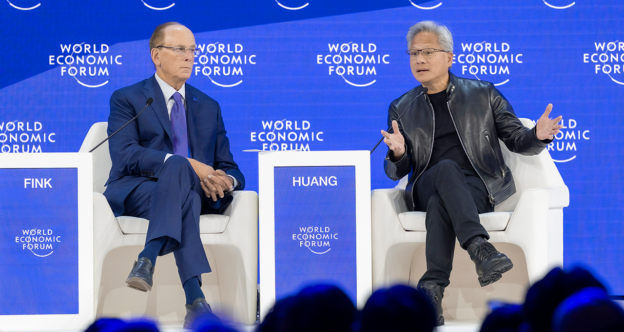
Nvidia (NVDA) CEO Jensen Huang took the stage at the annual World Economic Forum in Davos, Switzerland, on Wednesday for a conversation with BlackRock CEO Larry Fink to discuss the impact of artificial intelligence and its implications on everything from the labor market to the need for Europe to invest in its energy supply to power AI systems in the future.
According to Huang, the AI explosion has jump-started the “largest infrastructure buildout in history.” And despite the hundreds of billions of dollars companies have already spent on the technology, there’s still much more spending to do.
“There are trillions of dollars of infrastructure that needs to be built out,” Huang told Fink.
“Last year, 2025, was one of the largest years in VC funding ever,” Huang explained. “And last year most of the funding went to what are called AI native companies. These are companies in healthcare, they’re companies in robotics, financial services, all of the large industries in the world, you’re seeing huge investments going into these AI native companies.”
Huang said these investments are driven by the fact that AI models are now effective enough for companies to use them to build applications that will be used across various industries.
“This application layer could be in financial services, it could be in healthcare, it could be in manufacturing. This layer on top ultimately is where economic benefit will happen,” he added.
The AI buildout has led to frequent talk of an AI bubble, with some on Wall Street and beyond concerned that the massive investments in data centers and spending on AI chips will eventually come to a halt, creating a cascading impact on the economy similar to the dot-com bubble.
Read more: Are we in an AI bubble? How to protect your portfolio if your AI investments turn against you.
But Huang pushed back on the idea, saying that the only reason AI bubble fears come about is because the investments are so large but that the opportunity is “really quite extraordinary.”
Huang and Fink also hit on the need for Europe to increase its energy supply in order for countries to invest in AI infrastructure.
“I think that it’s fairly certain that you have to get serious about increasing your energy supply so that you could invest in the [AI] infrastructure layer so that you could have a rich ecosystem of artificial intelligence here in Europe,” Huang said.
On jobs, Huang said that while AI was initially thought to be an enormous threat to radiology jobs, the number of radiologists has actually gone up, adding that the technology allows the workers to spend more time with patients as the number of people seeking medical treatment increases.
Fink, however, also conceded that AI is being used to supplant certain jobs, explaining that while the data center industry is creating more positions for plumbers and electricians, AI is being used as a substitute for people who hold analyst positions at law firms and financial institutions.
And during a separate discussion at Davos, Kristalina Georgieva, managing director of the International Monetary Fund, provided a more dire view of the impact of AI on the job market saying that “on average 40% of jobs are touched by AI either enhanced or scrapped or changed quite significantly without implications for for better pay.”
Georgieva described AI expansion as a “tsunami” hitting the labor market.
“Even in the best prepared countries, I don’t think we are prepared enough,” she added.