




- AI investments are forecast to hit $3.3 trillion in 2027, but less than 1% of global corporate investment in the technology is currently aimed at social impact.
- The potential of AI for positive social outcomes is vast but the technology needs to be built around human dignity, inclusion and real-world contexts.
- The Global Coalition on AI & Social Innovation aims to be a collective effort to ensure social innovators are not only beneficiaries of AI, but also help shape how the technology is developed and deployed – for everyone’s benefit.
Artificial intelligence (AI) investments are expected to reach $3.3 trillion in 2027. This is roughly nine times the amount required for universal health coverage in low- and middle-income countries ($371 billion) or for achieving climate adaptation globally ($365 billion). It is also 127 times the amount flowing into climate adaptation ($26 billion).
The amounts are staggering – but so is the potential. AI could cut healthcare costs and broaden access to education. It already enables more accurate forecasts for extreme weather events and could unlock previously untapped technological advances to address the climate crisis.
But achieving these benefits will not be possible through technology alone. Equitable access and deployment require bringing together the people and institutions needed to build AI around human dignity, inclusion and real-world contexts.
As of 2025, less than 1% of global corporate investment in AI is directed at products and services built for social impact, yet over 70% of social innovators have already deployed some form of it in their work. This contrast reveals both the opportunity and the gap: people working closest to poverty, inequality and climate vulnerability are already finding practical uses for AI, yet most capital flows elsewhere.
AI already helps community health workers identify risks earlier through Dimagi’s CommCare solution, and connects people to public services via Haqdarshak. It also helps protect migrant workers and smallholder farmers against climate shocks through early warning systems and parametric insurance by innovators like Jan Sahas.
These applications matter because they strengthen the capabilities of those underserved by AI, by making expertise more available, decisions more informed and responses timelier.
However, AI is not neutral infrastructure. It shapes who gets opportunities, whose data is collected, and who holds power. AI is a global technology, and its consequences will be felt by governments, corporations and institutions, as well as individuals. The question is therefore not simply how quickly we can deploy it, but what kind of technology we are building and for whom?
Build for impact from the start
For social innovators, designing AI for impact begins with defining the problem alongside the people who experience it, asking whether AI is needed at all and setting a clear success measures. It means using only necessary data, securing informed consent and testing whether a system works across different languages, abilities, geographies and circumstances.
Social innovators sometimes even lean on Indigenous wisdom and principles to develop novel data governance frameworks, such as the Esethu Framework, a data collection model for low-resource languages in Africa, which enables commercial benefits to return to the communities while governing research uses under an open licence.
Designing AI for impact also means keeping people in control. A community health worker should be able to question an AI-generated recommendation, while a person applying for support should have a route to human review and a smallholder farmer should gain information and agency, not become dependent on an opaque tool.
These are practical design choices through which empathy, dignity and privacy become properties of technology rather than statements of intent.
Social innovators are well placed to make those choices because they work closely with the communities affected, meaning they can see more clearly how a tool works in practice and adapt it alongside those who use it.
Mapping across Asia has identified more than 2,800 AI-for-impact initiatives operating across 10 economies, showing that AI-for-impact activity is already happening at scale. Pace is also picking up: over 80% of participants in a recent working group meeting said their use of AI had increased, while one-third reported step-changes in adoption.
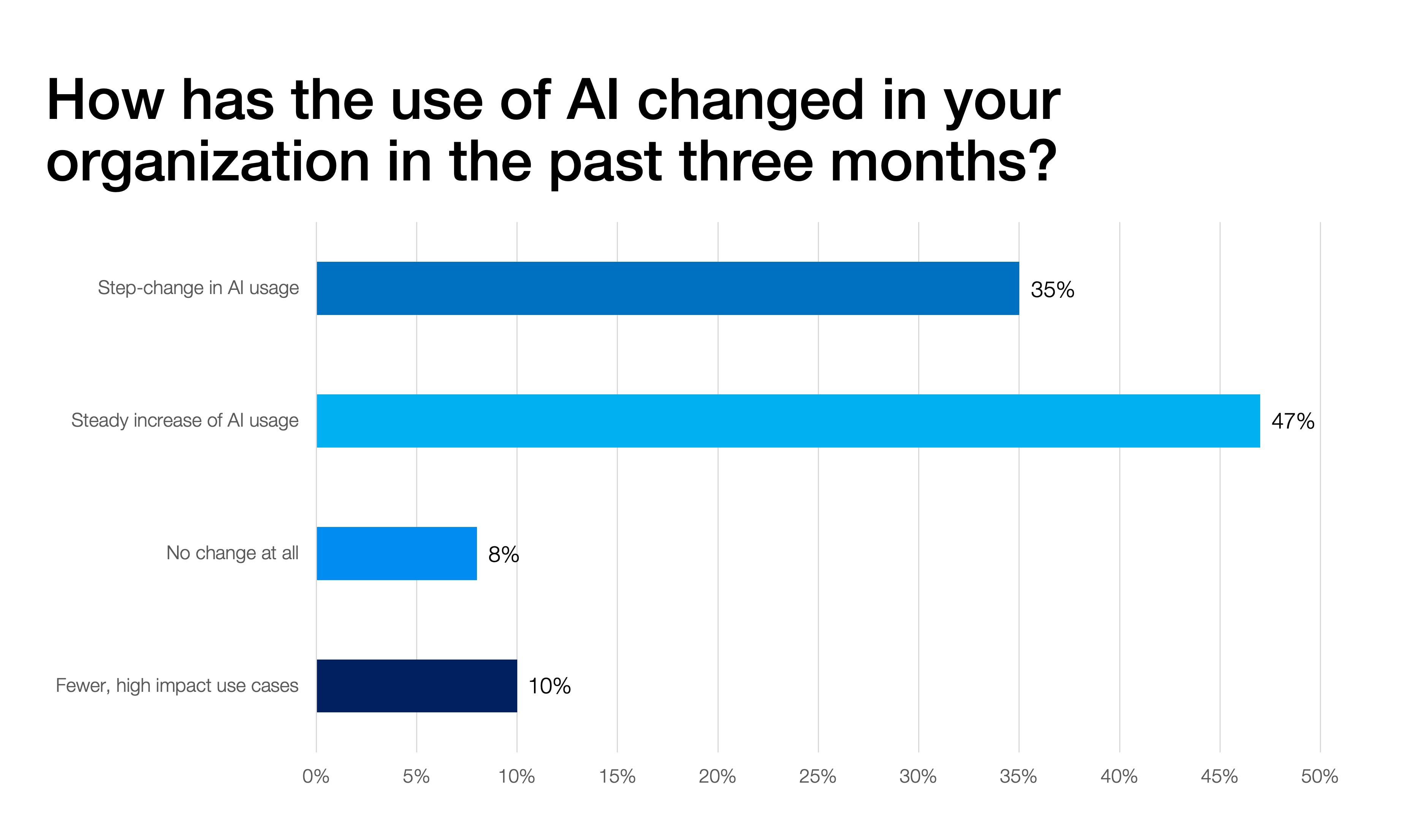
How has the use of AI changed in your organization in the past three months?Image: Authors
Continuity matters as much as capability
These principles are especially important when AI is used to sustain support over time. Consider a solo entrepreneur in rural India who completes a structured training programme, receiving weeks of mentorship and practical guidance from a dedicated expert.
But when the funding cycle ends, the trainer moves on, and she is left without anyone to turn to when facing a pricing dilemma, an unresponsive supplier or a loan application. An AI “buddy” could help bridge that gap. Rather than answering each question in isolation, it could retain relevant context about her business, previous decisions and challenges. Each conversation would help it offer more useful support over time.
This would extend guidance beyond the programme’s life, but its value would depend on its design. The entrepreneur should know when she is interacting with an AI system, understand how data is used and have access to human support when needed. The system should strengthen her confidence and decision-making, rather than encourage dependence.
The example also shows why these questions cannot be answered by technology companies alone. Whether an AI tool provides meaningful support will depend on how well it understands user circumstances, and whether social innovators, communities and technical experts help shape its design. Shared learning is essential if AI is to move to responsible, widely useful practice.
Ensuring collective approaches to a collective problem
National strategies, technical standards, corporate commitments, research alliances and public-interest programmes on AI remain isolated and evolve at varying speeds. We need to connect these efforts to the organizations applying AI on the ground.
More than 100 organizations have engaged in the Schwab Foundation’s Artificial Intelligence for Social Innovation initiative, sharing a recognition that the value social innovators bring is both the technology they are developing and how they develop it: designing for inclusion, solving problems alongside the people who experience them and remaining accountable to communities.
This work is now evolving into a formal coalition, convened in collaboration with EY, SAP, PROSUS and the World Economic Forum, that brings together social innovators with technology leaders, funders and academia.
Better AI for Impact needs different forms of expertise to meet on equal terms. We require arms-length collaboration to create space for different experts to work together around the practical challenges of developing AI for social impact.
From conversation to shared practice
Social innovators often lack affordable computing, patient capital, technical support and access to decision-makers, while technology companies may have talent but need deeper contextual understanding. Investors require technical expertise to make impactful funding decisions, while governments and public institutions need data and insights for responsible AI adoption.
Creating space for shared learning helps stakeholders explore the conditions needed to scale responsible AI applications, including surfacing what is working and what isn’t, making practical needs visible, and ensuring that communities affected by AI remain part of the conversation.
With much of public debate about AI currently trapped between excitement and anxiety, insights rooted in action are critical. Focusing on impact brings the discussion back to outcomes: better health, stronger livelihoods, more resilient communities, fairer access and greater human agency. It also makes room for humility; sometimes the right answer will be a simpler tool, a human process or no AI at all.
Developing responsible AI for impact
The opportunity is too important to leave to chance, and the risks are too extensive for any single actor to manage alone. AI will continue to evolve rapidly, but the outcomes forming our north star are immovable: human dignity, privacy, resilience and inclusive economic progress.
Realizing those outcomes requires investments designed for impact, technology solutions shaped by context, and social innovators to be recognized as partners in deciding how AI can become more meaningful.
We are now working to launch the Global Coalition on AI & Social Innovation to mobilize resources, develop sector infrastructure such as AI libraries and sandboxes, highlight successful implementations of AI for impact and monitor responsible AI in places where it matters most – at the heart of our communities.
https://www.weforum.org/stories/social-innovation/unlock-global-development-through-ai/?utm_source=facebook&utm_medium=social