



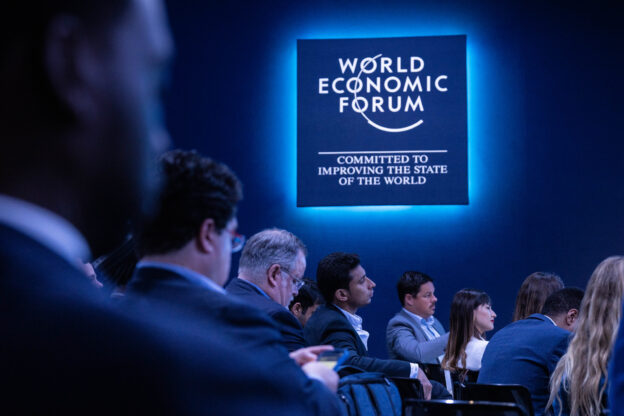
Welcome to the final day of the World Economic Forum’s Summer Davos 2026
- The final day of Summer Davos 2026 opens in Dalian with what may be the meeting’s most closely watched session: “US and China: From Here to Where?“ (08:30 Dalian time), with Graham Allison, Leslie Vinjamuri and Margery Kraus.
- Later: “The 15th Five-Year Plan, Unpacked“ (10:00 Dalian time), reflecting on what China’s new planning cycle means for industry, technology and the global economy.
Closing remarks: ‘Achievements are rich and solid’
Li Wenhai, Vice-Mayor of the Tianjin Municipal People’s Government, and Li Qiang, Mayor of the Dalian Municipal People’s Government, joined World Economic Forum Managing Director Mirek Dušek for the Summer Davos closing remarks.
This week’s “achievements are rich and solid — I believe this is exactly where the power and charm of Summer Davos lies” said Li Qiang. “To grasp innovation is to drive development; to plan for innovation is to shape the future.”
Li Wenhai, whose city will host Summer Davos 2027, added that “Tianjin is ready to work with the world, the World Economic Forum, and global partners” to continue the efforts to “tackle challenges and seize opportunities and jointly build a bright future featuring mutual benefits and shared prosperity.”
Watch the session here.
Innovating at Scale: What leaders are taking home from Dalian
The closing session of Summer Davos 2026 brought five leaders together to reflect on what it actually takes to turn innovation into impact.
Orit Gadiesh of Bain & Company offered the most direct diagnosis. Almost every company is doing something with AI, she said but very few are being truly changed by it. She identified four places where CEOs typically fall short: confusing activity with commitment (“lots of pilots don’t add up to a strategy”), spreading bets too thin instead of concentrating resources on two or three areas where the company’s own data gives it a real edge, giving away the architectural layer that ties everything together to a vendor, and delegating the transformation instead of owning it personally. “You need to choose to change, not just look towards change,” she said.
Padraig McDonnell of Agilent echoed the point from a life sciences perspective, naming “pilot purgatory” as the central failure mode where everything stays in the pilot phase and no one builds the muscle to scale. “You have to create abundance through AI for your customers through growth,” he said. “It’s a fundamental mistake to think you’re going to cost-cut your way with AI.”
Le Song of Genbio AI looked further ahead. He said AI is moving beyond productivity into generating new hypotheses, new therapies, new scientific discoveries.
Michael Liu of Pheno Innovations offered an analogy for companies. “AI has effectively taken us from MS-DOS to Windows XP. The solution is to change the operating system — not just download new apps onto an old one it doesn’t match with.”
Next year’s Summer Davos will be held in Tianjin.
Unpacking the next five years for China
China is entering yet another five-year increment of planned development, focused on boosting domestic consumption, revamping industry, and accelerating the green transition.
Participants in this panel (“15th Five-Year Plan, Unpacked”), including President of the China Society of Economic Reform Guo Lanfeng, economic historian Adam Tooze, HiTHIUM Chairman Wu Zuyu, and Johns Hopkins University’s Yuen Yuen Ang explored the context for this new phase of planned progress.
Guo Lanfeng noted a number of near-term challenges, including downbeat economic indicators and a Chinese population that has peaked in size. “With the reduction of the population we are going to experience downward pressure on China’s social insurance scheme,” he said.
The current geopolitical and trade situation has also created issues: “Some of them are going to generate long-term impacts.”
Adam Tooze said China’s relative ability to lay out clear and concise economic plans for the future, at least for someone coming from the US or Europe, is “a refreshing antidote.”
He said the country’s approach to global trade is straightforward (“there’s no Liberation Day, there’s no crazy tariffs”), though the fact that its imports are nowhere near approaching the massive quantity of its exports will continue to be questioned by the outside world.
Wu Zuyu was asked about the country’s green-technology ambitions in the context of the five-year plan.
“Every nation is concerned about their own energy security in the face of rising geopolitical tension,” he said, so green energy coupled with innovative battery storage technology could be “ideal.”
It stands to help countries “gain independence from your own natural-resource endowment and realize better energy security,” he said.
Adam Tooze said China should be unapologetic about its ability to churn out things like solar panels in massive quantities, despite criticisms of overcapacity. That’s because the world needs them.
“It’s very hard for me to see photovoltaics and batteries as anything but a net positive,” he said.
What has not been so positive, according to Guo Lanfeng: domestic consumption.
“Domestic consumption is becoming a pressing issue,” he said, though addressing it will require time. “We first need to ensure that people have money to spend,” he said, “to ensure people can find jobs, especially quality jobs.”
Watch the full session here.
More essential reading on the plan is here:
Have you read?
-
What does China’s new 5-Year Plan mean for global trade and investment?
-
Why China’s next success story may be healthcare
-
Can systemic green transitions unlock a new generation of competitiveness under China’s 15th Five-Year Plan?
-
How green trade is becoming the next engine of resilient growth for China
-
Will China’s innovation systems drive the next growth cycle?
-
Why China is evolving from building assets to investing in people
US and China relations: ‘A lot at stake for pretty much everybody on the planet’
The US and China remain deeply intertwined economically, yet unresolved trade, technology and security divides have created significant friction and raised fundamental questions about the trajectory of the relationship — and its global implications.
In this session, “US and China: From Here to Where?” expert panellists explored where relations between the world’s two largest economies are headed and what business and policy leaders should be preparing for.
“If China and the US can’t maintain a stable productive relationship, there’s a lot at stake for pretty much everybody on the planet,” said Leslie Vinjamuri, President and Chief Executive Officer of the Chicago Council on Global Affairs.
Professor Graham Allison of the Harvard Kennedy School of Government called the US and China “fierce rivals,” warning that the geopolitical theory of the Thucydides Trap points to conflict between the rising power and the established one.
The panellists, nonetheless, noted that the interconnectedness of the US and Chinese economies may push the two countries towards cooperation and away from conflict.
“The two nations are so inextricably entangled that each requires a level of cooperation with the other to ensure its own survival,” Allison said.
”
— Margery Kraus, Founder and Executive Chair of APCO
Joseph Luc Ngai, Chairman of Greater China at McKinsey & Company, added that business leaders are significant forces pushing for stability. “I’ve seen more multinational CEOs and boards having meetings in China than I’ve ever seen,” he said.
“You can’t have a successful business in a failed world,” added Margery Kraus, Founder and Executive Chair of APCO. “There is hope that reason will prevail because the alternative is not acceptable.”
The panellists noted that the summit last month between Chinese President Xi Jinping and US President Donald Trump in Beijing was a promising sign of cooperation.
“If you’re talking, you’re not fighting,” Kraus added.
Zhao Hai, Director of International Politics Studies at the Chinese Academy of Social Sciences (CASS), added that the rest of the world is “pushing for the bilateral relationship not to fall apart, not to be confrontational, but to be more cooperative, working together to solve common problems.”
Watch the session here.
Radio Davos Daily – Day 3
Bloomberg Business Week reporter and podcaster Stacey Vanek Smith joins the Forum’s Radio Davos podcast to look ahead to the final day at AMNC26.
Radio Davos is weekly throughout the year and will have more analysis of what happened in Dalian in the coming weeks. Follow wherever you get podcasts to be sure not to miss an episode.
Welcome to the final day of the World Economic Forum’s Summer Davos 2026
- The final day of Summer Davos 2026 opens in Dalian with what may be the meeting’s most closely watched session: “US and China: From Here to Where?“ (08:30 Dalian time), with Graham Allison, Leslie Vinjamuri and Margery Kraus.
- Later: “The 15th Five-Year Plan, Unpacked“ (10:00 Dalian time), reflecting on what China’s new planning cycle means for industry, technology and the global economy.