



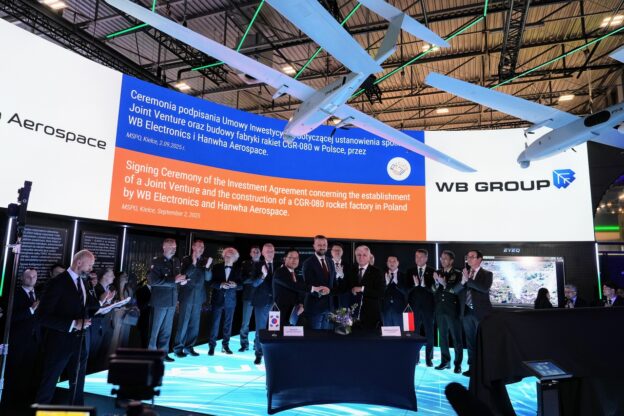
KIELCE, Poland — South Korean defense companies are accelerating their push into Poland’s expanding arms market, with new deals and ambitious bids unveiled at the annual International Defense Industry Exhibition, known as MSPO.
Twenty-seven South Korean defense companies showcased their products in Poland last week, from Sept. 2 to Friday, leveraging a quickly deepening strategic partnership between Seoul and Warsaw to solidify their presence in Europe.
The exhibition underscored that for Warsaw the draw of South Korean defense firms extends beyond hardware. Polish officials and industry leaders point to Seoul’s willingness to adapt designs and production to local requirements — a flexibility they say distinguishes Korean firms from more traditional suppliers in the US, Germany and Japan.
Stronger industrial pitches
Driving Warsaw’s defense boom is an urgent push to phase out its Soviet-era arsenal and build stronger capabilities amid mounting regional threats. Increasingly, many in Poland view South Korea’s weaponry as the most capable replacement — a sentiment reflected in the crowded Korean pavilion at MSPO.
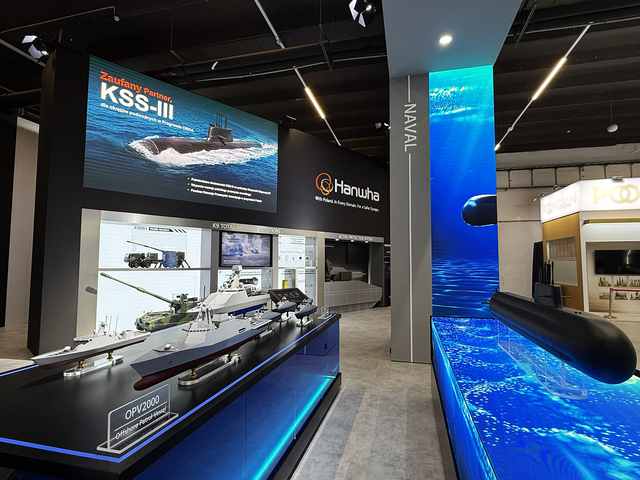
A key initiative in this push would be Poland’s Orka submarine project, which aims to replace the country’s only operational submarine — the Soviet-era Kilo-class ORP Orzel, now effectively decommissioned — by acquiring three to four advanced diesel-electric vessels, potentially by the mid-2030s. The project is worth around 8 trillion won ($5.6 billion), according to South Korea’s Hanwha Ocean.
With Warsaw conducting a formal bidding process, Hanwha Ocean has put forward the KSS-III Batch II submarine, a tailored Polish variant of its KSS-III Batch I. The design incorporates air-independent propulsion, lithium-ion battery systems and vertical launch capability — features that extend underwater endurance and allow the platform to carry long-range precision strike weapons. Hanwha is pitching the submarine not just as a weapons platform, but as part of a wider industrial package, highlighting partnerships designed to root the project firmly on Polish soil.
“It’s about revitalizing Poland’s shipyard,” Hanwha Ocean Senior Executive Vice President Jeong Seung-kyun told a group of reporters who visited the company’s booth at the exhibition on Tuesday. “One of the biggest advantages of signing a contract with us is that we can provide a vessel (for Warsaw) in just six years, which is incredibly fast.”
As Jeong emphasized, at the heart of Hanwha Ocean’s pitch is speed.
Company officials say that if a contract is signed this year, the first KSS-III submarine could be delivered by 2031, with all three boats in service by 2033 — an unusually fast timetable in the world of naval procurement. Hanwha has also pledged joint construction with Polish shipyards, the creation of a local maintenance hub and the transfer of systems to train a new generation of Polish shipbuilders.
The company is sweetening the offer further with a $100 million maritime development fund aimed at nurturing related industries in Poland.
While it mostly remains a straightforward buyer-seller relationship, some are choosing to move into a deeper partnership, with South Korean firms embedding themselves in Poland’s defense industry through joint ventures.
Hanwha Aerospace and Polish defense company WB Group signed a landmark joint venture deal on Sept. 2 to produce guided missiles for Poland’s Chunmoo rocket system. The deal, announced at MSPO, will give Hanwha a 51 percent stake and WB Group 49 percent, with the venture focused on manufacturing CGR-080 precision rockets, which have a range of about 80 kilometers, for Poland’s Homar-K launchers.
A new factory in Poland will take over production through a phased technology transfer, with Hanwha providing quality assurance and workforce training to localize the supply chain and build long-term capacity.
Hyundai Rotem grabbed the attention of participants with a display of an actual K2PL tank, the Polish version of the black panther K2 tank.
Seo Jun-mo, senior vice president of Hyundai Rotem, said that the K2 tank has recently managed to impress potential European buyers beyond Poland, in an exclusive interview with a group of reporters.
Building on that performance, a July contract set the stage for domestic production of K2PLs beginning in 2026 under Poland’s state-owned PGZ, with joint production in Slovakia also under consideration.
Seo estimated that Europe faces demand for more than 1,000 new tanks and argued that a successful Polish K2PL program could unlock wider exports across the continent. He dismissed reports of financing problems in Korea–Poland arms cooperation as “groundless,” saying state-backed credit lines were on track.
“This is a project of enormous scale,” he said. “It’s natural that outside parties might try to cast doubt.”
What partnership with Poland means
For Poland, South Korea’s appeal also lies in its rare willingness to share technology, co-develop systems and anchor production in Europe, according to officials in Warsaw.
Arkadiusz Tarnowski, deputy director of the Polish Investment and Trade Agency, commented that Warsaw has been seeking more than just a supplier — it wants a partner willing to co-develop and localize production. “It’s not a simple buyer-seller relationship,” he said. “We each bring something to the table, and through joint research and development, we can shape Korean technology together with our own ideas.”
That openness, Polish officials say, sets South Korea apart from competitors such as Japan and Israel, which maintain far stricter limits on defense technology exports. Looking ahead, Poland envisions not only “Polonization,” but also “Europization,” positioning itself as a hub to adapt Korean systems — such as the K2 tank — to the wider European theater, said Piotr Placha, a security-sector expert at the agency.
The vision, executives say, is also about building an interdependent defense ecosystem that binds Warsaw and Seoul across continents.
Remigiusz Wilk, communications director at WB Group, said, “With Korea, we’ve already taken historic first steps — creating a joint venture and beginning co-production of guided munitions.”
He pointed to WB’s Topaz fire-control system and Fonet communications, which link the Homar-K launchers seamlessly into NATO-standard networks.
“It’s essentially Korean technology inside a Polish systems shell, fully tied into our C4ISR and NATO infrastructure,” Wilk said.
He described the arrangement as only the start, pointing to contingency plans under which Polish and Korean factories could backstop one another in wartime — with Polish plants supplying ammunition to Seoul in an Asian conflict, and Korean facilities supporting Poland in Europe.
“The scope for cooperation is enormous,” he added.
https://m.koreaherald.com/article/10570882