



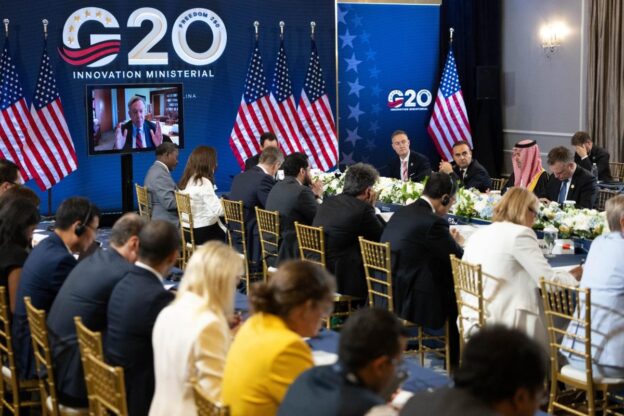
CHAPEL HILL, N.C. (WTVD) — The first day of the G20 Innovation Ministerial in Chapel Hill focused on artificial intelligence, emerging technologies and the growing demand for data centers, drawing virtual appearances from some of the tech industry’s most prominent leaders.
Officials and policymakers gathered Tuesday at the Carolina Inn as part of the international forum, which is centered on shaping policy around technological innovation.
Among the featured speakers were SpaceX founder Elon Musk, Meta founder Mark Zuckerberg and entrepreneur and investor David Sacks. The discussions included artificial intelligence investment, workforce development and concerns about whether existing energy infrastructure can keep pace with growing demand.
Musk warned that power generation could become a significant challenge as AI development accelerates.
“What the consensus is there will be a significant power shortfall next year, so not in the distant future,” said Musk, the event’s first invited speaker.
According to Stanford’s 2026 AI Index Report, U.S. data centers consume more energy than any other region. The report also found that U.S. private AI investment reached nearly $286 billion last year, leading the world with 1,953 newly funded AI companies.
Critics of data center development have raised concerns about environmental effects and impacts on utility costs.
“Data centers, if done right, bring electricity costs down, not up, because AI companies will generate new power generation,” Sacks said. “That’s really the key because obviously if you make AI companies compete for power or electricity with local residents and just plug it into the grid, that could cause electricity prices to go up.”
White House Office of Science and Technology Policy Director Michael Kratsios also addressed the issue when asked about land availability and local moratoriums.
“I think the thing that the president made clear in his Truth Social post yesterday was that ultimately, this is a community decision, and it’s something that communities have to get comfortable with,” Kratsios said. “But if done right, with having these data center providers either build, bring or buy all their own power, they can be actually very beneficial to the communities that they enter.”
Data Center Map reports North Carolina has 97 data centers, with the Charlotte region hosting the largest concentration, followed by the Triangle.
Kratsios praised the Triangle’s collaboration among government, academia and the private sector.
“What all of you are observing and hopefully being here in the Research Triangle will show that with the appropriate mix and collaboration between private sector, academia, and government, you can truly see some pretty generational changes in discovery,” he said.
Beyond infrastructure concerns, speakers discussed AI’s broader economic implications.
“I think AI will increase the global economy by 20-30%. That’s my rough estimate, meaning on the order of $20-$30 trillion per year,” Musk said.
Zuckerberg said AI could dramatically reduce barriers for entrepreneurs launching new businesses.
“I would expect that the cost of starting a business is going to go way down,” Zuckerberg said. “It’s going to take way less capital in the future, maybe way less people to get it started. Therefore, the shape of the economy going forward, I think there are going to be a larger number of startups and a larger number of thriving small businesses.”
At the same time, Zuckerberg explained workforce shortages are slowing efforts to build the infrastructure needed to support AI growth.
“We can’t find the volume of skilled tradespeople that we need to build the data centers. Even we, as just one company, are trying to build,” Zuckerberg said. “We created this program, America’s Workforce Academy, to help train people in skilled trades. We need way more carpenters, way more electricians, people who are skilled to build these complicated buildings.”
The G20 Innovation Ministerial continues Wednesday in Chapel Hill. Nvidia CEO Jensen Huang, OpenAI CEO Sam Altman and U.S. Commerce Secretary Howard Lutnick are scheduled to participate.
The event coincides with a separate G20 Finance Track meeting, which concluded Monday in Asheville.
UNC students split over G20 tech forum on campus
Students at the University of North Carolina expressed mixed reactions Tuesday to the G20 Forum taking place on campus, with some welcoming the focus on AI technology and others preparing to protest its environmental impact.
UNC student Anson Chen said he spent part of the afternoon outside the Carolina Inn hoping to catch a glimpse of tech leaders attending the event.
“Technology is like the future. So especially with AI,” he said.
Chen, who studies business, said he was surprised the university was chosen to host the global gathering.
“I mean like five-minute walk away from all my classes. So obviously it’s kind of crazy to imagine,” he said.
Not all students shared his enthusiasm.
UNC student Rhea Jacob and several friends plan to attend a demonstration Wednesday opposing AI development.
“We’re already not in a great global climate situation,” Jacob said.
She said she worries about the technology’s environmental effects.
“I think a lot of people are just really passionate about taking care of our environment and making sure that we’re not doing things to make things worse,” she said.
Chapel Hill’s mayor has said there will be a strong police presence around campus in the coming days.
– ABC11’s Elaina Athans contributed.
https://abc11.com/amp/post/g20-innovation-ministerial-talks-spotlight-ai-data-centers/19776405/