



Back in April, I talked to Sun Microsystems co-founder and early OpenAI investor Vinod Khosla, asked some important questions, and got some interesting answers.


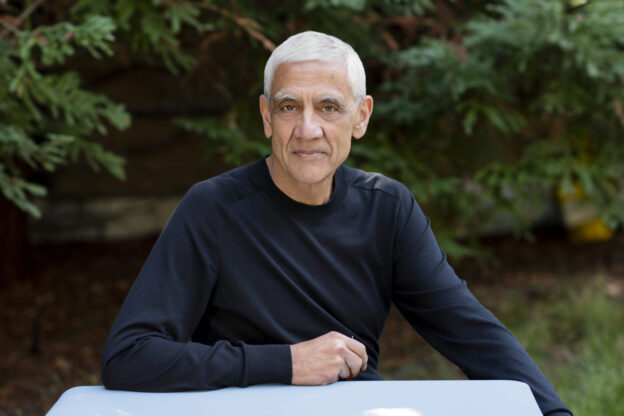
Portrait of Vinod Khosla
JOHN WERNER
A lot of this was related to what we’re going to see in terms of general artificial intelligence and specialized applications in the years to come. ChatGPT has taken the world by storm – we seem to be at an inflection point. So what does an early investor have to say about the future of AI?
Well, starting off the whole thing, Khosla talks about getting in on the ground floor. Going over a timeline, he mentions starting Sun in 1982, analyzing the emergence of the Internet in 1996, and starting Juniper later based on a belief in an exponential rise of technology within the next few years.
“Nobody else believed it,” he says. “It was uncertain that’s the time to jump in.”


Portrait of Vinod Khosla
JOHN WERNER
Take note, also, of some of Khosla’s predictions for the next quarter-century. He predicts that 80% of all jobs will be done by AI! He predicts FDA approval of an “AI-only family doctor” in five years, and talks about a project where a company is trying to come up with a top 10 music hit that’s created by AI without human participation.
“The process is pretty interesting,” he says.
Young entrepreneurs, pay attention: in terms of advice for a YC startup founder or anyone with skin in the game, Khosla suggests it’s better to look to the future, since new things get obsolete quickly.
“The most important thing a founder does is figure out whose advice to take,” he says.
Among other top Vinod Khosla tips: assemble great teams – use long-term analysis – and focus not just on one metric, but on a longer time horizon.
Answering our question about future techniques, he suggests that alternatives to large language models might come out of important research, including research right here at MIT. We’re blushing….
In terms of envisioning the future of AI, Khosla is optimistic.


Portrait of Vinod Khosla
JOHN WERNER
We’ll be in the era of great abundance,” he says, “of GDP growth – being able to be more creative – music, art, storytelling, all to be done by AI – all the way to oncology, and medicine, and robotics – almost anything you can imagine.”
At the same time, Khosla responds to my next question about inequality this way, agreeing that the outcomes of AI will increase inequality:
https://www.forbes.com/sites/johnwerner/2023/09/18/get-ready-ai-doctors-musicians-and-more-from-vinod-khosla/amp/