



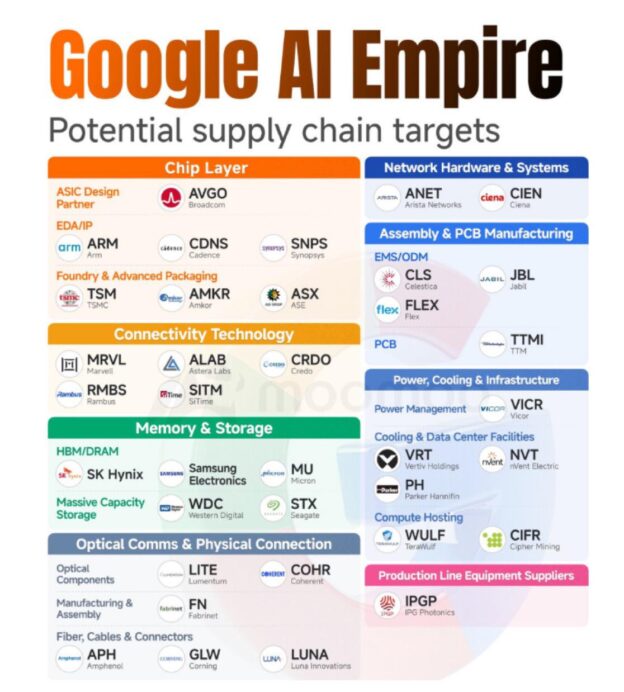
I. Introduction: The AI Revolution’s Quiet Giant
Google is a significant, often unseen, force in the AI revolution, driven by an “AI-first” strategy and substantial long-term investments. This exploration details how Google’s investments are shaping and constructing the infrastructure for the future of AI.
II. Genesis of a Giant: Google’s AI Legacy
Google’s AI dominance is a result of a long-cultivated legacy:
- Early Hardware Development: In 2014, Google began developing custom-built AI hardware, the Tensor Processing Unit (TPU), which became a cornerstone of its AI strategy.
DeepMind’s Impact: Google acquired DeepMind in 2014. Key achievements include:
- AlphaGo (2016): Defeated a world champion Go player, demonstrating AI’s advanced capabilities.
- AlphaFold: Solved the protein folding problem, promising to revolutionize biology and medicine.
- Research to Product Integration: DeepMind transitioned from pure research to a commercial AI entity, translating innovations into tangible products and services, including powering models like Gemini and influencing other Google offerings.
III. The Unseen Engine: Powering Google’s AI Infrastructure
Google’s AI infrastructure is characterized by massive investments and specialized hardware:
- Financial Commitment: Google plans to invest $75 billion in AI infrastructure for 2025.
Tensor Processing Units (TPUs):
- Custom-built chips designed specifically for AI workloads, offering superior speed, efficiency, and cost-effectiveness compared to general-purpose GPUs for AI tasks.
- Strategic partnership with Broadcom enhances TPU performance and cost-effectiveness.
- Evolution from v1 to Ironwood (v7) demonstrates continuous advancement in AI acceleration.
Data Centers:
- Global expansion of data centers in locations like Texas, India, Europe, and Asia to meet the growing demand for AI compute.
- A $40 billion commitment to Texas alone highlights this expansion.
Sustainable Energy:
- Acquisition of Intersect Power for $4.75 billion to secure renewable energy sources.
- Utilizing AI to optimize data center thermodynamics, reducing energy consumption and improving efficiency.
- Commitment to 100% renewable energy matching for its operations.
IV. The AI Toolkit: Google’s Offerings for All
Google democratizes AI access through various tools and technologies:
Gemini:
A multimodal AI model with different versions:
- Nano: Lightweight version.
- Ultra: Powerful version.
- Gemini Advanced: Acts as a smart chatbot for Google Workspace (Gmail, Docs).
- Gemini Enterprise: Provides AI agents for businesses and enables live captions in Google Meet.
Vertex AI
A unified platform for developers to build, train, and deploy AI models, featuring over 200 pre-trained models in its Model Garden.
AI Integration in Products:
- Search: Powered by SGE/AI Overview for more comprehensive results.
- Google Assistant: Enhanced responsiveness and intuitiveness.
- Pixel Phones: Advanced AI-powered camera features and personalized experiences.
Creative AI Tools:
- Veo: For video generation.
- Imagen: For image generation.
- Lyria: For music generation.
V. The AI Arena: Google’s Place in the Grand Battle
Google operates within a competitive AI landscape:
Collaborations:
- Anthropic utilizes 1 million TPUs for its Claude model.
- AP News partners with Gemini for news delivery.
- Cloud Computing: Google Cloud is experiencing significant growth (40%) and is positioned as “the AI cloud.”
Custom Chip Competition: Google’s TPUs compete with:
- AWS’s Inferentia and Trainium.
- Microsoft’s Maia and Cobalt (supported by substantial Nvidia purchases).
- Meta’s MTIA.
- Industry Recognition: Forrester has recognized Google Cloud as an AI infrastructure leader.
Challenges:
- Energy Consumption: The significant power demands of AI remain a concern, despite renewable energy initiatives.
- Regulatory Pressure: The European Commission’s ruling on anonymized user data sharing with competitors highlights ongoing oversight.
VI. Beyond the Horizon: Google’s AI Future
- Project Suncatcher: An initiative to deploy solar-powered satellites equipped with TPUs in orbit, with a prototype planned for early 2027.
- Artificial General Intelligence (AGI): DeepMind’s roadmap suggests the possibility of AI surpassing human capabilities by 2030.
- Ethical Development: Google is committed to responsible AI development through its Frontier Safety Framework, prioritizing safety, privacy, and bias prevention.
Conclusion: Google, the Ever-Evolving AI Powerhouse
Google has built a vast, vertically integrated AI ecosystem through consistent investment in TPUs, groundbreaking work with DeepMind, and democratizing AI tools like Vertex AI. With substantial financial commitments, custom hardware, leading AI models, and ambitious future projects, Google is actively architecting the AI revolution. The company’s future endeavors suggest that its AI capabilities will continue to expand, with no clear limits in sight.
If You Wish To Support Me As A Creator
- Clap 20 times for this story
- Leave a comment telling me your thoughts
https://medium.com/@Sathariels/googles-ai-empire-architecting-the-intelligent-future-2ca285184f1c