



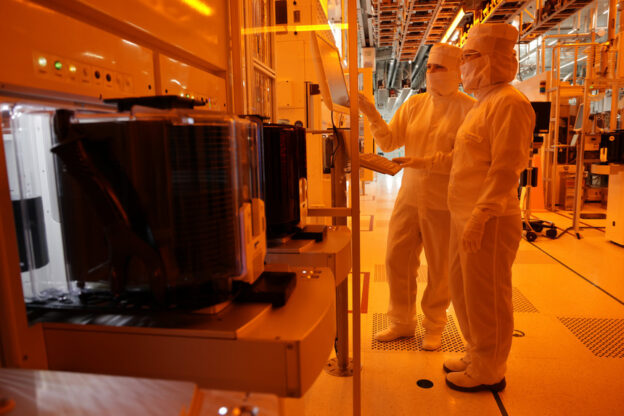
Tie-up aims to mitigate geopolitical risks in ‘back-end’ production
TOKYO — Intel will partner with 14 Japanese companies to develop technology to automate “back-end” chipmaking processes like packaging, Nikkei learned Monday, as the U.S. and Japan look to cut geopolitical risks to their semiconductor supply chains.
The tie-up, which includes electronics maker Omron, Yamaha Motor, and materials suppliers Resonac and Shin-Etsu Polymer, will be led by Kunimasa Suzuki, head of Intel’s Japanese arm.
The group is expected to invest tens of billions of yen (10 billion yen equals $65 million) in the effort, aiming to achieve working technology by 2028.
As advances in front-end operations like circuit formation start to approach their physical limits, competition is growing in back-end steps like stacking chips to improve performance.
Manual assembly is a major part of back-end production, which has been concentrated in countries with large labor pools such as China and Southeast Asian nations. Companies see automation technology as a necessary prerequisite for setting up facilities in higher-cost U.S. and Japan.
The Intel-led group will set up a trial back-end production line in Japan within the next few years, aiming for full automation. It will also look to standardize back-end technology, enabling manufacturing, inspection and handling equipment to be managed and controlled by a single system.
Japanese companies hold a roughly 30% combined share of global sales of semiconductor production equipment and 50% of semiconductor materials, according to Japan’s Ministry of Economy, Trade and Industry. The ministry is expected to provide up to tens of billions of yen in support for the effort.
The government earmarked about 4 trillion yen ($26 billion at current rates) from fiscal 2021 to 2023 to help an industry it sees as critical to economic security. It approved in April 53.5 billion yen in aid for back-end technology research by Rapidus, which aims to mass-produce cutting-edge chips in Japan, and is considering incentives to attract foreign back-end production players.
Japanese and U.S. policymakers seek to bring as much of the chipmaking process as possible within their borders, reducing the risk of vital supply chain links being cut off.
As of 2022, 38% of global back-end chipmaking capacity was in China, data from Boston Consulting Group shows. An executive at a U.S. contract manufacturer said the company had received requests from American and European customers to mitigate China-related supply risks.
The hope is that back-end automation will help to compensate for Japan’s dearth of chip engineers, as big fabrication facilities run by Taiwan Semiconductor Manufacturing Co. and Rapidus threaten to absorb much of the available personnel.
It could provide an edge in artificial intelligence development as well, as combining processors, memory and other functions into a single package can enable them to work more efficiently.
Beyond the Intel project, TSMC and Samsung Electronics have or plan to build research centers in Japan for back-end production. Market research firm TechInsights expects the back-end market to grow 13% this year to $12.5 billion.
https://asia.nikkei.com/Business/Tech/Semiconductors/Intel-assembles-Japan-team-for-chipmaking-automation