



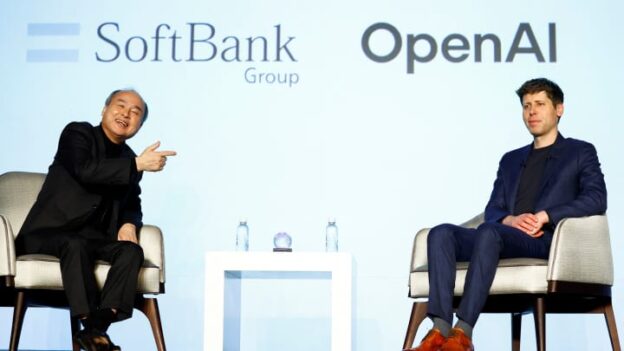
SoftBank CEO Masayoshi Son said OpenAI’s next model is being designed by another AI model, calling it a sign that superintelligence is approaching faster than he previously indicated, according to CNBC.
After conversations with OpenAI CEO Sam Altman and engineers at the company, Son said he learned that “a model is designing” a future model. That dynamic, he argued, will eventually leave human engineers unable to keep pace with the models they once built. “So once that happens, [the] model generates [the] next model … and it’s going to be exponentially smarter than all of us. That’s a superintelligence,” Son said.
Son revised his timeline for superintelligence’s arrival. Nearly two years ago, he had publicly said it would come within a decade, but he said that estimate was intentionally restrained. “In my mind, I thought it was coming in four years instead of 10 years. Now, I say it’s coming in the next two years,” he said.
Reached for comment, an OpenAI spokesperson would not address unreleased models but drew attention to existing ways the company has woven AI into its development process. OpenAI announced in February that GPT-5.3-Codex holds the distinction of being its “first model that was instrumental in creating itself,” as the Codex team put early builds to work diagnosing their own training runs, overseeing deployment, and evaluating test results.
Son’s comments arrive alongside a broader conversation in the industry about AI systems that can build their own successors — a concept researchers call recursive self-improvement. Anthropic, the maker of the Claude AI assistant, published an analysis of recursive self-improvement, a phenomenon it defined as an AI system reaching the point of being “capable of fully autonomously designing and developing its own successor.” Anthropic said it is not there yet but warned the milestone “could come sooner than most institutions are prepared for.”
Anthropic reported that as of May 2026, more than 80% of the code merged into its codebase was written by Claude, up from a low single-digit share before early 2025. Slowing the technology’s development through collective action among labs “would likely be a good thing,” Anthropic said, though the company noted that any single lab acting alone would achieve little.
A June research paper from OpenAI identified “early signs” of recursive self-improvement already present in current systems, cautioning that societies and governments are not yet equipped to handle what comes next and must develop tools to guide where the technology leads.
https://tech.yahoo.com/ai/articles/masayoshi-son-says-ai-designing-144448382.html?shem=rimspwouoe,