



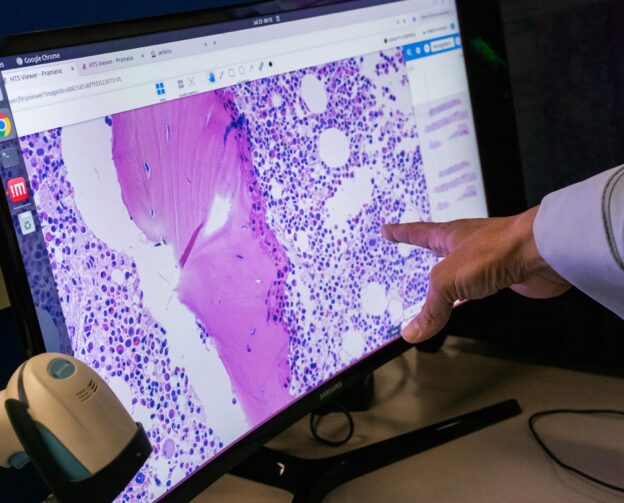
Rochester-based Mayo Clinic is using the technology to fuel its large-scale project to pull new insights from droves of pathology data, which may help with diagnostics.
Mayo Clinic has collaborated with the world’s most valuable company to launch the first supercomputer in a hospital using a new AI technology that could shorten the time to diagnosis and hasten treatment of deadly diseases.
It’s the first time AI chipmaker Nvidia’s technology will be used this way in a health care setting on a large scale.
“The confluence of the [AI computing power] that we’re talking about, the data, and the clinical knowledge coming together could be kind of a once-in-a-generation opportunity to truly transform how medicine is practiced,” said Jim Rogers, CEO of Mayo Clinic Digital Pathology.
The technology will help Mayo build new AI models to make advances in clinical areas such as pathology, which focuses on diagnosing and understanding diseases. Mayo did not share the system’s cost.

Dr. Matthew Callstrom, medical director of Mayo’s strategy department and leader of the generative AI program, said scientists will someday be able to build AI models around the droves of Mayo’s de-identified pathology data to help them understand high-stakes ideas such as the staging and progression of cancer.
The investment comes as Mayo Clinic revs up its broader AI strategy, including partnerships with Google, Microsoft and the genomics-focused AI company Cerebras.
Executives of the world-renowned health system hope AI can relieve administrative workload and facilitate medical breakthroughs.
Matt Redlon, Mayo’s vice president of digital biology for Mayo Clinic Digital Pathology, said the system’s capabilities are three to four times stronger than Mayo’s previous technology. Rogers said the infrastructure is “rocket fuel” accelerating innovation.
“This acquisition marks a transformative leap in digital pathology and precision medicine capabilities,” David Niewolny, director of business development for health care and medical at Nvidia, said in an email.
Specifically, Niewolny added, the technology will allow Mayo to fully digitize its enormous pathology archives in hopes of revealing new insights from aggregated patient data.
The system relies on Nvidia computing infrastructure called DGX SuperPOD. It’s a large computing “cluster” that, in Mayo’s case, uses 128 high-powered chips called Blackwell graphics processing units (GPUs).
https://www.startribune.com/mayo-clinic-ai/601427580