




- With Micron’s stock price up more than tenfold since the end of 2024, the company’s hometown of Boise, Idaho has a growing crop of newly minted millionaires.
- The AI-driven memory boom is showing up in the form of job growth, new construction projects, a bustling dining scene and an influx in new residents.
- But the rush of development along with Micron’s $50 billion expansion plan in Boise also means traffic jams, soaring housing costs and uneven wealth distribution.
Dave Petso has been a wealth manager in Boise, Idaho since the 1980s. His business has survived multiple recessions, the bursting of the dot-com bubble and the 2008 financial crisis.
For most of Petso’s 45-year career, Micron, the hometown maker of computer memory, has been a boring enterprise tech company and, in his words, a “terrible investment.”
But almost four years into the artificial intelligence craze, the sleepy semiconductor company is one of the hottest names on the planet, turning many of Petso’s clients into sudden millionaires. A big part of Petso’s job has become helping Micron employees diversify after a more than tenfold increase in the stock since the end of 2024 lifted the company’s market cap past $1 trillion.
“You’ve got a boatload of money now, and it’s all tied up in one company,” Petso said in an interview. Where clients had been figuring out what to do with some $20,000 worth of stock, “now we’re talking about hundreds of thousands or millions of dollars,” he said.
Across Boise, a Mountain West city of about 250,000 residents that’s best known for outdoor adventures and the blue turf football field at Boise State University, the Micron boom is showing up in the form of job growth, new construction projects, a bustling dining scene and an influx in new residents.
Micron has broken ground on two new chip manufacturing facilities that are expected to create more than 17,000 new jobs in the area. That includes 3,500 at Micron, which currently employs about 7,000 people in and around Boise.
On Thursday the company introduced Micron Research Labs, which will be headquartered in Boise and backed with $10 billion from Micron over the next decade. The company said it expects to start construction next year, and CEO Sanjay Mehrotra told CNBC’s Jim Cramer in an interview in Boise that the labs are “going to be driving America’s leadership in semiconductor and memory technology.”

With the city’s rapid expansion comes plenty of annoyances. Residents complain of frequent traffic jams around town or on Interstate 84, rising housing costs and a rush of people from California and elsewhere altering the local culture and landscape. Average rental prices in Boise have climbed 4.3% in the past year, while average prices nationwide have dropped, according to Zillow.
“One of Boise’s competitive advantages was our low cost of living,” said Jason Crawforth, a lifelong resident of Boise who’s been building tech companies in the area for almost 35 years. But Crawforth said that while he’s seeing his net worth go up from an investment in Micron, “there’s a large demographic of our community that doesn’t have a direct benefit from that.”
CNBC spoke to residents, business owners, real estate agents and others in the Boise area about the recent boom, its impact on the city and what could still be coming as Micron embarks on a $50 billion expansion plan. They collectively portray the city as an unexpected winner in the global AI buildout, one that’s trying to hang onto its identity while not becoming overreliant on a technology with a long history of boom-and-bust cycles.
While the trajectory still points up and to the right, Micron shares plunged 29% in July, their worst month since 2002. Shareholders hope it was just a corrective blip, and not a sign of things to come. The stock is up 14% so far in August.
Boise and the global memory race
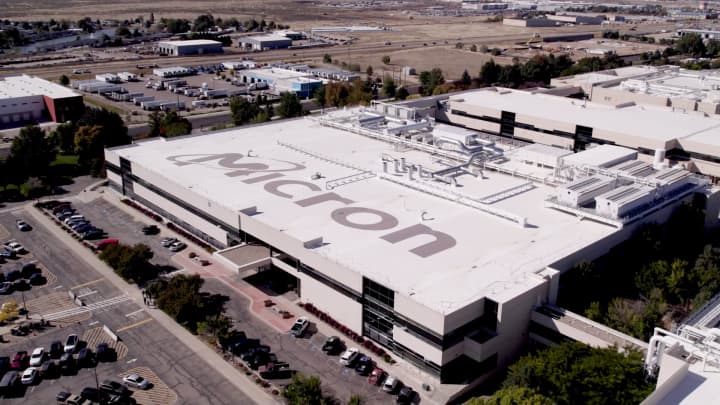
Micron was founded in Boise nearly 50 years ago in the basement of a dental office. By 1981 its first chip fabrication plant was up and running there, pumping out general-purpose memory chips known as DRAM. In its latest quarter, DRAM accounted for 76% of Micron’s total revenue.
DRAM is also the type of chips that are stacked to make high-bandwidth memory, or HBM, which is then added to the powerful processors used for AI.
As HBM gobbles up the world’s supply of DRAM, it’s caused a global shortage and skyrocketing memory costs, leading to higher prices across the board, even for consumer electronics like Apple’s MacBooks and iPads.
All three of the world’s top HBM suppliers — market leader SK Hynix, Samsung and Micron — are building huge new plants to try and meet demand. SK Hynix and Samsung are constructing mega-fabs in their home country of South Korea.
They’ve all been handsomely rewarded by the stock market despite the July pullback. Micron leads the pack, up almost 670% in the past year, followed by SK Hynix at about 470% and Samsung at over 250%.
The rally turned Mehrotra, a nine-year veteran of the company, into a billionaire earlier this year, though last month’s selloff pushed him below that mark. For Mehrotra, Boise represents a big opportunity to help turn his company into a hotbed for U.S. manufacturing.
“Memory is no longer the component in a system,” Mehrotra told Cramer on Thursday. “Memory is the strategic infrastructure for AI.”
The first of Micron’s two new Boise fabs is scheduled to come online in 2027. It will be the country’s first front-end factory for manufacturing leading-edge memory. Most of Micron’s top-end memory is currently produced in Taiwan, Japan and Singapore.
The site also includes utility and water-treatment buildings to support the resource-intensive process of making chips. Local utility Idaho Power told CNBC in a statement that it “does not expect large-load growth, including Micron’s expansion, to increase electric bills for other customers.”
Additional AI-driven growth in the area is coming from Meta, which is building an $800 million data center 20 miles southwest, in Kuna, Idaho, that it says will create about 100 operational jobs. There’s a flurry of new offices from Micron suppliers like Lam Research and cleanroom builder Exyte, plus contractors coming in for lucrative jobs helping to build Micron’s fabs.
With Boise, and an even bigger memory fab campus coming to Clay, New York, Micron’s long-term goal is to produce 40% of its DRAM in the U.S. It plans to spend $250 billion through 2035 to get there, with the help of up to $6.2 billion of CHIPS Act funds, which were granted under the Biden administration.

Micron is part of the fabric of Boise’s economy, alongside other local legends like the Albertsons grocery chain and the potato empire of J.R. Simplot, who was one of Micron’s first investors.
Today, the memory maker is among Ada County’s leading employers, after Boise State and the region’s health system.
“It’s always been something that we’ve been around, but of course recently, with Boise, Idaho being a very small market, it’s probably one of our largest success stories that we’ve ever had,” said JT Belnap, founder of Treasure Valley Financial Planning, which is now almost exclusively focused on managing Micron employees’ wealth.
Belnap told CNBC that his firm’s phones are “continuing to ring” with requests from Micron employees who are close to retirement.
Because of the stock appreciation, some are moving up their timelines to exit the workforce from three or four years to one or two, Belnap said. To take advantage of tax benefits, others are donating stock to charities. And plenty are taking some profit for a dream purchase, like one of Belnap’s clients who recently bought an $80,000 truck he’d always wanted.
“What I’ve learned doing financial planning for as long as I have is when anyone comes into some real wealth that’s kind of a sudden thing, you need to allow them to have a little bit of fun,” Belnap said.
Selling stock to buy jewelry, homes
About 9 miles east of Belnap’s office, a very different kind of business is noticing a similar trend. Lisa Zimowsky, owner of jewelry boutique The Diamond Girls, said her sales are up 60% for the year.
“I do know of several people that have sold some stock and bought with us,” Zimowsky said. “Usually it’s the people that got a quarterly bonus when the stock was $150,” or less than one-sixth its current price.
“The Boise economy is super strong,” Zimowsky added. “I think Micron’s been a big part of that.”
Then there’s the real estate market.
Sheila Smith, an agent in the area, said she’s seen more prospective buyers and fewer listings for homes in the southeast part of the city, near Micron’s headquarters. Smith said there’s so much construction that some Micron contractors involved with the new fabs are purchasing homes.
“Typically if somebody knows they’re only going to be here temporarily, for an interim-type job, such as the engineers, they don’t look to buy,” Smith said in an interview. “They are coming here and they are buying.”
Mortgage broker Gerald Robinson said that over about a month-long stretch, he consulted with four Micron clients who were looking to buy homes.
“We’re seeing a lot of stock options being executed right now, and people [are] purchasing,” said Robinson, CEO of 1st Choice Mortgage.