



On April 10, 2026, four astronauts splashed down in the Pacific Ocean off San Diego, completing the first crewed lunar voyage in 54 years. The flight took nearly 10 days. Rebuilding NASA’s ability to fly it and return to the moon took five decades. Why it took this long is, in many ways, as fascinating as the mission itself.
NASA’s Artemis II mission is just the beginning of many planned missions for the program, which seeks to establish a sustainable, long-term human presence on our nearest neighbor for science, exploration, resource development, and training for deep space missions to Mars and beyond. The mission was a crewed test flight that looped around the Moon in a great figure-eight trajectory and brought them home. This mission did not land on the lunar surface, but along the way, it made history, reaching the farthest from Earth that any human being has ever traveled.
Why Did It Take 54 Years?
One of the most common questions about the Artemis program is why NASA hasn’t returned to the moon since the iconic Apollo missions of the 1960s. The short answer is funding and politics. The longer one starts with how much more NASA wanted to accomplish on the Moon – and beyond.
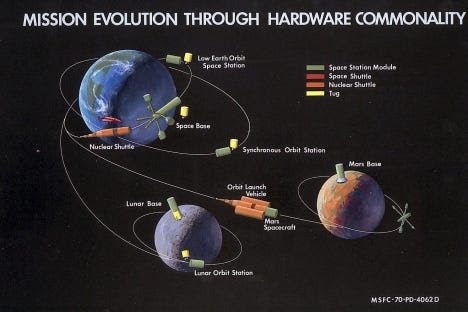
At the height of the Apollo Program, NASA had grand plans for continued large-scale missions under the Apollo Applications program, which sought to use the Apollo spacecraft, Lunar Module, and Saturn V rocket for a variety of expanded activities. One element of Apollo Applications that did come to fruition was Skylab, America’s first space station, which hosted crews in 1973 and 1974. A larger version of Apollo Applications was the Space Transportation System Integrated Program Plan, which envisioned a low Earth orbit (LEO) space station, a reusable space shuttle, a permanent lunar base, reusable nuclear-powered space freighters, and crewed missions to Mars by the 1980s. Unfortunately, as public attention drifted to Vietnam and unrest at home following the tremendous success of Apollo 11, the Nixon Administration shut down the Saturn V production line and funded just one piece of that grand plan — the Space Shuttle.
NASA hoped that the Shuttle would become a “space truck” that would facilitate the other elements of the plan later, but budgetary realities and military involvement compromised the design. The Shuttle included the winged orbiter, which housed the crew, cargo, and the three main engines; a disposable external fuel tank, which was dropped during each mission and needed to be replaced; and two solid rocket boosters that provided the majority of thrust at liftoff and would be recovered after parachuting into the ocean.
 |
The Shuttle broke new barriers as the world’s first reusable spacecraft and kept America in the human spaceflight business from 1981 to 2011. It opened access to a much larger and more diverse cadre of astronauts and inspired millions. This was an amazing service record but wasn’t without tragedy, notably including the Challenger and Columbia disasters in 1986 and 2003. The Shuttle also never lived up to its promises of rapid turnaround and low-cost access to space, with each launch costing over a billion dollars by the time it retired. The Shuttle’s signature achievement was providing the heavy lift and crew launch capability needed to assemble the International Space Station (ISS), which has maintained a continuous human presence in orbit since 2000 but is now nearing the end of its operational life. However, it couldn’t leave low Earth orbit, leaving NASA incapable of transporting people back to the Moon or beyond for thirty years.
The Shuttle and ISS absorbed a huge portion of NASA’s limited budget, leaving few resources to develop next-generation technologies or think about going back to the Moon. This began to change in 2004 when the Bush Administration launched Project Constellation to develop a new family of launch vehicles called Ares out of repurposed Shuttle hardware repackaged to enable moon missions. Two vehicles in the family were slated. Ares I was a “single-stick” rocket with one solid rocket booster derived from those on the Shuttle and a new upper stage. The much larger Ares V would provide super-heavy cargo lift capacity. A new crew capsule, Orion, which looked very similar to the Apollo spacecraft but was larger and incorporated more modern technology, was designed for the program. Ares I was intended to launch Orion to either LEO or to a rendezvous with an Earth Departure Stage (EDS) launched by Ares V, which would take the capsule to the moon. A new lander called Altair would be a larger version of the Apollo Lunar Module. This was a different architecture from Apollo, which was able to launch the entire Apollo spacecraft, including the Lunar Module, on a single Saturn V rocket. The overall Ares architecture was intended to replace the Shuttle in its capacity as the crew vehicle for the ISS in LEO as well as enable missions to the Moon, and eventually Mars (Ares was named for the Greek version of Mars, the god of war in classical mythology).
 |
However, Constellation soon ran into trouble. The Ares I-X test vehicle first flew in 2009, but the design experienced serious issues with pogo oscillation – a phenomenon that carried health risks for the crew and affected the propulsion system of the rocket. Because the gigantic Ares V rocket used a different tank diameter than the Shuttle’s external tank, it would require new tooling and production facilities. By 2010, the program was behind schedule and seriously over budget, at a time when the government’s spending was constrained by the global financial crisis. Following the recommendations of a panel of industry experts called the Augustine Commission, the Obama Administration canceled the Constellation program in 2010. This left NASA in a precarious position — not only was the moon back out of reach, but there was now no replacement for the Space Shuttle, which was set to retire in 2011 once the International Space Station’s assembly process was finished.
What followed was a humbling decade for American human spaceflight. From the Shuttle’s retirement in 2011 until 2020, the United States had no way to launch its own astronauts into orbit. Instead, NASA bought seats aboard Russian Soyuz spacecraft, paying Roscosmos a fare that climbed past $90 million per seat by the end of the arrangement. For the country that had won the original Space Race, it was a galling place to be.
Against this backdrop, Congress intervened in a bipartisan effort to save America’s space launch capabilities. The Orion capsule program, which was making good progress, was salvaged from the ashes of the Constellation project, and NASA was ordered by the US Senate to begin developing a new heavy-lift launch vehicle drawing on the lessons of the Ares program but without the limitations discovered during the project. This new vehicle was imaginatively named the ‘Space Launch System,’ or SLS. The hardware, though, was only half the problem. Each cancelled program also drained NASA of hard-won engineering expertise — the kind of institutional muscle that takes decades to build and only years to lose. Recently, that erosion is what NASA Administrator Jared Isaacman targeted when, at the a16z American Dynamism Summit in March 2026, he announced NASA Force, a program to recruit top aerospace, software, and systems talent from industry into the agency on roughly two-year terms.

The Hardware of Artemis II: SLS and Orion
SLS was designed to make maximum use of existing Shuttle hardware and production facilities, to cut costs, reduce certification time (certifying hardware for human spaceflight is time-consuming and expensive), and keep people employed on the critical Space Shuttle production lines. SLS’s design incorporated two Shuttle solid rocket boosters, but with an extra segment included in the middle (boosters are modular to facilitate rail transport from the production facility in Utah), four RS-25 engines identical to the Space Shuttle main engines, and a core stage based on the Shuttle External Tank, with the same diameter (allowing common tooling) and the same iconic orange thermal protection foam. The upper stage of the rocket, called the Interim Cryogenic Propulsion Stage (ICPS), was derived from the upper stage of the Delta IV Heavy rocket then in use by NASA and the US Air Force.
A large coalition of legacy aerospace companies was assembled to produce the full stack: Boeing is the prime contractor for the core stage, Northrop Grumman produces the solid rocket boosters (following its acquisition of Orbital ATK in 2018), Aerojet Rocketdyne (now part of L3Harris) produces the main engines, United Launch Alliance (a joint venture of Boeing and Lockheed Martin) produces the ICPS, Airbus Defense and Space produces the service module, and Lockheed Martin produces the Orion spacecraft. The Orion capsule itself carries four crew and offers roughly 60% more habitable volume than the Apollo command module, paired with a European-built service module that supplies power, propulsion, and life support, putting an international partnership into the hardware itself. All told, more than 1,100 contracting companies, spread across all 50 states, have a hand in the program. That distribution is on purpose, as spreading the work nationwide builds the broad congressional constituency that has kept SLS funded through multiple administrations — a fact of the program’s policies as much as its engineering.
Standing at 322 feet tall, SLS is taller than the Statue of Liberty, although it is slightly shorter than the Apollo-era Saturn V. Combined, the four main engines and two solid rocket boosters produce 8.8 million pounds of thrust at liftoff, making SLS the most powerful operational rocket in history (the Soviet N1 and SpaceX’s Starship have/had higher thrust ratings, but the N1 never successfully launched and Starship has yet to enter operational service).

 |
 |
SLS development proceeded at a relatively slow pace due to NASA’s constrained budget environment. NASA has received public criticism for the cost and delays associated with the program – each launch carries a price tag of roughly $4 billion, and development ran to roughly $27 billion. Set against the Saturn V, the numbers look different. Adjusted for inflation, the SLS cost less than half as much to develop as the Saturn V while operating under tighter annual budgets. Currently, NASA’s whole annual budget (encompassing Artemis as well as all other projects) accounts for about 0.3% of federal spending, contrasting to 4% of the federal budget in 1965, the peak year for Apollo development.
Orion flew its first test flight, called Exploration Test Flight-1, in 2014 on a Delta IV Heavy booster. The Space Shuttle flew its last flight in 2011, with the remaining orbiters retired to museums in Los Angeles, New York City, Washington, DC, and Cape Canaveral. Under NASA’s new scheme, Orion would no longer be responsible for crew transport to the ISS; instead, the Commercial Crew program was created to issue development contracts to private companies to develop new vehicles for LEO. This yielded the SpaceX Crew Dragon, which entered service in 2020 and is now the mainstay of America’s human spaceflight fleet, and the Boeing Starliner, which has faced a torturous development with many issues, most notably the time it “stranded” astronauts Butch Wilmore and Sunita Williams on the International Space Station for 286 days from 2024-2025.
 |
After years of delays, the first Space Launch System core stage was rolled out of the Michoud Assembly Facility (MAF) in New Orleans in 2020 and began a long series of tests called the Green Run campaign at NASA’s Stennis Space Center in Mississippi. After the successful completion of these tests, the stage was transported by barge to Kennedy Space Center in Florida, where it was mated with the solid rocket boosters, the upper stage, and the Orion spacecraft in the giant Vehicle Assembly Building (VAB), one of the world’s largest buildings. After several fits and starts – including a few scrubbed launches and two hurricanes – the SLS finally roared to life on the Artemis I mission on November 16, 2022. Artemis I was an uncrewed test of the Orion spacecraft that sent it into a distant retrograde orbit around the Moon. This was the first time a spacecraft designed to carry humans had left orbit in 50 years. SLS performed its mission flawlessly, unusual for the debut of a new launch vehicle, and a payoff for years of careful design and testing by NASA personnel and the 1,100-plus companies that built it. Orion also performed well, although examination of its heat shield following reentry revealed concerning divots, forcing a full review of the heat shield’s design and the vehicle’s reentry trajectory.
 |
 |
The Crew of Artemis II
Following the success of Artemis I, NASA began preparations for Artemis II, the first crewed flight of the program. A diverse crew was selected from NASA’s cadre of astronauts.
 |
Commander Reid Wiseman served as a fighter pilot for the US Navy in test and combat roles in Iraq and Afghanistan before joining NASA. He flew to space on ISS Expedition 40/41 and served as the chief of the Astronaut Office. Pilot Victor Glover served in the US Navy in Iraq before joining NASA in 2013, serving in ISS Expedition 64/65. He was the first person of color to travel to the moon. Mission Specialist Christina Hammock Koch worked in physics and other science roles with NASA Goddard, Johns Hopkins Applied Physics Laboratory, the US Antarctic Program, and NOAA before joining NASA in 2013. She completed the longest-duration spaceflight by a woman (328 days) on ISS Expedition 59/60/61, and was the first woman to travel to the moon. Mission specialist Jeremy Hansen served in the Royal Canadian Air Force as a CF-18 fighter pilot and served as a NEEMO aquanaut. He was the first non-US person to travel to the moon, on his first spaceflight.
NASA astronauts traditionally choose the names of their spacecraft; this crew decided to name the Artemis II Orion Integrity.
The Mission and Its Moments
Artemis II ultimately faced two years of delays from its initial projected launch date as NASA sought to address the heat shield concerns from Artemis I, which were ultimately addressed via a heat shield redesign for future missions and an adjusted trajectory for Artemis II. Artemis II launched on April 1, 2026 on the second SLS rocket, this one painted with special “America 250” livery to recognize the country’s sestercentennial. SLS performed so well, with over 99% orbital insertion accuracy, that two planned burns in the mission were not necessary. After initial checkouts in Earth orbit, including a simulated rendezvous maneuver, Integrity conducted the trans-lunar injection burn, becoming the first crewed spacecraft to leave Earth orbit in 54 years.
 |
 |
A photo of Earth captured by the crew during trans-lunar injection. The planet is backlit, with the sun behind it, rendering the atmosphere and auroras visible. (NASA)
 |
Artemis II’s overall mission profile was very similar to Apollo 8: a circumlunar flight to test out the spacecraft with humans aboard, essentially in a “figure 8” around the moon. However, the similarities didn’t end there. Apollo 8 famously flew at the end of 1968, during one of the most tumultuous years in modern American history – including the Vietnam War abroad, high-profile assassinations, and unrest at home. On Christmas Eve, its crew beamed back a message and a view of the Earth that briefly seemed to steady a reeling world. A private citizen later sent the astronauts a telegram that simply said: “You just saved 1968.”
Artemis II carried an uncanny echo of that moment. It, too, flew during a major holiday – Easter – and into a world unsettled by war in the Middle East and a highly polarized political environment at home. On Easter morning, Mission Pilot Victor Glover shared the following message:
“I think these observances are important, as we are so far from Earth and looking back at the beauty of creation. I think for me, one of the really important personal perspectives that I have up here is I can really see Earth as one thing.
And you know, when I read the Bible, and I look at all of the amazing things that were done for us, who were created, it’s…you have this amazing place, this spaceship. You guys are talking to us because we’re in a spaceship really far from Earth. But you’re on a spaceship called Earth that was created to give us a place to live in the universe, in the cosmos.
Maybe the distance we are from you makes you think what we’re doing is special. But we’re the same distance from you, and I’m trying to tell you—just trust me—you are special. In all of this emptiness—this is a whole bunch of nothing, this thing we call the universe—you have this oasis, this beautiful place that we get to exist together.
I think as we go into Easter Sunday, thinking about all the cultures all around the world, whether you celebrate it or not, whether you believe in God or not, this is an opportunity for us to remember where we are, who we are, and that we are the same thing, and that we got to get through this together.”
 |
On April 6, Integrity officially broke Apollo 13’s record for the farthest distance traveled from Earth. The crew maxed out at 252,756 miles from Earth, far enough out to see features on the far side of the Moon that no human eye had ever taken in before. Shortly after breaking the record, the crew shared a highly emotional moment when they named a crater “Carroll” after Commander Reid Wiseman’s late wife, an NICU nurse who passed away in 2020 after a courageous battle with cancer. The crater, located near the boundary between near and far sides of the moon, is visible from Earth as a bright spot at certain times. Their two teenage daughters, who gave Reid a friendship bracelet for the mission, watched from Mission Control.
 |
Adding even more emotion, NASA played a surprise recording of a message left by legendary Apollo 8 and 13 Commander Jim Lovell for the crew shortly before he passed away last year:
“Hello, Artemis II! This is Apollo astronaut Jim Lovell. Welcome to my old neighborhood! When Frank Borman, Bill Anders, and I orbited the moon on Apollo 8, we got humanity’s first up-close look at the Moon and got a view of the home planet that inspired and united people around the world. I’m proud to pass that torch on to you – as you swing around the Moon and lay the groundwork for missions to Mars…for the benefit of all. It’s a historic day, and I know how busy you’ll be. But don’t forget to enjoy the view. So, Reid, Victor, Christina, and Jeremy, and all the great teams supporting you – good luck and Godspeed from all of us here on the good Earth.”
After passing around the back side of the moon, Artemis II transmitted some amazing images of Earth and the moon eclipsing the sun.
 |
 |
Public response to the mission was overwhelmingly positive. Applications by kids to space camp doubled, and commentators cheered the crew for their clear demonstration of competent leadership, caring emotional support, and international cooperation. Artemis II truly gathered the best of us and put it on display for the world to see.
 |
Artemis II splashed down in the Pacific Ocean on April 10, 2026 and was picked up by the San Antonio-class landing platform dock USS John P. Murtha.
 |
What Comes Next?
Artemis II was just the beginning; a test flight. NASA’s next challenge is actually landing people on the moon for the first time since 1972. SpaceX and Blue Origin have been contracted to develop two very different lunar lander designs under the auspices of the Human Landing System (HLS) program. SpaceX’s giant vehicle is based on its Starship launch vehicle/spacecraft, while Blue Origin’s Blue Moon is a much more traditional design. NASA wants to test both vehicles in Low Earth Orbit on the Artemis III mission, which is slated to launch by the end of 2027. Houston-based Axiom Space is developing next-generation spacesuits for walking on the lunar surface, which are also expected to be tested on Artemis III. NASA wants to launch the actual landing mission, Artemis IV, by the end of 2028. This is an aggressive schedule given delays with the lander development and problems with the two launch vehicles, Starship and New Glenn, that are required to launch them. NASA is also planning