



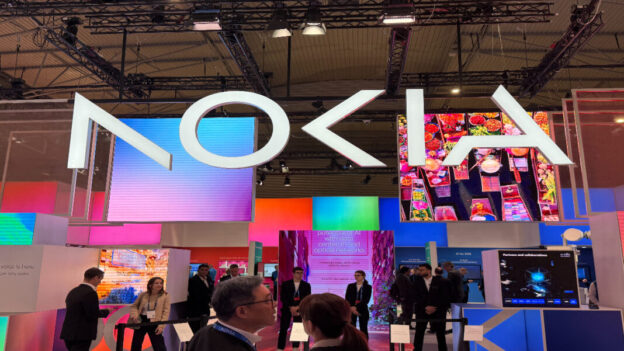
Nokia Oyj NOK used its second-quarter earnings call to highlight accelerating demand tied to artificial intelligence (AI) and cloud infrastructure, while management emphasized investments, restructuring and supply capacity expansion.
The company maintained its outlook and pointed to AI-driven growth in optical and IP networking as a key focus area entering the second half of 2026.
NOK Targets AI Infrastructure Growth
CEO Justin Hotard said Nokia’s strategy is centered on capturing opportunities from the AI supercycle, with early progress reflected in stronger Network Infrastructure results. He highlighted AI and cloud sales growth, broader customer demand and continued investment in differentiated connectivity technologies.
The company reported second-quarter net sales growth of 9% on a constant currency basis, with the comparable operating margin expanding to 9%. Network Infrastructure revenues increased 12%, driven by Optical Networks and IP Networks.
NOK reported adjusted EPS of $0.08, which beat the Zacks Consensus Estimate of $0.07. Revenues of $5.59 billion, however, missed the Zacks Consensus Estimate of $5.61 billion.
Nokia Corporation Price, Consensus and EPS Surprise
Nokia Corporation price-consensus-eps-surprise-chart | Nokia Corporation Quote
Nokia Expands AI Network Strategy
Nokia said AI and cloud customers remain the strongest growth contributor. Hotard noted that AI and cloud sales more than doubled year over year, while order intake reached EUR 2.8 billion during the quarter.
Management emphasized that order patterns can be uneven, but the company continues to benefit from the demand across optical networks and IP networks. Hotard said roughly half of the AI and cloud orders received during the second quarter are expected to convert into revenues over the next 12 months.
Nokia also highlighted the launch of its AI-RAN platform, which management said provides operators with a software-based path to improving network performance and supports future 6G upgrades.
NOK Addresses Supply Constraints
Supply availability was a key topic during the analyst discussion. A Raymond James analyst asked about risks involving memory, printed circuit boards and indium phosphide wafers.
Hotard said memory constraints remain the most significant supply issue and that Nokia is working to secure supply, simplify designs and coordinate with customers on longer lead times.
Regarding optical manufacturing, Hotard said Nokia’s capacity investments are designed to support future demand, including expanded indium phosphide manufacturing capabilities. The company is adding capacity in the United States through new facilities and planned expansion projects.
Nokia Details Outlook Priorities
Nokia maintained its full-year 2026 comparable operating profit outlook at EUR 2.1 billion to EUR 2.6 billion after a technical adjustment related to discontinued operations. Management said operational expectations remain unchanged.
CFO Marco Wiren said the company continues to track somewhat above the midpoint of its operating profit guidance range. He added that third-quarter sales are expected to increase sequentially by 3-7%, while operating profit is expected to remain broadly similar to the second quarter before improving in the fourth quarter.
Nokia also expects restructuring charges of approximately EUR 800 million in 2026 as it accelerates efficiency programs and organizational changes.
NOK Builds Optical Capacity
Optical Networks remained a central investment area, with second-quarter sales increasing 20% on a constant currency basis. IP Networks revenues rose 16%, supported by AI and cloud demand.
Hotard said Nokia is maintaining investments in optical manufacturing capacity to support long-term demand. The company is advancing its San Jose facility and expanding testing and packaging capacity in Pennsylvania.
NOK also discussed its focus on concentrating resources in areas where it sees stronger differentiation while reducing exposure to lower-priority businesses. The company classified Fixed Wireless Access CPE and Enterprise Campus Edge as discontinued operations.
Nokia Faces Analyst Scrutiny
Analysts focused on the durability of AI infrastructure demand and whether recent order strength can continue. A Morgan Stanley analyst questioned the sustainability of higher-order levels.
Hotard said Nokia is focused on long-term order momentum rather than quarter-to-quarter fluctuations. He emphasized that customer demand remains strong, particularly in data center interconnect and AI-related networking applications.
A Danske Bank analyst also asked about optical supply capacity. Management reiterated that current investments are intended to align manufacturing capabilities with expected market expansion.
NOK Maintains Strategic Focus
Hotard said Nokia entered the second half of 2026 with momentum driven by AI and cloud demand, while continuing to reshape operations around growth opportunities. Management emphasized technology development, internal productivity improvements and disciplined capital allocation.
The company’s strategy remains focused on scaling businesses tied to AI infrastructure while improving operational efficiency. Nokia’s outlook reflects continued investment alongside cost actions.
https://finance.yahoo.com/technology/ai/articles/nokia-q2-earnings-call-highlights-140000862.html