



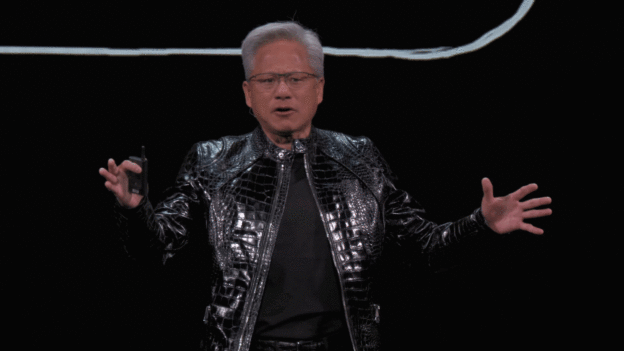
Huang, the founder and CEO of Nvidia, is considered one of the most influential figures in today’s global AI economy.
Huang was among the keynote speakers at the 3DEXPERIENCE World conference in Houston, hosted by French software giant Dassault Systèmes, a global leader in computer-aided design and 3D physics-based simulation. Its SOLIDWORKS software is used to design a wide range of industrial products, from everyday consumer goods to advanced defense systems.

Huang urged people to think about what forms around what he called an “AI factory,” referring to the supercomputer. Above it, he said, startups emerge, research expands, universities and students gain new capabilities, and major companies use the system to build generative AI, creating what he described as an economic flow “downstream.”
“The economic effects of a supercomputer are very deep,” he said.
“It’s all intelligence, and the changes it creates,” Huang added. AI, he argued, is needed in every industry, scientific field, application, and company. “So the implications of AI infrastructure in Israel are very important, and I’m very happy we are building the system,” he said in remarks.
Daloz, whose company also maintains a local presence in Israel, reiterated the optimism. “AI, meaning building supercomputers, is a field that is difficult to research,” he said, adding that he assumed Israel had found a way to “virtualize” aspects of it. AI, he argued, can open many opportunities, including wealth creation. Israel, he said, could capture benefits for startups while also creating products for markets beyond Israel and for the wider world.
Israel’s AI infrastructure gap
Both CEOs, however, also touched on a painful reality: Israel currently lacks adequate infrastructure for AI development, including a significant data center that enables large-scale AI applications, a situation expected to change with the planned data center in the north.
Huang has described AI as infrastructure in its own right, the article noted, comparable in its necessity to systems such as the internet and electricity.
Israel has no domestic supercomputing infrastructure of its own, lacks adequate energy infrastructure for AI data centers, and lacks planning tracks to build power-generation facilities to meet AI’s growing electricity demand. Israeli universities have only about 120 researchers working in core AI fields. By comparison, the University of California, Berkeley alone has around 70 researchers in the field.
The Nagel committee proposed allocating 25 billion shekels, which the article estimates was roughly $7 billion at the time and about $8 billion today. The report argued that the figure remains insufficient compared with far larger investments elsewhere, citing US spending via the CHIPS law, massive Chinese investments, and a Saudi plan to invest more than $100 billion over the next five years. Israel’s leadership, the article said, should heed the advice offered by figures such as Huang and Daloz, given their concern and clear-eyed assessment.
‘Physical AI’ partnership
The Houston meeting between the two CEOs also followed the announcement of an expanded partnership between Nvidia and Dassault Systèmes. The companies said they plan to invest in what they call “physical AI,” combining AI models with physics-based simulation to support the “AI economy,” including simulations for designing autonomous and electric vehicles and planning AI data centers based on Nvidia’s server-rack architecture.
Huang noted that the two companies have worked together for more than 25 years. In practical terms, he said, they function as both customers and partners: Dassault runs its systems on Nvidia hardware, while Nvidia uses Dassault products to plan and design processors, servers, and other components.
Another Israel-linked moment
The Walla report also pointed to another recent Israel-linked episode: in December, Huang met at Nvidia’s US headquarters with Avinatan Or and his partner Noa Argamani, described in the article as survivors of Hamas captivity, roughly two months after Or’s release. The meeting was organized by Amit Krig, Nvidia’s senior vice president and head of the company’s Israeli development site, and included Nvidia Israel’s leadership. During the conversation, the couple discussed plans they had already made together, and Huang noted that they were planning a long trip around the world.
https://www.jpost.com/business-and-innovation/tech-and-start-ups/article-885601