



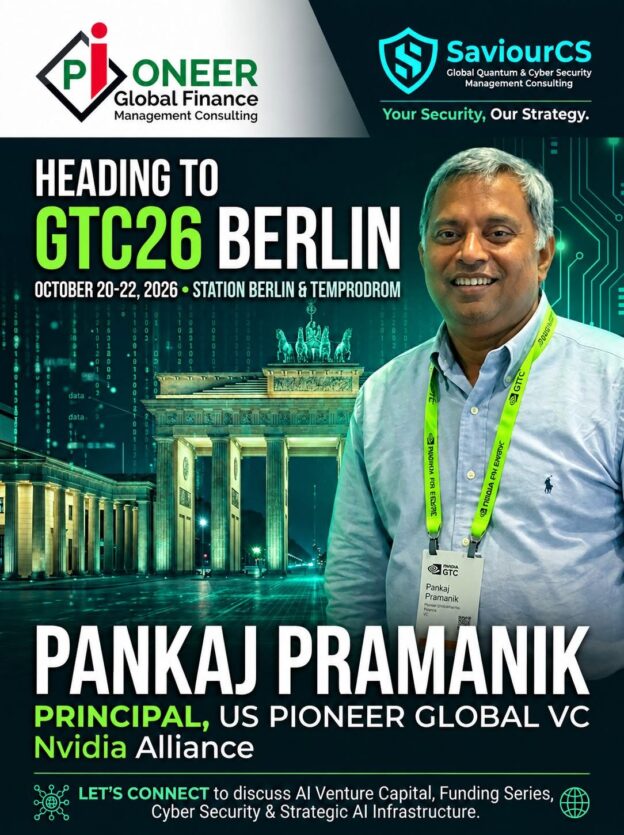
NVIDIA GTC Berlin 2026 is designed to deepen European industrial and sovereign AI dependence on NVIDIA’s full-stack hardware and software, embedding its ecosystem into manufacturing and robotics. The event frames NVIDIA as the essential partner, aligning its offerings with Europe’s strategic priorities.
Monitoring Brief: NVIDIA GTC Berlin 2026
Strategic Signal
NVIDIA GTC Berlin 2026 is positioned as a key intervention to solidify NVIDIA’s full-stack dominance as the indispensable partner for Europe’s industrial and sovereign AI ambitions. The conference agenda is being crafted to address core European political and economic priorities—industrial competitiveness, robotics, and digital sovereignty—while simultaneously framing NVIDIA’s proprietary and curated ecosystems as the sole viable pathway to achieve them. The strategic goal is to deepen the dependence of European industry and state-backed initiatives on NVIDIA’s hardware and software, moving beyond the data centre to embed its stack into the “Physical AI” of manufacturing, robotics, and autonomous systems. The event aims to convert NVIDIA’s market power in chips into durable structural power over the industrialisation and operationalisation of AI in Europe.
Agenda-Setting Actors
- Primary Actor (Agenda Setter): NVIDIA. Led by CEO Jensen Huang, the corporation is the principal architect of the conference narrative. The selection of session topics like “Agentic AI,” “Physical AI,” “Open Models,” and “Sovereign Guardrails” reveals a deliberate strategy to align NVIDIA’s product roadmap with European policy language and industrial needs. NVIDIA executives from key divisions (AI Software, AI for Science, Physical AI) are slated to lead foundational sessions, ensuring tight message control.
- Secondary Actors (Agenda Validators): NVIDIA has curated a set of high-profile European partners to validate its central role.
- Industrial Champions: The presence of Jörg Burzer, CTO of Mercedes-Benz Group AG, is a critical endorsement, signalling deep integration of NVIDIA’s stack into the heart of Germany’s premier industrial sector.
- Public Infrastructure: Gabriella Scipione from CINECA, a major Italian public supercomputing centre, represents the state-backed “AI Factory” customer base, underscoring NVIDIA’s role in building Europe’s sovereign compute capacity.
- Startup & Open-Source Ecosystem: Speakers like Robin Rombach (Black Forest Labs, a German AI startup with roots in the open-source community) and Claire Knight (n8n) are included to demonstrate that NVIDIA’s ecosystem is a platform for innovation, co-opting the “open” narrative that is politically resonant in Europe.
Affected Capability-Conversion Layers
- Industrialisation: This is the conference’s primary focus. The emphasis on “Physical AI,” robotics, manufacturing applications, and training labs is designed to equip developers and enterprises to move AI from prototype to mass-produced, industrial-grade systems. The narrative around “Europe’s High-Performance AI Factories” explicitly frames the mass production of AI capabilities using NVIDIA’s infrastructure.
- Operationalisation: The agenda targets the deployment phase with sessions on “Agentic AI in Production” and tools for developers to “inspect, adapt, and deploy” models. This directly addresses the challenge of integrating complex AI systems into live business and industrial environments.
- Conversion Governance: NVIDIA is proactively shaping the governance layer by introducing its own concepts like “Sovereign Guardrails” and a curated “Open Models” strategy. This is an attempt to define the terms of compliance and sovereignty in a way that aligns with its technology stack, positioning NVIDIA as a partner in, rather than an obstacle to, European strategic autonomy.
Control Surfaces in Play
- Infrastructure: The foundational control surface is NVIDIA’s dominance in accelerated computing hardware (GPUs) and its proprietary CUDA software. The conference serves to reinforce this chokepoint by showcasing it as the essential infrastructure for everything from supercomputing (“AI Factories”) to robotics (“Physical AI”).
- Firm-State Interdependence: The event is a theatre for deepening the interdependence between NVIDIA and key European actors. By becoming the core technology provider for both flagship industrial companies like Mercedes-Benz and state-funded HPC centres like CINECA, NVIDIA embeds its stack into national and regional economic strategy, increasing switching costs and institutional lock-in.
- Standards: NVIDIA is using the event to establish its new software concepts, such as “Agentic AI” and the “OpenClaw” project, as de facto industry standards. By defining and branding these emerging categories, NVIDIA aims to control the next layer of the AI software stack, just as it did with CUDA for accelerated computing.
- Compliance: The “Sovereign Guardrails” session signals a move to offer compliance as a service built into the NVIDIA platform. This strategy positions NVIDIA’s ecosystem as the path of least resistance for enterprises navigating Europe’s regulatory landscape, turning potential regulatory hurdles into a market opportunity.
What to Watch Next
- Jensen Huang’s Keynote Announcements (Oct 21): The keynote is where new hardware, software, and strategic partnerships are revealed. Watch for specific product announcements related to the successor to the Blackwell architecture and concrete details on the “Agentic AI” and “OpenClaw” software platforms. Any announcements of major European sovereign cloud or industrial partnerships will be significant.
- The Substance of “Sovereign AI”: Monitor how NVIDIA defines its “Sovereign Guardrails” and support for European AI. Assess whether the offerings provide genuine autonomy and control for European customers or primarily serve to bind them more tightly to the NVIDIA ecosystem under a politically acceptable label.
- The “Open Models” Strategy: Scrutinise the details of NVIDIA’s engagement with open models. The distinction between providing tools to run third-party models versus releasing powerful, truly open base models of its own will clarify its strategy to either compete with or co-opt the open-source movement.
- Mercedes-Benz Presentation Details: The specifics shared by the Mercedes-Benz CTO will be a crucial indicator of the maturity of “Physical AI” deployment in a core industrial setting. Note the specific NVIDIA platforms being used and the production scale of the deployment.
- Evidence of Ecosystem Lock-in: Track the language and technical details in developer-focused sessions. The extent to which new tools and platforms require the full, end-to-end NVIDIA stack will reveal the strategy for strengthening ecosystem lock-in and closing off avenues for interoperability with competing hardware or software.
https://www.geopoliticsofai.com/conferences/nvidia-gtc-berlin-2026-signals-deepening-european-industrial-dependence-on-full-stack-ai?shem=aimgspe,