



While Nvidia (NVDA) CEO Jensen Huang calmed the market’s AI jitters by posting another blockbuster third quarter, its growing auto business keeps humming along, driven by new deals in the space.
Nvidia reported Q3 automotive revenue of $592 million, a 32% jump year over year. Nvidia CFO Colette Kress said the gain was primarily driven by “continued adoption of our self-driving platforms.”
That $600 million or thereabouts is just a sliver of the monster $57 billion in sales Nvidia reported in Q3. However, the auto business is still growing and poised to top $2 billion this year.
Nvidia’s self-driving platforms — like the latest DRIVE AGX Hyperion 10 — combine hardware including its new DRIVE AGX Thor chips with its DriveOS software to power advanced driver-assistance features in next-generation vehicles.
Nvidia unveiled Hyperion 10 this quarter, claiming it as a reference compute and sensor architecture capable of powering level 4, or nearly fully autonomous, self-driving.
Nvidia also revealed its IGX Thor platform in Q3, which the company says will bring real-time “physical AI” directly to the edge cases — think robotaxis on the roads and robots working in factories.
These products were the cornerstone of big deals Nvidia made in the quarter.
The chipmaker partnered with Uber (UBER) to create what the company says will be the world’s largest level 4-ready robotaxi network with a target start date of 2027 and 100,000 vehicles on the road.
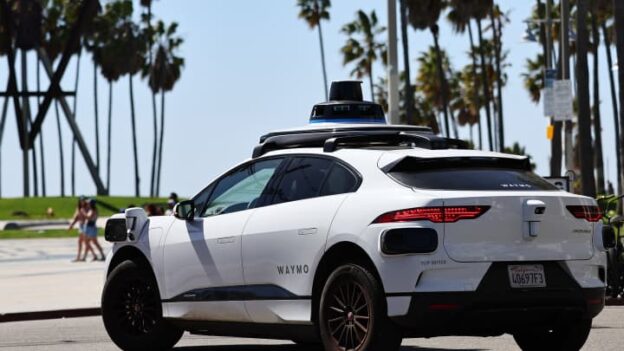
Nvidia also announced in late October a new deal with EV maker Lucid (LCID) to bring level 4 autonomous driving functionality to Lucid EVs. Nvidia said “mind-free” autonomous driving will be coming to Lucid’s upcoming midsize vehicle, powered by Nvidia’s DRIVE AGX computers and DriveOS. The level 4 autonomous tech means these new Lucid vehicles will be fully self-driving when engaged, but only when certain conditions are met, similar to how Waymo robotaxis fully function in defined geographic areas.
Nvidia said earlier this year that Toyota (TM) — the world’s largest automaker by volume — would be using Nvidia’s self-driving tech as well.
Nvidia’s platform is already used to power self-driving technologies for Mercedes-Benz (MBGAF), Volvo (VOLCAR-B.ST), China’s BYD (BYDDY), and device maker Foxconn (FXCOF), among others.
During the company’s 2024 Q4 earnings call earlier this year, Nvidia projected the auto business revenue would hit $5 billion in the 2025 fiscal year. Unless the company posts a monster Q4 this year, the $5 billion goal won’t be hit.
But the business is still chugging along, and if it can keep growing at a 30% clip, it will soon hit that $5 billion mark.
Jensen Huang believes that is only really step one for the auto business. The rockstar CEO sees physical AI solutions like autonomous driving as a “multitrillion-dollar” opportunity.
https://finance.yahoo.com/news/nvidias-auto-business-jumps-32-driven-by-new-self-driving-tech-partnerships-170024536.html