



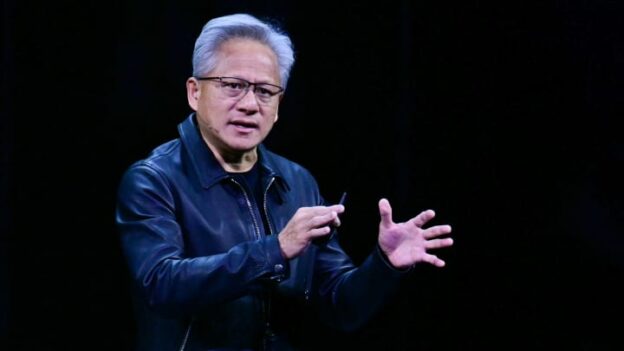
NVIDIA’s CEO, Jensen Huang, responds to the claims that AI is similar to the ‘dot-com’ bubble, saying that the compute demand out there is solid, unlike what the Internet era brought.
NVIDIA’s CEO Claims That The Demand For Compute Power Is Rising In Parallel With the Speed of AI Queries
The resemblance of AI and the dot-com bubble isn’t derived from core technologies and their influence over the industry; instead, it comes from stock valuations and the ‘crazy gains’ people have seen in the past as a retailer. The inference is made from the growth NVIDIA has seen over the years, breaking stock valuation barriers within a period of months; however, Jensen has given his verdict, calling AI a ‘bubble’. In the Financial Times’ “The Minds of Modern AI” segment, NVIDIA’s CEO believes that, unlike the dot-com era, the deployment of “dark fibre” has created real demand for computing power in AI.
Question: Yeah. You know, tell us about, are you worried that we are getting to the point where people don’t quite understand and we’re all getting ahead of ourselves and there’s going to be a reckoning that there’s a bubble that’s going to burst and then it will right itself? And if not, what is the kind of biggest misconception about demand coming from AI that is different to, say, the dot-com era or that people don’t understand, you know, if that’s not the case?
Jensen Huang: During the dot-com era, during the bubble, the vast majority of the fiber deployed were dark, meaning the industry deployed a lot more fiber than it needed. Today, almost every GPU you could find is lit up and used.
Well, if you are unaware of what the term ‘dark fibre’ means, it refers to the fact that during the mid- to late-1990s, the buildout of internet infrastructure was so massive that companies anticipated a drastic scaling up of the need for optical cables. Due to this, operators had dug in trenches and laid cables in a higher quantity than the actual demand back then, to make their operations ‘future-proof’, but their thesis turned out to be wrong, which is why the return on investment became practically zero. So, the concept of dark fibre means creating artificial demand.
Now, NVIDIA’s CEO claims that AI has evolved tremendously, while the mainstream consumer still sees the end representation of the technology as ChatGPT or image generation applications. Artificial intelligence has evolved to the point where it can “effectively think and ground itself through research”, and this form of the technology is yet to be adopted amongst the masses. Jensen argues that not only are the computing needs of companies increasing exponentially, but the number of queries generated is also rising, indicating that the demand isn’t artificial at all.


We won’t comment on whether NVIDIA’s CEO is right here when it comes to computing demand and the parallels between the dot-com and AI frenzy, but what we do know is that artificial intelligence has massive room for growth, which requires computing capabilities, whether they come from NVIDIA, AMD, or Intel. However, there are constraints to consider with such a massive buildout, one of which is the energy concerns associated with it. Another pivotal consideration is whether CSPs like Microsoft have the capability to integrate AI chips produced by NVIDIA or others.
https://wccftech.com/there-are-no-dark-fibers-in-ai-nvidia-jensen-huang-dismisses-dot-com-bubble-comparisons/amp/