



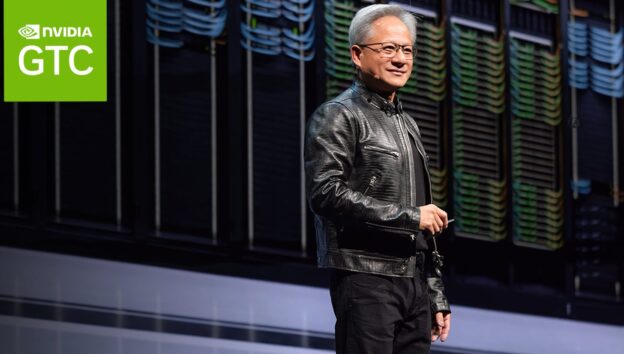
Jensen Huang had some pointed words for the wave of tech executives cutting jobs and calling it artificial intelligence (AI) progress.
Speaking at Nvidia’s GTC conference, the company’s founder and CEO told Jim Cramer exactly what he thinks of leaders who respond to AI breakthroughs by trimming employee headcount rather than growing their ambitions.
“Because you’re out of imagination,” he said. “For companies with imagination, you will do more with more.”
It’s a gutsy thing to declare publicly — especially when the companies doing the cutting are among Nvidia’s biggest customers.
Don’t Miss
-
Stop the leak: 5 costs Canadians (still) overpay for every single month. How many are sabotaging your 2026 budget?
-
What’s your worth? Here are the 3 net worth milestones that change everything for Canadians (and what they say about you)
-
Dave Ramsey says this 7-step plan ‘works every single time’ to kill debt, get rich — and that ‘anyone’ can do it
The pattern Huang is pushing back on
The past year has seen steady layoff announcements from the biggest names in tech, with AI cited as the reason in each case. Meta is reportedly preparing to cut roughly 15,000 employees — around 20% of its global workforce — while simultaneously doubling its AI budget to US$135 billion ($188 billion) in 2026. Amazon eliminated 16,000 corporate roles in January, stating AI and automation as the efficiency engine behind the cuts (1). Microsoft shed more than 15,000 positions through 2025 while pouring US$80 billion (C$111 billion) to AI infrastructure.
The justification from each company is essentially the same: AI makes us more productive, so we need fewer people.
Huang rejects that framing entirely. In his view, the question isn’t how to maintain output with a smaller team — it’s how to do things that weren’t possible before. Companies cutting jobs in response to new capabilities aren’t being efficient. They’re being unimaginative.
The pattern is creeping into Canada, too. Amazon and IBM have both cut workers at the Vancouver and Toronto offices, and tech job postings across Canada have dropped 19% since 2020 — falling 43% in Vancouver specifically (2). A Concordia University researcher writing in Policy Options recently warned that Canada’s labour laws cover only 6% to 8% of workers when it comes to protections around technological change — leaving the vast majority with little recourse when AI restructuring takes over their roles (3).
And, as CBC has reported, not everyone buys the AI explanation at face value (4). Some analysts see pandemic-era over hiring as the bigger culprit, with AI providing a tidy, forward-looking narrative for cuts that might have happened anyway.
Why Huang can afford to say this
It’s worth questioning why the CEO of a company that’s financially entangled with Meta, Amazon and Microsoft would publicly question their judgment.
Part of the answer is that Nvidia’s revenue base has shifted. Huang told Cramer that the company now sells into sovereign governments, enterprise on-premise infrastructure, health care, manufacturing and a new wave of AI-originated companies. At GTC, cloud competitors like CoreWeave and Oracle Cloud Infrastructure were front and centre — signs that the hyperscalers no longer have the market to themselves. Huang’s point was clear: Nvidia’s fortunes are no longer tied to any single customer relationship the way they once were.
The other part is how Huang has reframed what Nvidia is to these companies. Rather than a chip supplier, he describes Nvidia as a demand generator — one that builds developer ecosystems on CUDA and funnels those developers onto cloud platforms. His argument is that AWS, Google Cloud and Azure need Nvidia more than the transaction price suggests.
“They’re not just our customers. We are their market partners. We bring customers to them.” Huang said.
When you believe that, you can afford to be candid about their strategic choices.
https://ca.finance.yahoo.com/news/nvidias-jensen-huang-thinks-ceos-131000230.html