



-
Nvidia is quietly positioning itself at the center of quantum computing by linking today’s fastest AI GPUs with early quantum processors through its new NVQLink and CUDA-Q systems.
-
This hybrid approach doesn’t make qubits stronger — it makes progress faster, allowing AI to stabilize and train quantum machines in real time, potentially pulling major breakthroughs years forward.
-
Suppliers like TSMC, Micron, Broadcom, and ASML stand to benefit first, as Nvidia’s GPU-based architecture becomes the standard bridge between current computing and the quantum frontier.
Quantum computing is still years away, but Nvidia just built the bridge that will bring it closer — a quiet integration of AI, GPUs, and patience that could shorten the wait for the next computing revolution.
Quantum computing is less a machine than a mission — a team of scouts sent to explore a landscape too complex to map by sight. Each scout sets out along a different path, testing what’s possible in parallel. Together, they can sense many routes at once — that’s the genius of the approach.
The challenge is keeping the team in contact. The radios crackle, the maps blur, and even a shift in weather can scatter their signals. These scouts — qubits — are astonishingly sensitive. They can explore multiple directions simultaneously, but the hardware carrying them is still too fragile for the conditions. A breath of heat or a tremor of noise can throw the expedition off course.
So instead of racing ahead, researchers spend most of their time stabilizing the mission: fixing equipment, recalibrating coordinates, and rerunning lost trails. The frontier remains open, but progress comes in slow, careful steps. That patience has defined the field — until now. And suddenly, the rhythm changed.
A new command post
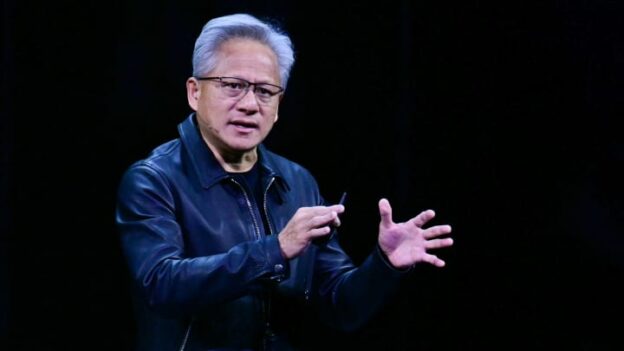
At its recent D.C. conference, Nvidia (NVDA+5.15%) unveiled technology that could quicken that pace. Its new hybrid system — NVQLink and CUDA-Q — acts like a central command post for the scouts. It doesn’t ease the terrain, but it strengthens communication.
NVQLink connects quantum processors (the scouts) with today’s computing systems (the analysts) at microsecond speed — orders of magnitude faster than before. CUDA-Q, Nvidia’s open-source software layer, lets researchers choreograph that link — running AI models, quantum algorithms, and error-correction routines together as one system. That jump allows artificial intelligence to monitor the expedition in real time, learning the patterns of interference and correcting them before the team drifts apart.

Image source: Getty Images.
Why would Nvidia care so much about a field still years from profit? Because whoever builds the bridge first controls the traffic that follows.
Where to invest $1,000 right now?
We’ve been helping individual investors work toward their goals of beating the market for decades – not with hype, but with time-tested long-term stock recommendations, a team of experienced stock analysts, and a community that’s got your back.
After all, Stock Advisor’s total average return is 1,036%* — a market-crushing outperformance compared to 191% for the S&P 500. Invest smarter, not harder. Join The Motley Fool today and revealed what we believe are the 10 best stocks for investors to buy right now.
*Stock Advisor returns as of November 10, 2025.
It’s the difference between reviewing the map after every failed trip and guiding the scouts live as they move. For researchers, that means hundreds of new iterations where there used to be one — a genuine acceleration of discovery. It’s the quiet kind of progress engineers love — invisible, but indispensable.
Owning the bridge between today and tomorrow
Nvidia didn’t build new scouts; it built the infrastructure that keeps them coordinated. Its GPUs (graphics processing units) are already tuned for the dense, parallel calculations these explorations demand, making them the natural partner for any emerging quantum processor.
And that partnership matters. Nvidia’s GPUs remain the most widely used AI chips available today, refined by two decades of iteration and supported by the industry’s most mature software stack. The CUDA platform gives developers fine-grained control — the ability to tune workloads, manage memory, and orchestrate timing with precision. That precision is what gives researchers trust; each improvement in control becomes a new kind of progress. In the context of quantum research, that means any new quantum chip can be optimized alongside the fastest general-purpose GPUs on the planet.
Other companies chase better quantum hardware — superconducting, photonic, trapped-ion — but all of them need reliable coordination with the computing power we already have. By offering that link, Nvidia turns its GPU ecosystem into the operating environment of hybrid computing, the connective tissue between what exists now and what’s coming next.
And because the system is open, every new lab or start-up that connects strengthens Nvidia’s position as the default hub for quantum experimentation.
https://www.fool.com/investing/2025/11/09/nvidias-quiet-move-into-quantum-computing-could-re/